Search
 元素の検索
元素の検索 構造の検索
構造の検索


Thermo Scientific Chemicals
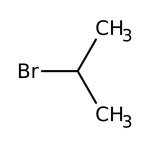
2-Bromopropane, 99%
CAS: 75-26-3 | C3H7Br | 122.993 g/mol


化学物質識別子
CAS75-26-3
IUPAC Name2-bromopropane
Molecular FormulaC3H7Br
InChI KeyNAMYKGVDVNBCFQ-UHFFFAOYSA-N
SMILESCC(C)Br
さらに表示
仕様 スペックシート
スペックシートAppearance (Color)Clear colorless
FormLiquid
Assay (GC)≥98.5%
Identification (FTIR)Conforms
Refractive Index1.4235-1.4265 @ 20?C
2-Bromopropane serves as an alkylating agent in organic synthesis. It is also used as an intermediate to form alkylated amines and alkylated metallic compounds. Further, it acts as a solvent for industrial cleaning, degreasing, metal processing and finishing, electronics, aerospace and aviation, aerosols, textiles, adhesives and inks. In addition, it is used for introducing the isopropyl functional group in organic synthesis.
This Thermo Scientific Chemicals brand product was originally part of the Alfa Aesar product portfolio. Some documentation and label information may refer to the legacy brand. The original Alfa Aesar product / item code or SKU reference has not changed as a part of the brand transition to Thermo Scientific Chemicals.
Applications
2-Bromopropane serves as an alkylating agent in organic synthesis. It is also used as an intermediate to form alkylated amines and alkylated metallic compounds. Further, it acts as a solvent for industrial cleaning, degreasing, metal processing and finishing, electronics, aerospace and aviation, aerosols, textiles, adhesives and inks. In addition, it is used for introducing the isopropyl functional group in organic synthesis.
Solubility
Miscible with alcohol, benzene, chloroform and ether. Slightly miscible with water and acetone.
Notes
Avoid all possible sources of ignition.Incompatible with strong oxidizing agents and strong bases.
2-Bromopropane serves as an alkylating agent in organic synthesis. It is also used as an intermediate to form alkylated amines and alkylated metallic compounds. Further, it acts as a solvent for industrial cleaning, degreasing, metal processing and finishing, electronics, aerospace and aviation, aerosols, textiles, adhesives and inks. In addition, it is used for introducing the isopropyl functional group in organic synthesis.
Solubility
Miscible with alcohol, benzene, chloroform and ether. Slightly miscible with water and acetone.
Notes
Avoid all possible sources of ignition.Incompatible with strong oxidizing agents and strong bases.
RUO – Research Use Only
General References:
- Can be used, (K2CO3 in DMF), to protect phenolic OH groups as their isopropyl ethers, more stable than benzyl ethers to Lewis acids: J. Chem. Soc., Perkin 1, 2593 (1979).
- Vatsal, A.; Zinjarde, S. S.; Kumar, A. R. Yarrowia lipolytica NCIM 3589, a tropical marine yeast, degrades bromoalkanes by an initial hydrolytic dehalogenation step. Biodegradation 2015, 26 (2), 127-138.
- Simonetti, S. O.; Larghi, E. L.; Kaufman, T. S. Alternate and Step-Economic Synthesis of the β-Methylstyrene Chelating Pre-ligand of the Hoveyda-Grubbs’ II Catalyst. Org. Prep. Proced. Int. 2015, 47 (3), 227-231.