Search
 元素の検索
元素の検索 構造の検索
構造の検索


Thermo Scientific Chemicals
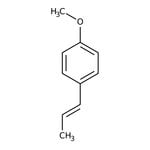
trans-Anethole, 98+%
CAS: 4180-23-8 | C10H12O | 148.205 g/mol



化学物質識別子
CAS4180-23-8
IUPAC Name1-methoxy-4-[(1E)-prop-1-en-1-yl]benzene
Molecular FormulaC10H12O
InChI KeyRUVINXPYWBROJD-ONEGZZNKSA-N
SMILESCOC1=CC=C(\C=C\C)C=C1
さらに表示
仕様 スペックシート
スペックシートCommentResidual toluene <100ppm
Refractive Index1.5580-1.5625 as melt
Appearance (Color)Translucent/colourless to pale yellow
FormLow-melting solid or clear liquid as melt
Assay (GC)≥98.0%
さらに表示
trans-Anethole is used to inhibits lung and forestomach carcinogenesis, used as carbon and energy supplement in the culture media of Pseudomonas putida strain. It is also used as used as a flavoring substance.
This Thermo Scientific Chemicals brand product was originally part of the Alfa Aesar product portfolio. Some documentation and label information may refer to the legacy brand. The original Alfa Aesar product / item code or SKU reference has not changed as a part of the brand transition to Thermo Scientific Chemicals.
Applications
trans-Anethole is used to inhibits lung and forestomach carcinogenesis, used as carbon and energy supplement in the culture media of Pseudomonas putida strain. It is also used as used as a flavoring substance.
Solubility
Soluble in benzene, ethyl acetate, acetone, carbon disulfide.
Notes
Light Sensitive. Keep container tightly closed. Store in cool, dry conditions in well sealed containers.
trans-Anethole is used to inhibits lung and forestomach carcinogenesis, used as carbon and energy supplement in the culture media of Pseudomonas putida strain. It is also used as used as a flavoring substance.
Solubility
Soluble in benzene, ethyl acetate, acetone, carbon disulfide.
Notes
Light Sensitive. Keep container tightly closed. Store in cool, dry conditions in well sealed containers.
RUO – Research Use Only
General References:
- Kotaro Satoh.; Shoichi Saitoh.; Masami Kamigaito. A Linear Lignin Analogue: Phenolic Alternating Copolymers from Naturally Occurring β-Methylstyrene via Aqueous-Controlled Cationic Copolymerization. J. Am. Chem. Soc. 2007, 129, (31), 9586-9587.
- Kaewta Kaewtatip.; Paul Menut.; Remi Auvergne.; Varaporn Tanrattanakul.; Marie-Helene Morel.; Stephane Guilbert. Interactions of Kraft Lignin and Wheat Gluten during Biomaterial Processing: Evidence for the Role of Phenolic Groups. J. Agric. Food Chem. 2010, 58, (7), 4185-4192.