Search
 元素の検索
元素の検索 構造の検索
構造の検索

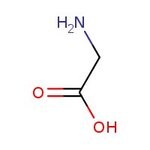



化学物質識別子
CAS56-40-6
IUPAC Name2-aminoacetic acid
Molecular FormulaC2H5NO2
InChI KeyDHMQDGOQFOQNFH-UHFFFAOYSA-N
SMILESNCC(O)=O
さらに表示
仕様 スペックシート
スペックシートAppearance (Color)White to pale cream
Assay (Non-aqueous acid-base Titration)≥98.5 to ≤101.5% (non-U.S. specification)
CommentSpecification differs for U.S. and non-U.S. material where indicated
FormCrystals or powder or crystalline powder
Assay from Suppliers CofA≥98.5% (U.S. specification)
さらに表示
Glycine is used as an additive in pet food, animal feed and sweetener and taste enhancer in human foods. It is also used as a buffering agent in antacids, analgesics, antiperspirants, cosmetics and toiletries. It acts as a neurotransmitter in the central nervous system, especially in the spinal cord, brainstem, and retina. It serves as a buffer agent and prevents the sample damage during electrophoresis. Further, it is used to remove protein-labelling antibodies from western blot membranes. In addition to this, it is involved in the production of rubber sponge products, metal complexants and fertilizers.
This Thermo Scientific Chemicals brand product was originally part of the Alfa Aesar product portfolio. Some documentation and label information may refer to the legacy brand. The original Alfa Aesar product / item code or SKU reference has not changed as a part of the brand transition to Thermo Scientific Chemicals.
Applications
Glycine is used as an additive in pet food, animal feed and sweetener and taste enhancer in human foods. It is also used as a buffering agent in antacids, analgesics, antiperspirants, cosmetics and toiletries. It acts as a neurotransmitter in the central nervous system, especially in the spinal cord, brainstem, and retina. It serves as a buffer agent and prevents the sample damage during electrophoresis. Further, it is used to remove protein-labelling antibodies from western blot membranes. In addition to this, it is involved in the production of rubber sponge products, metal complexants and fertilizers.
Solubility
Soluble in water and pyridine. Slightly soluble in acetone. Insoluble in diethyl ether, n-octanol and ethanol.
Notes
Incompatible with strong oxidizing agents.
Glycine is used as an additive in pet food, animal feed and sweetener and taste enhancer in human foods. It is also used as a buffering agent in antacids, analgesics, antiperspirants, cosmetics and toiletries. It acts as a neurotransmitter in the central nervous system, especially in the spinal cord, brainstem, and retina. It serves as a buffer agent and prevents the sample damage during electrophoresis. Further, it is used to remove protein-labelling antibodies from western blot membranes. In addition to this, it is involved in the production of rubber sponge products, metal complexants and fertilizers.
Solubility
Soluble in water and pyridine. Slightly soluble in acetone. Insoluble in diethyl ether, n-octanol and ethanol.
Notes
Incompatible with strong oxidizing agents.
RUO – Research Use Only
General References:
- Kar, J. R.; Hallsworth, J. E.; Singhal, R. S. Fermentative production of glycine betaine and trehalose from acid whey using Actinopolyspora halophila (MTCC 263). Environ. Technol. Innovation 2015, 3, 68-76.
- Rao, K. S.; Sentilnathan, J.; Cho, H. W.; Wu, J. J.; Yoshimura, M. Soft Processing of Graphene Nanosheets by Glycine-Bisulfate Ionic-Complex-Assisted Electrochemical Exfoliation of Graphite for Reduction Catalysis. Adv. Funct. Mater. 2015, 25 (2), 298-305.