Search
 元素の検索
元素の検索 構造の検索
構造の検索


Thermo Scientific Chemicals
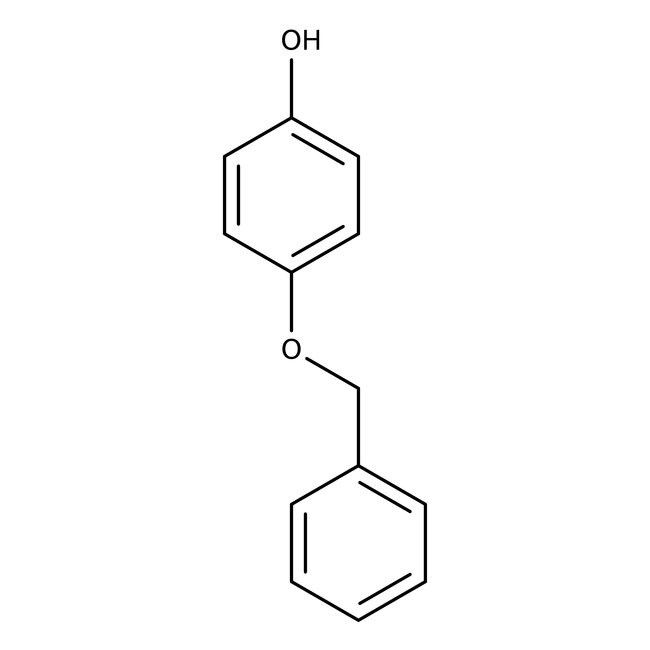
4-Benzyloxyphenol, 98+%
CAS: 103-16-2 | C13H12O2 | 200.237 g/mol



化学物質識別子
CAS103-16-2
IUPAC Name4-(benzyloxy)phenol
Molecular FormulaC13H12O2
InChI KeyVYQNWZOUAUKGHI-UHFFFAOYSA-N
SMILESOC1=CC=C(OCC2=CC=CC=C2)C=C1
さらに表示
仕様 スペックシート
スペックシートAppearance (Color)White to cream to pale brown to pale gray
FormCrystals or powder or crystalline powder
Assay (GC)≥98.0%
Identification (FTIR)Conforms
4-Benzyloxyphenol is used in the synthesis of bis(4-benzyloxyphenoxy)phenyl phosphine oxide. It plays an essential role in the preparation of hetaryl-azophenol dyes via heterocyclic amines in nitrosyl sulphuric acid. It is also used for polyester fiber dyeing and in rubber industry. It acts as a depigmenting agent.
This Thermo Scientific Chemicals brand product was originally part of the Alfa Aesar product portfolio. Some documentation and label information may refer to the legacy brand. The original Alfa Aesar product / item code or SKU reference has not changed as a part of the brand transition to Thermo Scientific Chemicals.
Applications
4-Benzyloxyphenol is used in the synthesis of bis(4-benzyloxyphenoxy)phenyl phosphine oxide. It plays an essential role in the preparation of hetaryl-azophenol dyes via heterocyclic amines in nitrosyl sulphuric acid. It is also used for polyester fiber dyeing and in rubber industry. It acts as a depigmenting agent.
Solubility
Slightly soluble in water. Soluble in alcohol, acetone, benzene, and diethyl ether.
Notes
Keep the container tightly closed in a dry and well-ventilated place. Incompatible with strong oxidizing agents and strong bases.
4-Benzyloxyphenol is used in the synthesis of bis(4-benzyloxyphenoxy)phenyl phosphine oxide. It plays an essential role in the preparation of hetaryl-azophenol dyes via heterocyclic amines in nitrosyl sulphuric acid. It is also used for polyester fiber dyeing and in rubber industry. It acts as a depigmenting agent.
Solubility
Slightly soluble in water. Soluble in alcohol, acetone, benzene, and diethyl ether.
Notes
Keep the container tightly closed in a dry and well-ventilated place. Incompatible with strong oxidizing agents and strong bases.
RUO – Research Use Only
General References:
- Zhu, Y.; Wang, S.; Xu, A. A mouse model of vitiligo induced by monobenzone. Exp. Dermatol. 2013, 22 (7), 499-501.
- Rordam, O. M.; Lenouvel, E. W.; Maalo, M. Successful Treatment of Extensive Vitiligo with Monobenzone. J. Clin. Aesthet. Dermatol. 2012, 5 (12), 36-39.