Search
 元素の検索
元素の検索 構造の検索
構造の検索

Thermo Scientific Chemicals
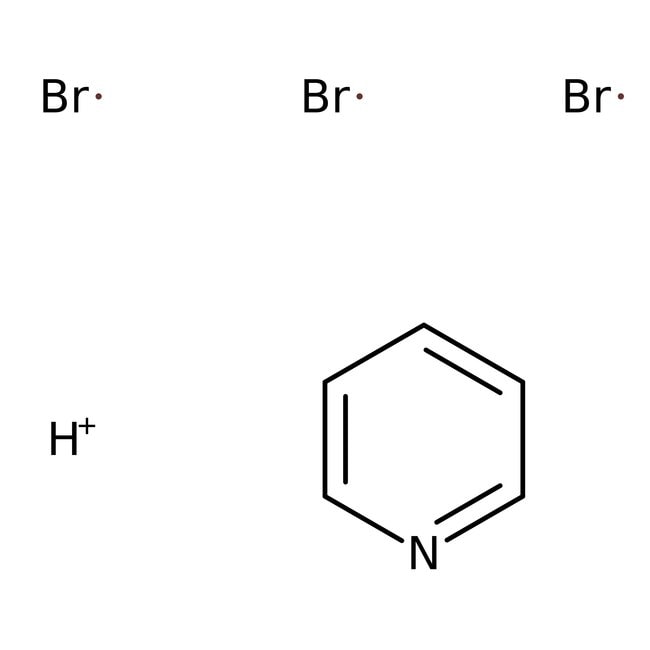
Pyridine hydrobromide perbromide, tech. 90%
CAS: 39416-48-3 | C5H5N·HBr3



化学物質識別子
CAS39416-48-3
Molecular FormulaC5H6Br3N
InChI KeyGWJBDYRGIFGTOG-UHFFFAOYSA-O
SMILES[H+].[Br].[Br].[Br].C1=CC=NC=C1
Molecular Weight (g/mol)319.82
仕様 スペックシート
スペックシートAppearance (Color)Yellow to orange to red to red-brown to brown
FormCrystals or powder or crystalline powder or fused/lumpy solid or chunks
Assay (Iodometric Titration)≥88.0% (non-U.S. specification)
Assay≥88.0% (U.S. specification)
CommentSpecification differs for U.S. and non-U.S. material where indicated
さらに表示
Pyridine hydrobromide perbromide is used as a brominating reagent in alfa-bromination and alfa-thiocyanation of ketones, phenols, unsaturated and aromatic ethers. It is used as a raw material in the preparation of beta-adrenergic blocking agents. Furthermore, it is used as an analytical reagent.
This Thermo Scientific Chemicals brand product was originally part of the Alfa Aesar product portfolio. Some documentation and label information may refer to the legacy brand. The original Alfa Aesar product / item code or SKU reference has not changed as a part of the brand transition to Thermo Scientific Chemicals.
Applications
Pyridine hydrobromide perbromide is used as a brominating reagent in alfa-bromination and alfa-thiocyanation of ketones, phenols, unsaturated and aromatic ethers. It is used as a raw material in the preparation of beta-adrenergic blocking agents. Furthermore, it is used as an analytical reagent.
Solubility
Soluble in methanol, acetic acid, ethanol, n-butanol and terahydrofuran. Insoluble in water, carbon tetrachloride, ethyl bromide, benzene, toluene, ligroin, petroleum ether.
Notes
Store in cool place. Incompatible with strong oxidizing agents and strong bases.
Pyridine hydrobromide perbromide is used as a brominating reagent in alfa-bromination and alfa-thiocyanation of ketones, phenols, unsaturated and aromatic ethers. It is used as a raw material in the preparation of beta-adrenergic blocking agents. Furthermore, it is used as an analytical reagent.
Solubility
Soluble in methanol, acetic acid, ethanol, n-butanol and terahydrofuran. Insoluble in water, carbon tetrachloride, ethyl bromide, benzene, toluene, ligroin, petroleum ether.
Notes
Store in cool place. Incompatible with strong oxidizing agents and strong bases.
RUO – Research Use Only
General References:
- Stable, crystalline, readily-handled source of bromine, useful for a wide range of brominations, including ɑ-bromination of ketones: J. Am. Chem. Soc., 70, 417 (1948), and conversion of alkenes to vic-dibromides. See, for example: Org. Synth. Coll., 5, 604 (1973), Note 2. The rate of addition to alkenes increases markedly on increased substitution, so that selective bromination of the more substituted of two double bonds can be achieved: Synthesis, 966 (1979).
- In pyridine, cyclopentenones are converted directly to their ɑ-bromo derivatives (addition-elimination): Synth. Commun., 18, 1323 (1988).
- Selective monobromination of anilines, predominantly at the para-position, can be effected in THF: Synth. Commun., 23, 855 (1993). In aqueous AcOH, alkyl aryl ethers are p-brominated in high yield: Synth. Commun., 28, 499 (1998), whereas aryl methyl ethers are demethylated on heating in xylene: Indian J. Chem., 33B, 288 (1994). Cleaves thioacetals in the presence of TBAB: J. Org. Chem., 46, 1745 (1981).
- Hu, Y.; Ju, L.; Lu, L.; Ma, H.; Yu, X. Stereoselective alpha-indolylation of enals via an organocatalytic formal cross-coupling with indoles. Org. Biomol. Chem. 2015, 13 (33), 8869-8874.
- Amaya, T.; Hirao, T. Chemistry of Sumanene. Chem Rec 2015, 15 (1), 310-321.