Search
 元素の検索
元素の検索 構造の検索
構造の検索


Thermo Scientific Chemicals
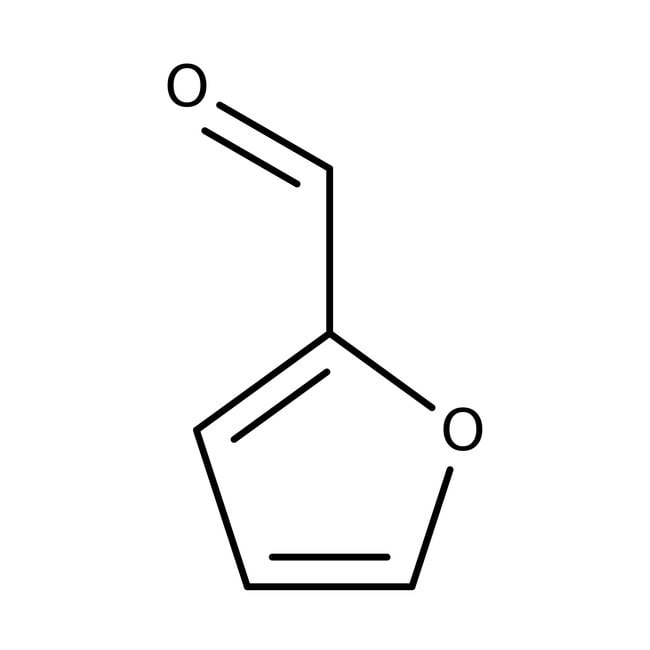
2-Furaldehyde, 98%
CAS: 98-01-1 | C5H4O2 | 96.09 g/mol



化学物質識別子
CAS98-01-1
IUPAC Namefuran-2-carbaldehyde
Molecular FormulaC5H4O2
InChI KeyHYBBIBNJHNGZAN-UHFFFAOYSA-N
SMILESO=CC1=CC=CO1
さらに表示
仕様 スペックシート
スペックシートFormLiquid
Appearance (Color)Clear pale yellow to orange to brown to dark brown
Assay (GC)≥97.5% (non-U.S. specification)
Assay from Suppliers CofA≥97.5% (U.S. specification)
Identification (FTIR)Conforms (non-U.S. specification)
さらに表示
2-Furaldehyde is used in the manufacture of furfural-phenol plastics such as Durite; in solvent refining of petroleum oils and in the preparation of pyromucic acid. It is used as a solvent for nitrated cotton, cellulose acetate and gums; for accelerating vulcanization; in the synthesis of furan derivatives.
This Thermo Scientific Chemicals brand product was originally part of the Alfa Aesar product portfolio. Some documentation and label information may refer to the legacy brand. The original Alfa Aesar product / item code or SKU reference has not changed as a part of the brand transition to Thermo Scientific Chemicals.
Applications
2-Furaldehyde is used in the manufacture of furfural-phenol plastics such as Durite; in solvent refining of petroleum oils and in the preparation of pyromucic acid. It is used as a solvent for nitrated cotton, cellulose acetate and gums; for accelerating vulcanization; in the synthesis of furan derivatives.
Solubility
Soluble in water (83 g/L).
Notes
Air sensitive. Incompatible with oxidizing agents and acids.
2-Furaldehyde is used in the manufacture of furfural-phenol plastics such as Durite; in solvent refining of petroleum oils and in the preparation of pyromucic acid. It is used as a solvent for nitrated cotton, cellulose acetate and gums; for accelerating vulcanization; in the synthesis of furan derivatives.
Solubility
Soluble in water (83 g/L).
Notes
Air sensitive. Incompatible with oxidizing agents and acids.
RUO – Research Use Only
General References:
- Michael Jerry Antal Jr.; Tongchit Leesomboon; William S.Mok; Geoffrey N.Richards. Mechanism of formation of 2-furaldehyde from d-xylose. Carbohydrate Research. 1991, 217, 71-85
- Michael S.McClure; Bobby Glover; Ellen McSorley; Alan Millar; Martin H.Osterhout; Frank Roschangar. Regioselective palladium-catalyzed arylation of 2-furaldehyde. Org. Lett. 2001, 3, (11),1677-1680