Search
 元素の検索
元素の検索 構造の検索
構造の検索


Thermo Scientific Chemicals
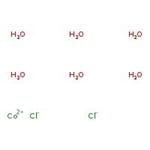
Cobalt(II) chloride hexahydrate, 98%
CAS: 7791-13-1 | Cl2CoH12O6 | 237.92 g/mol


化学物質識別子
CAS7791-13-1
IUPAC Nameλ²-cobalt(2+) hexahydrate dichloride
Molecular FormulaCl2CoH12O6
InChI KeyGFHNAMRJFCEERV-UHFFFAOYSA-L
SMILESO.O.O.O.O.O.[Cl-].[Cl-].[Co++]
さらに表示
仕様 スペックシート
スペックシートAppearance (Color)Red-purple or purple
Assay (Titration ex Chloride)≥97.5 to ≤102.5% (as hexahydrate)
Water Content (Karl Fischer Titration)42.2-48.4% (5.25-6.75 waters)
FormCrystals or powder or crystalline powder
Identification (FTIR)Conforms
Cobalt(II) chloride hexahydrate is widely used as a drying agent in painting and coloring agents for glass ceramics. It is an excellent indicator for water in dessicants as well as an indicator for silica gel dryer. It helps in electroplating. It acts as an inducer of HIF-1 production used to study apoptotic effects in HepG2 cells.
This Thermo Scientific Chemicals brand product was originally part of the Alfa Aesar product portfolio. Some documentation and label information may refer to the legacy brand. The original Alfa Aesar product / item code or SKU reference has not changed as a part of the brand transition to Thermo Scientific Chemicals.
Applications
Cobalt(II) chloride hexahydrate is widely used as a drying agent in painting and coloring agents for glass ceramics. It is an excellent indicator for water in dessicants as well as an indicator for silica gel dryer. It helps in electroplating. It acts as an inducer of HIF-1 production used to study apoptotic effects in HepG2 cells.
Solubility
Soluble in water, ether, acetone and alcohol.
Notes
Incompatible with strong oxidizing agents and metals.
Cobalt(II) chloride hexahydrate is widely used as a drying agent in painting and coloring agents for glass ceramics. It is an excellent indicator for water in dessicants as well as an indicator for silica gel dryer. It helps in electroplating. It acts as an inducer of HIF-1 production used to study apoptotic effects in HepG2 cells.
Solubility
Soluble in water, ether, acetone and alcohol.
Notes
Incompatible with strong oxidizing agents and metals.
RUO – Research Use Only
General References:
- Kimer, J. T.; Elliott, C. M. Are High-Potential Cobalt Tris(bipyridyl) Complexes Sufficiently Stable to Be Efficient Mediators in Dye-Sensitized Solar Cells? Synthesis, Characterization, and Stability Tests. J. Phys. Chem. C 2015, 119 (31), 17502-17514.
- Parmentier, D.; Hoogerstraete, T. V.; Metz, S. J.; Binnemans, K.; Kroon, M. C. Selective Extraction of Metals from Chloride Solutions with the Tetraoctylphosphonium Oleate Ionic Liquid. Ind. Eng. Chem. Res. 2015, 54 (18), 5149-5158.