Search
 元素の検索
元素の検索 構造の検索
構造の検索
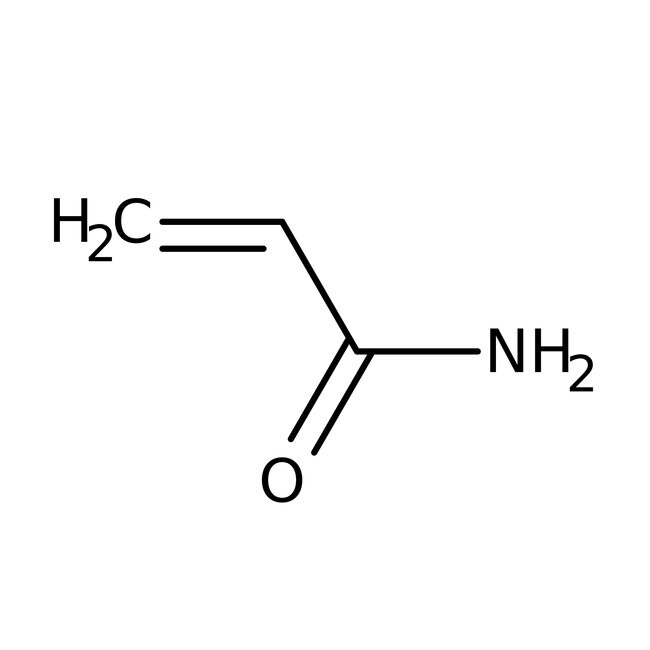



化学物質識別子
CAS79-06-1
IUPAC Nameprop-2-enamide
Molecular FormulaC3H5NO
InChI KeyHRPVXLWXLXDGHG-UHFFFAOYSA-N
SMILESNC(=O)C=C
さらに表示
仕様 スペックシート
スペックシートWater Content (Karl Fischer Titration)≤2.0%
Melting Point (clear melt)79-87?C
Assay (GC)≥98.0%
Appearance (Color)White
FormCrystals or crystalline powder
さらに表示
Acrylamide is used as a monomer in the synthesis of polyacrylamides, which finds application as water-soluble thickeners in waste water treatment, gel electrophoresis, ore processing and dyes production. In molecular biology, it is used as a carrier as well as involved in the precipitation of small amounts of DNA. It plays an important role as an intermediate in the preparation of N-methylol acrylamide and N-butoxyacrylamide.
This Thermo Scientific Chemicals brand product was originally part of the Alfa Aesar product portfolio. Some documentation and label information may refer to the legacy brand. The original Alfa Aesar product / item code or SKU reference has not changed as a part of the brand transition to Thermo Scientific Chemicals.
Applications
Acrylamide is used as a monomer in the synthesis of polyacrylamides, which finds application as water-soluble thickeners in waste water treatment, gel electrophoresis, ore processing and dyes production. In molecular biology, it is used as a carrier as well as involved in the precipitation of small amounts of DNA. It plays an important role as an intermediate in the preparation of N-methylol acrylamide and N-butoxyacrylamide.
Solubility
Slightly soluble in water.
Notes
Hygroscopic. Air and light sensitive. Store in a cool place. Keep the container tightly closed in a dry and well-ventilated place. Incompatible with acids, bases, oxidizing agents, reducing agents, iron and iron salts, copper, aluminum, brass and free radical initiators.
Acrylamide is used as a monomer in the synthesis of polyacrylamides, which finds application as water-soluble thickeners in waste water treatment, gel electrophoresis, ore processing and dyes production. In molecular biology, it is used as a carrier as well as involved in the precipitation of small amounts of DNA. It plays an important role as an intermediate in the preparation of N-methylol acrylamide and N-butoxyacrylamide.
Solubility
Slightly soluble in water.
Notes
Hygroscopic. Air and light sensitive. Store in a cool place. Keep the container tightly closed in a dry and well-ventilated place. Incompatible with acids, bases, oxidizing agents, reducing agents, iron and iron salts, copper, aluminum, brass and free radical initiators.
RUO – Research Use Only
General References:
- Pelucchi, C.; Bosetti, C.; Galeone, C.; La Vecchia, C. Dietary acrylamide and cancer risk: An updated meta-analysis. Int. J. Cancer 2015, 136 (12), 2912-2922.
- Vaclavik, L.; Capuano, E.; Gökmen, V.; Hajslova, J. Prediction of acrylamide formation in biscuits based on fingerprint data generated by ambient ionization mass spectrometry employing direct analysis in real time (DART) ion source. Food Chem. 2015, 173, 290-297.