Search
 元素の検索
元素の検索 構造の検索
構造の検索


Thermo Scientific Chemicals
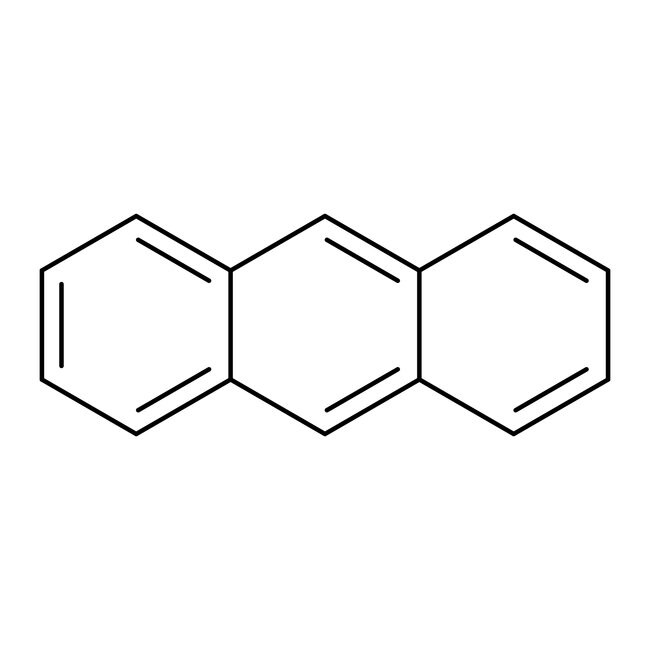
Anthracene, 97%
CAS: 120-12-7 | C14H10 | 178.23 g/mol



化学物質識別子
CAS120-12-7
IUPAC Nameanthracene
Molecular FormulaC14H10
InChI KeyMWPLVEDNUUSJAV-UHFFFAOYSA-N
SMILESC1=CC2=CC3=CC=CC=C3C=C2C=C1
さらに表示
仕様 スペックシート
スペックシートAppearance (Color)Pale cream to cream to yellow to green to pale brown to black
FormCrystals or powder or crystalline powder
Assay (HPLC)≥96.0%
Identification (FTIR)Conforms
Melting Point (clear melt)213.0-222.0?C
This Thermo Scientific Chemicals brand product was originally part of the Alfa Aesar product portfolio. Some documentation and label information may refer to the legacy brand. The original Alfa Aesar product / item code or SKU reference has not changed as a part of the brand transition to Thermo Scientific Chemicals.
Suitable for battery materials development.
Applications
Anthracene is used as a source of dyestuffs and involved in the preparation of red dye alizarin. It is an organic semiconductor used as a scintillator for detectors of high energy photons, electrons and alfa particles. It is doped with polyvinyltoluene to prepare plastic scintillator. Further, it is used in the preparation of anthraquinone, wood preservatives, coating materials and pigments. In addition to this, it is used to prepare 1-hydroxyanthracene, 2-hydroxyanthracene and in 9,10-dihydroxyanthracene.
Solubility
Soluble in methanol, benzene, chloroform, ether, carbon disulfide, carbon tetrachloride and toluene. Slightly soluble in acetone. Insoluble in water.
Notes
Light sensitive. Incompatible with strong oxidizing agents and hypochlorites.
Anthracene is used as a source of dyestuffs and involved in the preparation of red dye alizarin. It is an organic semiconductor used as a scintillator for detectors of high energy photons, electrons and alfa particles. It is doped with polyvinyltoluene to prepare plastic scintillator. Further, it is used in the preparation of anthraquinone, wood preservatives, coating materials and pigments. In addition to this, it is used to prepare 1-hydroxyanthracene, 2-hydroxyanthracene and in 9,10-dihydroxyanthracene.
Solubility
Soluble in methanol, benzene, chloroform, ether, carbon disulfide, carbon tetrachloride and toluene. Slightly soluble in acetone. Insoluble in water.
Notes
Light sensitive. Incompatible with strong oxidizing agents and hypochlorites.
RUO – Research Use Only
General References:
- Malkondu, S.; Turhan, D.; Kocak, A. Copper(II)-directed static excimer formation of an anthracene-based highly selective fluorescent receptor. Tetrahedron Lett. 2015, 56 (1), 162-167.
- Ma, Z.; Yang, F.; Wang, Z.; Jia, X. Mechanically induced color change based on the chromophores of anthracene and rhodamine 6G. Tetrahedron Lett. 2015, 56 (2), 393-396.