Search


Citations & References (19)
Invitrogen™
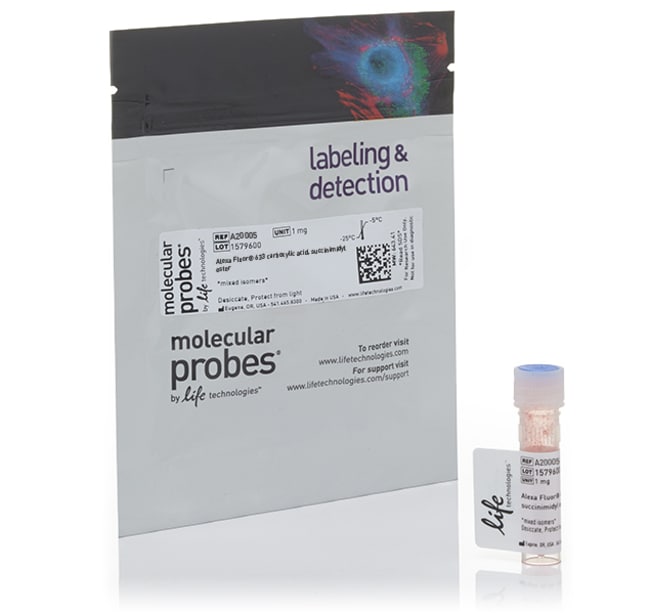
Alexa Fluor™ 633 NHS Ester (Succinimidyl Ester)
Alexa Fluor™ 633は、633 nmレーザーラインに最適な励起を備えた明るく光安定性の高い遠赤外蛍光色素です。Alexa Fluor™ 633色素は、イメージングやフローサイトメトリーで安定したシグナルを生成するために使用され、水溶性でpH詳細を見る


製品番号(カタログ番号) A20005
価格(JPY)
88,100
Each
数量:
1 mg
Alexa Fluor™ 633は、633 nmレーザーラインに最適な励起を備えた明るく光安定性の高い遠赤外蛍光色素です。Alexa Fluor™ 633色素は、イメージングやフローサイトメトリーで安定したシグナルを生成するために使用され、水溶性でpH 4~10の影響を受けません。この長波長Alexa Fluor™色素の蛍光は人間の目には見えませんが、ほとんどのイメージングシステムで容易に検出されます。反応性色素製剤に加えて、さまざまな抗体、ペプチド、タンパク質、トレーサー、および細胞の標識や検出用に最適化された増幅基質に結合させたAlexa Fluor™ 633色素も提供しています。Alexa Fluor™ 633のNHSエステル(またはスクシンイミジルエステル)は、この色素をタンパク質または抗体に結合させるためのもっとも一般的なツールです。NHSエステルは、タンパク質の一級アミン(R-NH2)、アミン修飾オリゴヌクレオチド、およびその他のアミン含有分子を標識するのに使用できます。結果として生じるAlexa Fluor™コンジュゲートコンジュゲートは、スペクトル的に類似した他のフルオロフォアコンジュゲートよりも明るい蛍光と、より高い光安定性を発揮します。
このAlexaFluor™ NHSエステルの詳細情報:
フルオロフォア標識:Alexa Fluor™ 633色素
反応基:NHSエステル
反応性:タンパク質およびリガンドの一級アミン、アミン修飾オリゴヌクレオチド
コンジュゲートの励起/発光:621/639 nm
減衰係数:159,000 cm-1M-1
スペクトル的に類似した色素:Cy5™
分子量:約1,200
標準的な結合反応
アミン反応性試薬をほぼあらゆるタンパク質またはペプチドと結合させることができます(提供されているプロトコルはIgG抗体用に最適化されています)。任意のタンパク質量に合わせて反応規模を調整できますが、最適な結果を得るにはタンパク質の濃度を2 mg/mL以上にする必要があります。反応試薬とタンパク質の3つのモル比を使用して、3つの異なる標識度を試すことが推奨されます。
Alexa Fluor™ NHS Esterは通常、高品質の無水ジメチルホルムアミド(DMF)またはジメチルスルホキシド(DMSO)(D12345)に溶解し、0.1~0.2 Mの重炭酸ナトリウムバッファー(pH 8.3)中で室温で1時間反応させます。末端アミンのpKaはリジンのエプシロンアミノ基のpKaよりも低いため、中性pHに近いバッファーを使用するとアミン末端をより選択的に標識できます。
コンジュゲート精製
標識抗体は通常、Sephadex™ G-25、BioGel™ P-30、または同等のゲルろ過カラムを使用して、遊離Alexa Fluor™色素から分離できます。タンパク質のサイズが大きい場合や小さい場合は、適切な分子量分画のゲルろ過培地を選択するか、または透析により精製してください。当社は、さまざまな量の抗体コンジュゲート用に最適化された精製キットを複数提供しています:
0.5~1 mg用Antibody Conjugate Purification Kit(A33086)
20~50 µg用Antibody Conjugate Purification Kit(A33087)
50~100 µg用Antibody Conjugate Purification Kit(A33088)
タンパク質および抗体の標識に関する詳細
当社は、 お客様の出発物質および実験のセットアップに適したMolecular Probes™抗体およびタンパク質標識キットを幅広く提供しています。その他の選択肢は、当社の抗体標識キットをご覧になるか、当社の標識化学選択ツールをご利用ください。標識キットの詳細については、Molecular Probes™ハンドブックのタンパク質および核酸の標識キット—セクション 1.2をご覧ください。
当社では、お客様に合わせてカスタムコンジュゲートを実施
当社のオンラインカタログで目的の製品が見つからない場合は、カスタム抗体またはタンパク質コンジュゲートをご用意ください。当社のカスタム結合サービスは効率的かつ機密性が確保され、品質が保証されています。当社はISO 9001:2000認証を取得しています。
このAlexaFluor™ NHSエステルの詳細情報:
フルオロフォア標識:Alexa Fluor™ 633色素
反応基:NHSエステル
反応性:タンパク質およびリガンドの一級アミン、アミン修飾オリゴヌクレオチド
コンジュゲートの励起/発光:621/639 nm
減衰係数:159,000 cm-1M-1
スペクトル的に類似した色素:Cy5™
分子量:約1,200
標準的な結合反応
アミン反応性試薬をほぼあらゆるタンパク質またはペプチドと結合させることができます(提供されているプロトコルはIgG抗体用に最適化されています)。任意のタンパク質量に合わせて反応規模を調整できますが、最適な結果を得るにはタンパク質の濃度を2 mg/mL以上にする必要があります。反応試薬とタンパク質の3つのモル比を使用して、3つの異なる標識度を試すことが推奨されます。
Alexa Fluor™ NHS Esterは通常、高品質の無水ジメチルホルムアミド(DMF)またはジメチルスルホキシド(DMSO)(D12345)に溶解し、0.1~0.2 Mの重炭酸ナトリウムバッファー(pH 8.3)中で室温で1時間反応させます。末端アミンのpKaはリジンのエプシロンアミノ基のpKaよりも低いため、中性pHに近いバッファーを使用するとアミン末端をより選択的に標識できます。
コンジュゲート精製
標識抗体は通常、Sephadex™ G-25、BioGel™ P-30、または同等のゲルろ過カラムを使用して、遊離Alexa Fluor™色素から分離できます。タンパク質のサイズが大きい場合や小さい場合は、適切な分子量分画のゲルろ過培地を選択するか、または透析により精製してください。当社は、さまざまな量の抗体コンジュゲート用に最適化された精製キットを複数提供しています:
0.5~1 mg用Antibody Conjugate Purification Kit(A33086)
20~50 µg用Antibody Conjugate Purification Kit(A33087)
50~100 µg用Antibody Conjugate Purification Kit(A33088)
タンパク質および抗体の標識に関する詳細
当社は、 お客様の出発物質および実験のセットアップに適したMolecular Probes™抗体およびタンパク質標識キットを幅広く提供しています。その他の選択肢は、当社の抗体標識キットをご覧になるか、当社の標識化学選択ツールをご利用ください。標識キットの詳細については、Molecular Probes™ハンドブックのタンパク質および核酸の標識キット—セクション 1.2をご覧ください。
当社では、お客様に合わせてカスタムコンジュゲートを実施
当社のオンラインカタログで目的の製品が見つからない場合は、カスタム抗体またはタンパク質コンジュゲートをご用意ください。当社のカスタム結合サービスは効率的かつ機密性が確保され、品質が保証されています。当社はISO 9001:2000認証を取得しています。
研究用にのみ使用できます。診断用には使用いただけません。
仕様
化学反応性アミン
発光639 nm
励起621 nm
標識または色素Alexa Fluor™ 633
製品タイプNHSエステル(スクシンイミジルエステル)
数量1 mg
反応性部分活性エステル、スクシンイミジルエステル
出荷条件室温
標識タイプAlexa Fluor色素
製品ラインAlexa Fluor
Unit SizeEach
組成および保存条件
フリーザー(-5~-30度)に保存し、遮光してください。
よくあるご質問(FAQ)
I am labeling a protein with Alexa Fluor 488 SDP ester. The manual recommends using a sodium bicarbonate buffer at pH 8.3. Can I use a different buffer instead?
I am not going to use all of my Alexa Fluor succinimidyl ester reactive dye. Can I just make it up in DMSO and store aliquots at -20 degrees C?
引用および参考文献 (19)
引用および参考文献
Abstract
Fluorescence imaging for monitoring the colocalization of two single molecules in living cells.
Journal:Biophys J
PubMed ID:15596511
The interaction, binding, and colocalization of two or more molecules in living cells are essential aspects of many biological molecular processes, and single-molecule technologies for investigating these processes in live cells, if successfully developed, would become very powerful tools. Here, we developed simultaneous, dual-color, single fluorescent molecule colocalization imaging, to
Quantitative comparison of long-wavelength Alexa Fluor dyes to Cy dyes: fluorescence of the dyes and their bioconjugates.
Journal:J Histochem Cytochem
PubMed ID:14623938
'Amine-reactive N-hydroxysuccinimidyl esters of Alexa Fluor fluorescent dyes with principal absorption maxima at about 555 nm, 633 nm, 647 nm, 660 nm, 680 nm, 700 nm, and 750 nm were conjugated to antibodies and other selected proteins. These conjugates were compared with spectrally similar protein conjugates of the Cy3, Cy5,
Practical guidelines for dual-color fluorescence cross-correlation spectroscopy.
Journal:Nat Protoc
PubMed ID:18007619
'Dual-color fluorescence cross-correlation spectroscopy (FCCS) allows for the determination of molecular mobility and concentrations and for the quantitative analysis of molecular interactions such as binding or cleavage at very low concentrations. This protocol discusses considerations for preparing a biological system for FCCS experiments and offers practical advice for performing FCCS
Virtual and biomolecular screening converge on a selective agonist for GPR30.
Journal:Nat Chem Biol
PubMed ID:16520733
'Estrogen is a hormone critical in the development, normal physiology and pathophysiology of numerous human tissues. The effects of estrogen have traditionally been solely ascribed to estrogen receptor alpha (ERalpha) and more recently ERbeta, members of the soluble, nuclear ligand-activated family of transcription factors. We have recently shown that the
Biologically-active laminin-111 fragment that modulates the epithelial-to-mesenchymal transition in embryonic stem cells.
Journal:
PubMed ID:24706882
'The dynamic interplay between the extracellular matrix and embryonic stem cells (ESCs) constitutes one of the key steps in understanding stem cell differentiation in vitro. Here we report a biologically-active laminin-111 fragment generated by matrix metalloproteinase 2 (MMP2) processing, which is highly up-regulated during differentiation. We show that the ß1-chain-derived