Search


Citations & References (198)
Invitrogen™
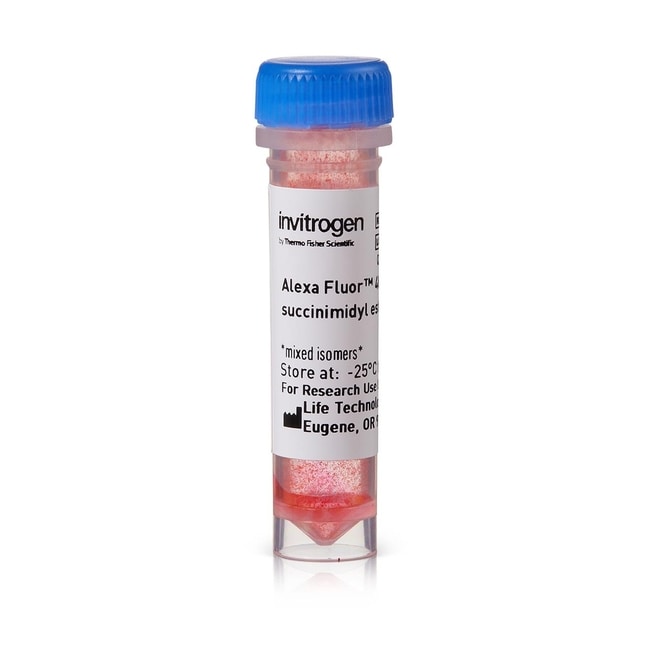
Alexa Fluor™ 488 NHS Ester (Succinimidyl Ester)
Alexa Fluor™ 488は、488 nmレーザーラインで最適に励起する、明るい緑色蛍光色素です。Alexa Fluor™ 488色素は、イメージングやフローサイトメトリーで安定したシグナルを生成するために使用され詳細を見る


製品番号(カタログ番号) A20100
価格(JPY)
375,200
Each
数量:
5 mg
Alexa Fluor™ 488は、488 nmレーザーラインで最適に励起する、明るい緑色蛍光色素です。Alexa Fluor™ 488色素は、イメージングやフローサイトメトリーで安定したシグナルを生成するために使用され、水溶性でpH 4~10の影響を受けません。反応性色素製剤に加えて、さまざまな抗体、ペプチド、タンパク質、トレーサー、および細胞の標識や検出用に最適化された増幅基質に結合させたAlexa Fluor ™488色素も提供しています(詳細ろ見る)。
Alexa Fluor™ 488のNHSエステル(またはスクシンイミジルエステル)は、この色素をタンパク質または抗体に結合させるためのもっとも一般的なツールです。NHSエステルは、タンパク質の一級アミン(R-NH2)、アミン修飾オリゴヌクレオチド、およびその他のアミン含有分子を標識するのに使用できます。結果として生じるAlexa Fluor™コンジュゲートコンジュゲートは、スペクトル的に類似した他のフルオロフォアコンジュゲートよりも明るい蛍光と、より高い光安定性を発揮します。
このAlexaFluor™ NHSエステルの詳細情報:
フルオロフォア標識:Alexa Fluor™ 488色素
反応基:NHSエステル
反応性:タンパク質およびリガンドの一級アミン、アミン修飾オリゴヌクレオチド
コンジュゲートの励起/発光:494/517 nm
減衰係数:73,000 cm-1M-1
スペクトル的に類似した色素:FITC、Oregon Green 488
分子量:643.4
標準的な結合反応
アミン反応性試薬をほぼあらゆるタンパク質またはペプチドと結合させることができます(提供されているプロトコルはIgG抗体用に最適化されています)。任意のタンパク質量に合わせて反応規模を調整できますが、最適な結果を得るにはタンパク質の濃度を2 mg/mL以上にする必要があります。反応試薬とタンパク質の3つのモル比を使用して、3つの異なる標識度を試すことが推奨されます。
Alexa Fluor™ NHS Esterは通常、高品質の無水ジメチルホルムアミド(DMF)またはジメチルスルホキシド(DMSO)(D12345)に溶解し、0.1~0.2 Mの重炭酸ナトリウムバッファー(pH 8.3)中で室温で1時間反応させます。末端アミンのpKaはリジンのエプシロンアミノ基のpKaよりも低いため、中性pHに近いバッファーを使用するとアミン末端をより選択的に標識できます。
コンジュゲート精製
標識抗体は通常、Sephadex™ G-25、BioGel™ P-30、または同等のゲルろ過カラムを使用して、遊離Alexa Fluor™色素から分離できます。タンパク質のサイズが大きい場合や小さい場合は、適切な分子量分画のゲルろ過培地を選択するか、または透析により精製してください。当社は、さまざまな量の抗体コンジュゲート用に最適化された精製キットを複数提供しています:
0.5~1 mg用Antibody Conjugate Purification Kit(A33086)
20~50 µg用Antibody Conjugate Purification Kit(A33087)
50~100 µg用Antibody Conjugate Purification Kit(A33088)
タンパク質および抗体の標識に関する詳細
当社は、 お客様の出発物質および実験のセットアップに適したMolecular Probes™抗体およびタンパク質標識キットを幅広く提供しています。その他の選択肢は、当社の抗体標識キットをご覧になるか、当社の標識化学選択ツールをご利用ください。標識キットの詳細については、Molecular Probes™ハンドブックのタンパク質および核酸の標識キット—セクション 1.2をご覧ください。
当社では、お客様に合わせてカスタムコンジュゲートを実施
当社のオンラインカタログで目的の製品が見つからない場合は、カスタム抗体またはタンパク質コンジュゲートをご用意ください。当社のカスタム結合サービスは効率的かつ機密性が確保され、品質が保証されています。当社はISO 9001:2000認証を取得しています。
Alexa Fluor™ 488のNHSエステル(またはスクシンイミジルエステル)は、この色素をタンパク質または抗体に結合させるためのもっとも一般的なツールです。NHSエステルは、タンパク質の一級アミン(R-NH2)、アミン修飾オリゴヌクレオチド、およびその他のアミン含有分子を標識するのに使用できます。結果として生じるAlexa Fluor™コンジュゲートコンジュゲートは、スペクトル的に類似した他のフルオロフォアコンジュゲートよりも明るい蛍光と、より高い光安定性を発揮します。
このAlexaFluor™ NHSエステルの詳細情報:
フルオロフォア標識:Alexa Fluor™ 488色素
反応基:NHSエステル
反応性:タンパク質およびリガンドの一級アミン、アミン修飾オリゴヌクレオチド
コンジュゲートの励起/発光:494/517 nm
減衰係数:73,000 cm-1M-1
スペクトル的に類似した色素:FITC、Oregon Green 488
分子量:643.4
標準的な結合反応
アミン反応性試薬をほぼあらゆるタンパク質またはペプチドと結合させることができます(提供されているプロトコルはIgG抗体用に最適化されています)。任意のタンパク質量に合わせて反応規模を調整できますが、最適な結果を得るにはタンパク質の濃度を2 mg/mL以上にする必要があります。反応試薬とタンパク質の3つのモル比を使用して、3つの異なる標識度を試すことが推奨されます。
Alexa Fluor™ NHS Esterは通常、高品質の無水ジメチルホルムアミド(DMF)またはジメチルスルホキシド(DMSO)(D12345)に溶解し、0.1~0.2 Mの重炭酸ナトリウムバッファー(pH 8.3)中で室温で1時間反応させます。末端アミンのpKaはリジンのエプシロンアミノ基のpKaよりも低いため、中性pHに近いバッファーを使用するとアミン末端をより選択的に標識できます。
コンジュゲート精製
標識抗体は通常、Sephadex™ G-25、BioGel™ P-30、または同等のゲルろ過カラムを使用して、遊離Alexa Fluor™色素から分離できます。タンパク質のサイズが大きい場合や小さい場合は、適切な分子量分画のゲルろ過培地を選択するか、または透析により精製してください。当社は、さまざまな量の抗体コンジュゲート用に最適化された精製キットを複数提供しています:
0.5~1 mg用Antibody Conjugate Purification Kit(A33086)
20~50 µg用Antibody Conjugate Purification Kit(A33087)
50~100 µg用Antibody Conjugate Purification Kit(A33088)
タンパク質および抗体の標識に関する詳細
当社は、 お客様の出発物質および実験のセットアップに適したMolecular Probes™抗体およびタンパク質標識キットを幅広く提供しています。その他の選択肢は、当社の抗体標識キットをご覧になるか、当社の標識化学選択ツールをご利用ください。標識キットの詳細については、Molecular Probes™ハンドブックのタンパク質および核酸の標識キット—セクション 1.2をご覧ください。
当社では、お客様に合わせてカスタムコンジュゲートを実施
当社のオンラインカタログで目的の製品が見つからない場合は、カスタム抗体またはタンパク質コンジュゲートをご用意ください。当社のカスタム結合サービスは効率的かつ機密性が確保され、品質が保証されています。当社はISO 9001:2000認証を取得しています。
研究用にのみ使用できます。診断用には使用いただけません。
仕様
化学反応性アミン
発光517 nm
励起494 nm
標識または色素Alexa Fluor™ 488
製品タイプ色素
数量5 mg
反応性部分活性エステル、TFPエステル
出荷条件室温
標識タイプAlexa Fluor色素
製品ラインAlexa Fluor
Unit SizeEach
組成および保存条件
フリーザー(-5∼-30度)に保存し、遮光してください。
よくあるご質問(FAQ)
I am labeling a protein with Alexa Fluor 488 SDP ester. The manual recommends using a sodium bicarbonate buffer at pH 8.3. Can I use a different buffer instead?
I am not going to use all of my Alexa Fluor succinimidyl ester reactive dye. Can I just make it up in DMSO and store aliquots at -20 degrees C?
What are the signal intensity differences between Alexa Fluor 350 dye and Alexa Fluor 488 dye?
引用および参考文献 (198)
引用および参考文献
Abstract
Activity of human IgG and IgA subclasses in immune defense against Neisseria meningitidis serogroup B.
Journal:Journal of immunology (Baltimore, Md. : 1950)
PubMed ID:11342648
Reconstituted syntaxin1a/SNAP25 interacts with negatively charged lipids as measured by lateral diffusion in planar supported bilayers.
Journal:Biophys J
PubMed ID:11423412
According to the soluble N-ethylmaleimide-sensitive factor (NSF)-attachment protein (SNAP) receptor hypothesis (SNARE hypothesis), interactions between target SNAREs and vesicle SNAREs (t- and v-SNAREs) are required for membrane fusion in intracellular vesicle transport and exocytosis. The precise role of the SNAREs in tethering, docking, and fusion is still disputed. Biophysical measurements
Tubulin equilibrium unfolding followed by time-resolved fluorescence and fluorescence correlation spectroscopy.
Journal:Protein Sci
PubMed ID:14691224
The pathway for the in vitro equilibrium unfolding of the tubulin heterodimer by guanidinium chloride (GdmCl) has been studied using several spectroscopic techniques, specifically circular dichroism (CD), two-photon Fluorescence Correlation Spectroscopy (FCS), and time-resolved fluorescence, including lifetime and dynamic polarization. The results show that tubulin unfolding is characterized by distinct
Segregation of nitrogen fixation and oxygenic photosynthesis in the marine cyanobacterium Trichodesmium.
Journal:Science
PubMed ID:11711677
'In the modern ocean, a significant amount of nitrogen fixation is attributed to filamentous, nonheterocystous cyanobacteria of the genus Trichodesmium. In these organisms, nitrogen fixation is confined to the photoperiod and occurs simultaneously with oxygenic photosynthesis. Nitrogenase, the enzyme responsible for biological N2 fixation, is irreversibly inhibited by oxygen in
Cytoplasmic dynein/dynactin drives kinetochore protein transport to the spindle poles and has a role in mitotic spindle checkpoint inactivation.
Journal:J Cell Biol
PubMed ID:11756470
'We discovered that many proteins located in the kinetochore outer domain, but not the inner core, are depleted from kinetochores and accumulate at spindle poles when ATP production is suppressed in PtK1 cells, and that microtubule depolymerization inhibits this process. These proteins include the microtubule motors CENP-E and cytoplasmic dynein,