Search


Citations & References (7)
Invitrogen™
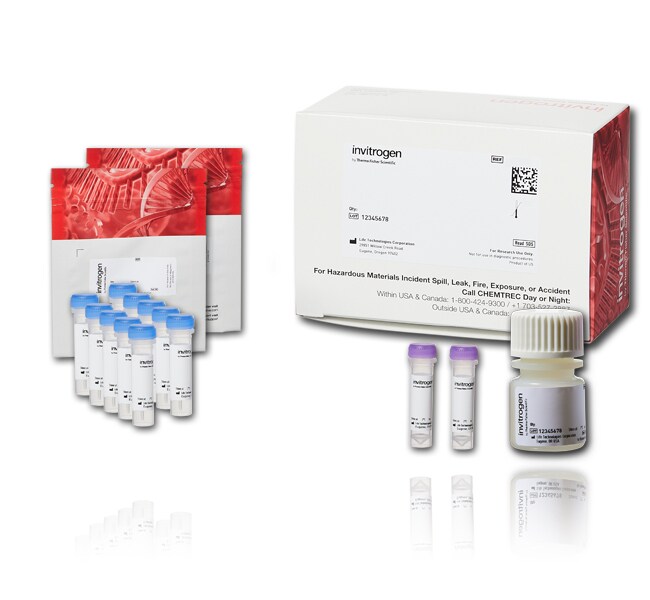
ARES™ Alexa Fluor™ 488 DNA Labeling Kit
ARES™ Alexa Fluor™ DNA標識キットは、当社のAlexa Fluor™色素でDNAを標識するための多用途な2ステップの方法を提供します。最初のステップでは、従来の酵素標識法を用いてアミン修飾ヌクレオチドをDNAに組み込みます。2番目のステップでは、特許取得済みのアミン反応性Alexa詳細を見る
| 製品番号(カタログ番号) | 数量 |
|---|---|
| A21665 | 1 kit |
製品番号(カタログ番号) A21665
価格(JPY)
87,500
Online offer
Ends: 26-Jun-2026
125,100割引額 37,600 (30%)
Each
数量:
1 kit
ARES™ Alexa Fluor™ DNA標識キットは、当社のAlexa Fluor™色素でDNAを標識するための多用途な2ステップの方法を提供します。最初のステップでは、従来の酵素標識法を用いてアミン修飾ヌクレオチドをDNAに組み込みます。2番目のステップでは、特許取得済みのアミン反応性Alexa Fluor™ 488色素を使用して、アミン修飾DNAを化学的に標識します。標識プローブは、蛍光in situハイブリダイゼーション(FISH)およびマイクロアレイ法に使用できます。ARES™ Alexa Fluor™ DNA標識キットは、5種類の蛍光色で提供され、各キットは1~5 µgのDNAの標識反応5~10回分に十分な試薬を提供します。
ARES™ Alexa Fluor™標識キットの仕様:
• 色素(Ex/Em):Alexa Fluor™ 488(492/520 nm)
• 標識ヌクレオチドの酵素的組み込み法よりも均一で一貫性のある標識を実現
• 通常、12~20塩基ごとに1つの色素を生成
• FISHおよびマイクロアレイに最適
ARES™標識キットでより均一な標識化
ARES™ Alexa Fluor™標識キットは、2ステップの標識技術、すなわちアミン修飾ヌクレオチド(アミノアリルdUTP)を酵素的に組み込むためのニックトランスレーションと、それに続くAlexa Fluor™色素による化学的標識を採用しています。この方法は、従来の標識ヌクレオチドの酵素的組み込みでは得ることが困難な標識の均一性と一貫性を実現します。
この2ステップの標識技術は、FISH Tag™DNAおよびFISH Tag™ RNAキットでも提供されています。これらのキットは、プローブ合成、標識化、精製用のすべての試薬と蛍光顕微鏡法でのシグナル保護に役立つ退色防止剤を含む、FISHアプリケーションのための完全なワークフローソリューションを提供します。
核酸標識のその他のオプション
核酸標識のさまざまなオプション(DNAおよびRNA FISHを含む)については、Molecular Probes™ハンドブックのオリゴヌクレオチドと核酸の標識化—セクション8.2を参照してください。
研究用途にのみ使用できます。ヒトまたは動物の治療もしくは診断用には使用できません。
ARES™ Alexa Fluor™標識キットの仕様:
• 色素(Ex/Em):Alexa Fluor™ 488(492/520 nm)
• 標識ヌクレオチドの酵素的組み込み法よりも均一で一貫性のある標識を実現
• 通常、12~20塩基ごとに1つの色素を生成
• FISHおよびマイクロアレイに最適
ARES™標識キットでより均一な標識化
ARES™ Alexa Fluor™標識キットは、2ステップの標識技術、すなわちアミン修飾ヌクレオチド(アミノアリルdUTP)を酵素的に組み込むためのニックトランスレーションと、それに続くAlexa Fluor™色素による化学的標識を採用しています。この方法は、従来の標識ヌクレオチドの酵素的組み込みでは得ることが困難な標識の均一性と一貫性を実現します。
この2ステップの標識技術は、FISH Tag™DNAおよびFISH Tag™ RNAキットでも提供されています。これらのキットは、プローブ合成、標識化、精製用のすべての試薬と蛍光顕微鏡法でのシグナル保護に役立つ退色防止剤を含む、FISHアプリケーションのための完全なワークフローソリューションを提供します。
核酸標識のその他のオプション
核酸標識のさまざまなオプション(DNAおよびRNA FISHを含む)については、Molecular Probes™ハンドブックのオリゴヌクレオチドと核酸の標識化—セクション8.2を参照してください。
研究用途にのみ使用できます。ヒトまたは動物の治療もしくは診断用には使用できません。
研究用にのみ使用できます。診断用には使用いただけません。
仕様
標識または色素を含む可
標識法間接ラベリング
製品ラインARES、Alexa Fluor
製品タイプDNA Labeling Kit
数量1 kit
出荷条件室温
検出法蛍光
最終産物タイププローブ(標識DNA)、cDNA(標識)
フォーマットキット
Labeling TargetDNA(一般)、cDNA
標識または色素Alexa Fluor™ 488
Unit SizeEach
組成および保存条件
フリーザー(-5∼-30度)に保存し、遮光してください。
よくあるご質問(FAQ)
My purified RNA comes from multiple sources, but I am getting variable efficiency of labeling with the same ARES kit. What can cause this?
Could you make an ARES Alexa Fluor 633 DNA Labeling Kit? This would be a good fit with my 633 nm laser.
How stable is the ARES-labeled DNA to high temperature?
Can probes labeled using the ARES Alexa Fluor DNA Labeling Kits be stored for later use?
How do the Alexa Fluor dyes used in the ARES Alexa Fluor DNA Labeling Kits compare to Cy dyes for fluorescence intensity at different labeling ratios?
引用および参考文献 (7)
引用および参考文献
Abstract
Mitochondrial nucleoids maintain genetic autonomy but allow for functional complementation.
Journal:J Cell Biol
PubMed ID:18573913
'Mitochondrial DNA (mtDNA) is packaged into DNA-protein assemblies called nucleoids, but the mode of mtDNA propagation via the nucleoid remains controversial. Two mechanisms have been proposed: nucleoids may consistently maintain their mtDNA content faithfully, or nucleoids may exchange mtDNAs dynamically. To test these models directly, two cell lines were fused,
SCFSlimb ubiquitin ligase suppresses condensin II-mediated nuclear reorganization by degrading Cap-H2.
Journal:J Cell Biol
PubMed ID:23530065
Condensin complexes play vital roles in chromosome condensation during mitosis and meiosis. Condensin II uniquely localizes to chromatin throughout the cell cycle and, in addition to its mitotic duties, modulates chromosome organization and gene expression during interphase. Mitotic condensin activity is regulated by phosphorylation, but mechanisms that regulate condensin II
Cell cycle dependent morphology changes and associated mitochondrial DNA redistribution in mitochondria of human cell lines.
Journal:Mitochondrion
PubMed ID:16120295
Mitochondria of osteosarcoma cells (143B) in culture have variable morphologies, classified according to the shape and size of the organelle as reticular, fragmented or intermediate. Synchronization and release from G0 has shown that the morphology of mitochondria oscillates between the reticular and fragmented state in a cell cycle dependent manner.
Rapid analysis of mitochondrial DNA depletion by fluorescence in situ hybridization and immunocytochemistry: potential strategies for HIV therapeutic monitoring.
Journal:J Histochem Cytochem
PubMed ID:15258176
Nucleoside reverse transcriptase inhibitors (NRTIs) have been a mainstay in the treatment of human immunodeficiency virus since the introduction of azidothymidine (AZT) in 1987. However, none of the current therapies can completely eradicate the virus, necessitating long-term use of anti-retroviral drugs to prevent viral re-growth. One of the side effects
DNA microarray analysis of the hyperthermophilic archaeon Pyrococcus furiosus: evidence for anNew type of sulfur-reducing enzyme complex.
Journal:J Bacteriol
PubMed ID:11717259
DNA microarrays were constructed by using 271 open reading frame (ORFs) from the genome of the archaeon Pyrococcus furiosus. They were used to investigate the effects of elemental sulfur (S(primary)) on the levels of gene expression in cells grown at 95 degrees C with maltose as the carbon source. The