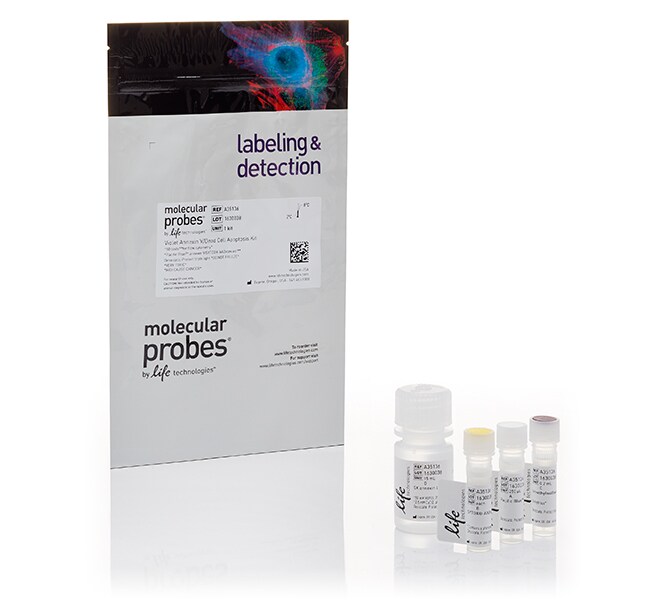
I want to study apoptosis using an Annexin V conjugate, but with adherent cells via microscopy instead of flow cytometry. Can this be done?
It has been done, but we don‘t recommend it. Both healthy cells and apoptotic cells possess phosphatidylserine on the cell surface, which can be detected with Annexin V, but apoptotic cells have significantly more of it. You can easily tell the difference between these two populations with flow cytometry, because flow cytometers are more sensitive and have a higher throughput. But with a microscope, you cannot always tell the difference, especially for adherent cells. Instead, for microscopy, we recommend a different technique, such as detecting caspases with CellEvent Caspase Detection Reagents.
Find additional tips, troubleshooting help, and resources within our Cell Analysis Support Center.
I trypsinized my adherent cells and labeled with annexin V, and now my flow data is showing a high percentage of apoptotic cells even for control, untreated cells. What is the problem?
Trypsinization or mechanical scraping of cells temporarily disrupts the plasma membrane, allowing annexin V to bind phosphatidylserine on the cytoplasmic surface of the cell membrane and thus leading to false positive staining. Allow the cells to recover for about 30 minutes in optimal cell culture conditions and medium after trypsinizing/scraping so that they can recover their membrane integrity before staining. For lightly adherent cell lines, such as HeLa and NIH 3T3, another option is to use non-enzyme treatments like Gibco Cell Dissociation Buffer (Cat. No. 13151014).
Find additional tips, troubleshooting help, and resources within our Cell Analysis Support Center.
Can I detect annexin V staining in an imaging assay?
Annexin V staining is not typically used in imaging experiments; it is a better reagent for flow cytometry analysis. All cells will stain to some extent, so it can be difficult to distinguish a relatively bright annexin V-stained cell from a dimmer non-apoptotic cell. Caspase activation, detected using our CellEvent Caspase 3/7 or Image-iT LIVE Caspase detection kits, is a better method for detecting apoptosis in an imaging assay.
Find additional tips, troubleshooting help, and resources within our Cell Analysis Support Center.
When should I stain adherent cells with annexin V for flow cytometric analysis? Before or after I trypsinize them?
Trypsinize first and then allow the cells to recover about 30 minutes in optimal cell culture conditions and medium before staining with annexin V conjugates. Trypsinization or mechanical scraping of cells temporarily disrupts the plasma membrane, allowing for annexin V to bind phosphatidylserine on the cytoplasmic surface of the cell membrane and thus leading to false positive staining. For lightly adherent cell lines such as HeLa and NIH 3T3, you could use a less harsh (non-enzymatic) dissociation product like Gibco Cell Dissociation Buffer (Cat. No. 13151014).
Find additional tips, troubleshooting help, and resources within our Cell Analysis Support Center.
Can I fix my cells after annexin V labeling?
Annexin V staining is best analyzed on live cells. If you need to fix your cells for analysis, then fix in 3.7% formaldehyde in PBS containing calcium and magnesium to maintain binding during fixation. The signal will not be retained after permeabilization, thus annexin V staining is not compatible with internal antibody labeling.
Find additional tips, troubleshooting help, and resources within our Cell Analysis Support Center.