Search


Citations & References (12)
Thermo Scientific™
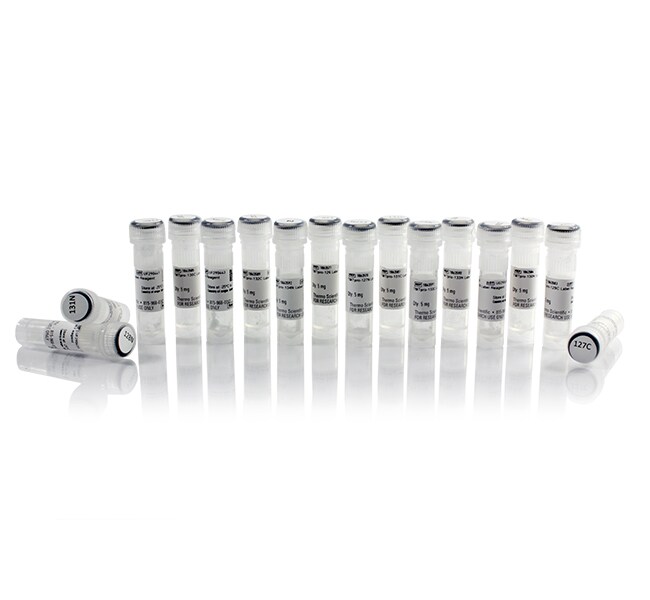
TMTpro™ 16plex Label Reagent Set
Thermo Scientific TMTpro 16plex標識試薬セットは、タンデム質量分析(MS/MS)を使用したタンパク質の同定および定量のための最大16サンプルのマルチプレックス化を可能にします。このTMTpro 16plex標識試薬セットの特長は以下のとおりです。•マルチプレックス詳細を見る


製品番号(カタログ番号) A44520
価格(JPY)
1,655,000
Each
数量:
1 x 5 mg(タグあたり)
Thermo Scientific TMTpro 16plex標識試薬セットは、タンデム質量分析(MS/MS)を使用したタンパク質の同定および定量のための最大16サンプルのマルチプレックス化を可能にします。
このTMTpro 16plex標識試薬セットの特長は以下のとおりです。
•マルチプレックス — 細胞、組織または生体液から得られた最大16サンプルの同時MS分析
• ロバスト — マルチプレックス機能の強化により、サンプルの定量値欠測が減少し、複製の信頼性が向上
• 効率的 — アミン反応性のNHSエステル活性化試薬により、タンパク質配列やタンパク質分解酵素の特異性に関係なく、すべてのペプチドの効率的な標識を実現
• 適合性 — Proteome Discoverer 2.3で完全にサポートされているデータ解析によるOrbitrap Eclipse TribridおよびOrbitrap Exploris 480質量分析計を含む、Q ExactiveおよびOrbitrap Fusion Tribrid装置シリーズなどの高解像度Thermo Scientific MS/MSプラットフォームでの使用に最適化
TMTpro標識試薬は、次世代のタンデム質量タグで、タンパク質の同定および定量に関して妥協することなく、サンプルのマルチプレックス化のレベルを高めるように設計されています。TMTproタグ構造は、タグがアイソバリックかつアミン反応性の状態にとどまる点でTMTタグ構造に似ていますが、より長いスペーサー領域およびイソブチルプロリン質量レポーター領域の点では異なります。MS/MSフラグメンテーションの後、各TMTproタグは、タンパク質発現レベルの相対定量に使用される高解像度MS/MSスペクトルの低質量領域で固有のレポーター質量(TMTpro 126-134Da)を生成します。
TMTproタグの利点として、マルチプレックス相対定量の向上、サンプルスループットの向上、サンプルの定量値欠測の減少などがあります。TMTpro 16plex標識試薬は、阻害剤の用量反応実験、経時的変化の実験、サーマルシフトアッセイまたは生物学的複製などの複数のタンパク質サンプルの分析に適しています。業界最先端の高解像度Orbitrap装置およびソフトウェアと組み合わせることで、TMTpro試薬は定量的なタンパク質発現解析のための統合トータルソリューションを提供します。
TMTpro標識ペプチドの高解像度解析の場合、Nanospray Flexイオン源に推奨されるLCカラムはAcclaim PepMap 100 C18 LCカラムです(カタログ番号164942または164939)です。EASY-Sprayイオン源の場合、推奨されるLCカラムはEASY-Spray C18 LCカラムです(カタログ番号ES802またはES803)。これらの製品には、限定的使用に関する商標ライセンスが適用されます。
このTMTpro 16plex標識試薬セットの特長は以下のとおりです。
•マルチプレックス — 細胞、組織または生体液から得られた最大16サンプルの同時MS分析
• ロバスト — マルチプレックス機能の強化により、サンプルの定量値欠測が減少し、複製の信頼性が向上
• 効率的 — アミン反応性のNHSエステル活性化試薬により、タンパク質配列やタンパク質分解酵素の特異性に関係なく、すべてのペプチドの効率的な標識を実現
• 適合性 — Proteome Discoverer 2.3で完全にサポートされているデータ解析によるOrbitrap Eclipse TribridおよびOrbitrap Exploris 480質量分析計を含む、Q ExactiveおよびOrbitrap Fusion Tribrid装置シリーズなどの高解像度Thermo Scientific MS/MSプラットフォームでの使用に最適化
TMTpro標識試薬は、次世代のタンデム質量タグで、タンパク質の同定および定量に関して妥協することなく、サンプルのマルチプレックス化のレベルを高めるように設計されています。TMTproタグ構造は、タグがアイソバリックかつアミン反応性の状態にとどまる点でTMTタグ構造に似ていますが、より長いスペーサー領域およびイソブチルプロリン質量レポーター領域の点では異なります。MS/MSフラグメンテーションの後、各TMTproタグは、タンパク質発現レベルの相対定量に使用される高解像度MS/MSスペクトルの低質量領域で固有のレポーター質量(TMTpro 126-134Da)を生成します。
TMTproタグの利点として、マルチプレックス相対定量の向上、サンプルスループットの向上、サンプルの定量値欠測の減少などがあります。TMTpro 16plex標識試薬は、阻害剤の用量反応実験、経時的変化の実験、サーマルシフトアッセイまたは生物学的複製などの複数のタンパク質サンプルの分析に適しています。業界最先端の高解像度Orbitrap装置およびソフトウェアと組み合わせることで、TMTpro試薬は定量的なタンパク質発現解析のための統合トータルソリューションを提供します。
TMTpro標識ペプチドの高解像度解析の場合、Nanospray Flexイオン源に推奨されるLCカラムはAcclaim PepMap 100 C18 LCカラムです(カタログ番号164942または164939)です。EASY-Sprayイオン源の場合、推奨されるLCカラムはEASY-Spray C18 LCカラムです(カタログ番号ES802またはES803)。これらの製品には、限定的使用に関する商標ライセンスが適用されます。
For Research Use Only. Not for use in diagnostic procedures.
仕様
最終産物タイプペプチド
使用対象 (装置)質量分析計
標識または色素Tandem Mass Tag™(TMT)標識
数量1 x 5 mg(タグあたり)
出荷条件ドライアイス
ワークフローステップタンパク質標識
検出法質量分析
製品ラインTMT
製品タイプIsobaric Label Reagent Set
原料ペプチド
Unit SizeEach
よくあるご質問(FAQ)
What is the shelf life for the TMTpro 16plex Label Reagent Set?
Can the TMT and TMTpro reagents be mixed?
Can TMTpro label reagents dissolved in anhydrous acetonitrile be dried down and stored for later use?
What size formats is the TMTpro 16plex Label Reagent Set available in?
If I already have TMTpro 16-plex tags, what do I need to order to get a total of 18-plex TMTpro tags?
引用および参考文献 (12)
引用および参考文献
Abstract
Automated 16-Plex Plasma Proteomics with Real-Time Search and Ion Mobility Mass Spectrometry Enables Large-Scale Profiling in Naked Mole-Rats and Mice.
Journal:Journal of proteome research
PubMed ID:33499602
Performing large-scale plasma proteome profiling is challenging due to limitations imposed by lengthy preparation and instrument time. We present a fully automated multiplexed proteome profiling platform (AutoMP3) using the Hamilton Vantage liquid handling robot capable of preparing hundreds to thousands of samples. To maximize protein depth in single-shot runs, we
Discovering the Radiation Biomarkers in the Plasma of Total-Body Irradiated Leukemia Patients.
Journal:Radiation research
PubMed ID:38315067
The increased risk of acute large-scale radiological exposure for the world's population underlines the need for optimal radiation biomarkers. Ionizing radiation triggers a complex response by the genome, proteome, and metabolome, all of which have been reported as suitable indicators of radiation-induced damage in vivo. This study analyzed peripheral blood samples
Improved Proteomics-Based Drug Mechanism-of-Action Studies Using 16-Plex Isobaric Mass Tags.
Journal:Journal of proteome research
PubMed ID:33621079
Multiplexed quantitative proteomics enabled complex workflows to study the mechanisms by which small molecule drugs interact with the proteome such as thermal proteome profiling (TPP) or multiplexed proteome dynamics profiling (mPDP). TPP measures changes in protein thermal stability in response to drug treatment and thus informs on direct targets and
Establishing Quality Control Procedures for Large-Scale Plasma Proteomics Analyses.
Journal:Journal of the American Society for Mass Spectrometry
PubMed ID:37163770
Proteomics research has been transformed due to high-throughput liquid chromatography (LC-MS/MS) tandem mass spectrometry instruments combined with highly sophisticated automated sample preparation and multiplexing workflows. However, scaling proteomics experiments to large sample cohorts (hundreds to thousands) requires thoughtful quality control (QC) protocols. Robust QC protocols can help with reproducibility, quantitative
Proteomic Profiling of Cerebrospinal Fluid by 16-Plex TMT-Based Mass Spectrometry.
Journal:Methods in molecular biology (Clifton, N.J.)
PubMed ID:34905163
Mass spectrometry (MS) has become a mainstream platform for comprehensive profiling of proteome, especially with the improvement of multiplexed tandem mass tag labeling coupled with two-dimensional liquid chromatography and tandem mass spectrometry (TMT-LC/LC-MS/MS). Recently, we have established a robust method for direct profiling of undepleted cerebrospinal fluid (CSF) proteome with