Search



Citations & References (16)
Invitrogen™
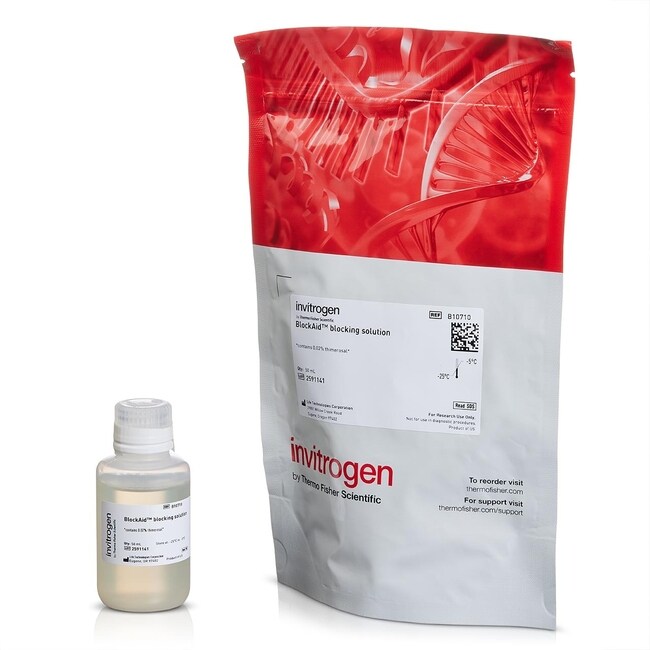
BlockAid™ Blocking Solution
BlockAid™ブロッキング溶液は、細胞または組織切片で使用するウシ血清アルブミン、正常血清やカゼインなどの一般的に使用されるブロッキング試薬よりも優れています。タンパク質ブロッキング成分の最適化された混合物で、希釈は不要です。BlockAid™ブロッキング溶液は、非特異的抗体の結合を最小限に抑えるために一次抗体を適用する前の最初のブロッキング試薬として、また一次抗体と二次抗体の両方の希釈液として使用できます。この試薬は、細胞または組織の免疫蛍光アプリケーションに適しています詳細を見る
| 製品番号(カタログ番号) | 数量 |
|---|---|
| B10710 | 50 mL |
製品番号(カタログ番号) B10710
価格(JPY)
36,600
Each
数量:
50 mL
BlockAid™ブロッキング溶液は、細胞または組織切片で使用するウシ血清アルブミン、正常血清やカゼインなどの一般的に使用されるブロッキング試薬よりも優れています。タンパク質ブロッキング成分の最適化された混合物で、希釈は不要です。BlockAid™ブロッキング溶液は、非特異的抗体の結合を最小限に抑えるために一次抗体を適用する前の最初のブロッキング試薬として、また一次抗体と二次抗体の両方の希釈液として使用できます。この試薬は、細胞または組織の免疫蛍光アプリケーションに適しています。また、ストレプトアビジンコンジュゲートおよびミクロスフェアタンパク質コンジュゲートとの使用についても検証されています。
BlockAid™ブロッキング溶液の重要な特長:
•優れたバックグラウンド低減効果—従来のブロッキング溶液より効果的
• すぐに使用可能—希釈やストック溶液の調製は不要
• 多用途—一次または二次抗体、ストレプトアビジンコンジュゲートミクロスフェアタンパク質コンジュゲートまたはQdot™コンジュゲートと使用可能
抗体の非特異的タンパク質結合によるバックグラウンドを最小限に抑えることは、感度の向上と最大限のシグナル/バックグラウンド比のために不可欠です。これは、低発現抗原を探す場合、高い自己蛍光を持つサンプルを使用する場合、またはシグナルがもともと不明瞭な場合(直接標識された一次抗体の使用や超高分解能イメージングの使用など)に特に重要です。
BlockAid™ブロッキング溶液の重要な特長:
•優れたバックグラウンド低減効果—従来のブロッキング溶液より効果的
• すぐに使用可能—希釈やストック溶液の調製は不要
• 多用途—一次または二次抗体、ストレプトアビジンコンジュゲートミクロスフェアタンパク質コンジュゲートまたはQdot™コンジュゲートと使用可能
抗体の非特異的タンパク質結合によるバックグラウンドを最小限に抑えることは、感度の向上と最大限のシグナル/バックグラウンド比のために不可欠です。これは、低発現抗原を探す場合、高い自己蛍光を持つサンプルを使用する場合、またはシグナルがもともと不明瞭な場合(直接標識された一次抗体の使用や超高分解能イメージングの使用など)に特に重要です。
研究用にのみ使用できます。診断用には使用いただけません。
仕様
数量50 mL
試薬タイプブロッキング/バックグラウンド抑制試薬
出荷条件湿氷
製品ラインBlockAid
タイプブロッキング液
Unit SizeEach
組成および保存条件
フリーザー(-5°C∼-30°C)に保存。
よくあるご質問(FAQ)
Can BlockAid blocking solution be used as a protein blocking solution for antibody labeling on cell or tissue samples, or does it only work with microspheres?
I used a neuron-specific antibody to label my neurons. How can I reduce non-specific antibody binding?
What should I use to block my cells for flow cytometry analysis?
After labeling with my antibody, I am seeing non-specific background binding in my cells or tissue. What could be the cause?
What concentration of my antibody should I use for cell analysis?
引用および参考文献 (16)
引用および参考文献
Abstract
Restriction of receptor movement alters cellular response: physical force sensing by EphA2.
Journal:Science
PubMed ID:20223987
'Activation of the EphA2 receptor tyrosine kinase by ephrin-A1 ligands presented on apposed cell surfaces plays important roles in development and exhibits poorly understood functional alterations in cancer. We reconstituted this intermembrane signaling geometry between live EphA2-expressing human breast cancer cells and supported membranes displaying laterally mobile ephrin-A1. Receptor-ligand binding,
Proinflammatory and vasodilator effects of nociceptin/orphanin FQ in the rat mesenteric microcirculation are mediated by histamine.
Journal:Am J Physiol Heart Circ Physiol
PubMed ID:17766480
'Nociceptin/orphanin FQ (N/OFQ) is the endogenous ligand for the N/OFQ peptide receptor (NOP). N/OFQ causes hypotension and vasodilation, and we aimed to determine the role of histamine in inflammatory microvascular responses to N/OFQ. Male Wistar rats (220-300 g, n = 72) were anesthetized with thiopental (30 mg/kg bolus, 40-90 mg
Green- and red-fluorescent nanospheres for the detection of cell surface receptors by flow cytometry.
Journal:J Immunol Methods
PubMed ID:9831388
'Fluorescent probes serve as sensitive tools for obtaining structural and functional information in cellular systems. In spite of the high sensitivity provided by fluorescent reagents, cell surface receptors expressed in low numbers often escape detection with commonly used fluorescent probes. R-Phycoerythrin (R-PE), a molecule with a very high quantum yield,
Micromechanical tests of adhesion dynamics between neutrophils and immobilized ICAM-1.
Journal:Biophys J
PubMed ID:14747356
'Strong, integrin-mediated adhesion of neutrophils to endothelium during inflammation is a dynamic process, requiring a conformational change in the integrin molecule to increase its affinity for its endothelial counterreceptors. To avoid general activation of the cell, Mg(2+) was used to induce the high-affinity integrin conformation, and micromechanical methods were used
Reversible self-assembly and directed assembly of DNA-linked micrometer-sized colloids.
Journal:Proc Natl Acad Sci U S A
PubMed ID:15758072
'We present a technique for the directed assembly and self-assembly of micrometer-scale structures based on the control of specific DNA linkages between colloidal particles. The use of DNA links combined with polymer brushes provides an effective way to regulate the range and magnitude of addressable forces between pairs (and further