Search
 元素の検索
元素の検索 構造の検索
構造の検索


Thermo Scientific Chemicals
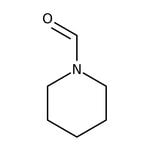
1-Formylpiperidine, 99%
CAS: 2591-86-8 | C6H11NO | 113.16 g/mol



化学物質識別子
CAS2591-86-8
IUPAC Namepiperidine-1-carbaldehyde
Molecular FormulaC6H11NO
InChI KeyFEWLNYSYJNLUOO-UHFFFAOYSA-N
SMILESO=CN1CCCCC1
さらに表示
仕様 スペックシート
スペックシートAppearance (Color)Clear colorless to pale yellow
FormLiquid
Assay (GC)≥98.5%
Identification (FTIR)Conforms
Refractive Index1.4830-1.4860 @ 20°C
1-Formylpiperidine reacts with Grignard or alkyllithium reagents gives aldehydes in high yield. It can be used as a polar aprotic solvent, with better hydrocarbon solubility than other amide solvents such as dimethylformamide. In some formylation reaction of alkyllithium compounds it gives higher yields than the DMF.
This Thermo Scientific Chemicals brand product was originally part of the Alfa Aesar product portfolio. Some documentation and label information may refer to the legacy brand. The original Alfa Aesar product / item code or SKU reference has not changed as a part of the brand transition to Thermo Scientific Chemicals.
Applications
1-Formylpiperidine reacts with Grignard or alkyllithium reagents gives aldehydes in high yield. It can be used as a polar aprotic solvent, with better hydrocarbon solubility than other amide solvents such as dimethylformamide. In some formylation reaction of alkyllithium compounds it gives higher yields than the DMF.
Solubility
Freely soluble in water.
Notes
Incompatible materials are oxidizing agents. Store in cool place. Keep container tightly closed in a dry and well-ventilated place.
1-Formylpiperidine reacts with Grignard or alkyllithium reagents gives aldehydes in high yield. It can be used as a polar aprotic solvent, with better hydrocarbon solubility than other amide solvents such as dimethylformamide. In some formylation reaction of alkyllithium compounds it gives higher yields than the DMF.
Solubility
Freely soluble in water.
Notes
Incompatible materials are oxidizing agents. Store in cool place. Keep container tightly closed in a dry and well-ventilated place.
RUO – Research Use Only
General References:
- Mary Jo Garber; Martha Gill; Yousheng Hua; Dennis Jenke. Development and Characterization of an LC-MS Method for Quantitating Aqueous Extractables, including Bisphenol A, 1 -Formylpiperidine, and Bis-(pentamethylene)-urea, from Plastic Materials. Journal of Chromatographic Science.2011, 49, (3), 214-220.
- Reaction with Grignard or alkyllithium reagents gives aldehydes in high yield: Angew. Chem. Int. Ed., 20, 878 (1981); Org. Synth. Coll., 7, 451 (1990).