Search


Citations & References (10)
Invitrogen™
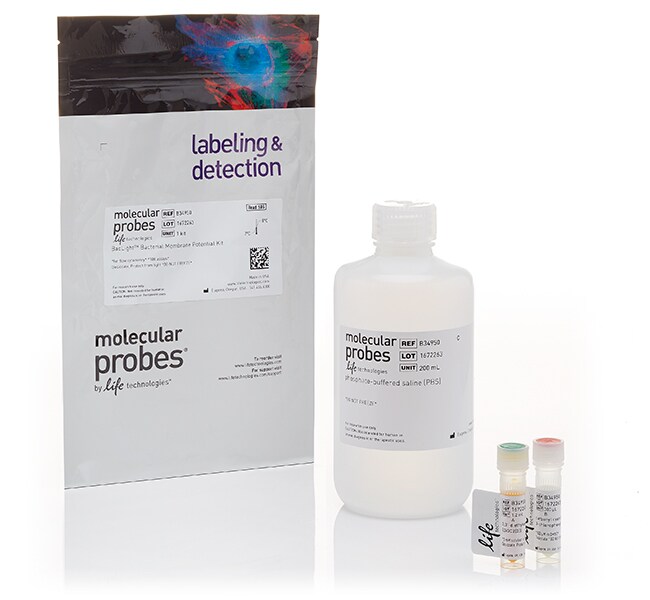
BacLight™ Bacterial Membrane Potential Kit
BacLight™細菌膜電位キットは、蛍光膜電位インジケータ色素であるDioC 2(3)に加え、プロトンイオン化(CCCP)および混合済みバッファーを提供します。低濃度のDioc 2詳細を見る
| 製品番号(カタログ番号) | 数量 |
|---|---|
| B34950 | 1キット |
製品番号(カタログ番号) B34950
価格(JPY)
55,300
Online offer
Ends: 25-Dec-2026
79,100割引額 23,800 (30%)
Each
数量:
1キット
BacLight™細菌膜電位キットは、蛍光膜電位インジケータ色素であるDioC 2(3)に加え、プロトンイオン化(CCCP)および混合済みバッファーを提供します。低濃度のDioc 2(3)はすべての細菌細胞で緑色の蛍光を示しますが、膜電位を維持している健康な細胞により濃縮され、色素が自己結合し、蛍光発光が赤色に変化します。赤および緑の蛍光細菌集団は、フローサイトメーターを使用して簡単に識別できます。CCCPはプロトングラジエントを根絶し、細菌膜の潜在性を排除するため、コントロール用としてキットに含まれています。
フローサイトメトリー用のすべての微生物学アッセイに関する追加情報を表示します。
フローサイトメトリー用のすべての微生物学アッセイに関する追加情報を表示します。
研究用にのみ使用できます。診断用には使用いただけません。
仕様
検出法蛍光
染色剤タイプ膜電位プローブ
放射波長482⁄497
フォーマットチューブ
数量1キット
出荷条件湿氷
使用対象(アプリケーション)膜電位アッセイ
使用対象 (装置)フローサイトメーター
製品ラインBacLight
製品タイプBacterial Membrane Potential Kit
Unit SizeEach
組成および保存条件
DiOC2(3)(DMSO中3 mM溶液1.2 mL)、CCCP(500 μMのDMSO溶液のうち300 μL)、PBS(200 mL)を含有。 冷蔵庫(2~8℃)に保存し、遮光。
よくあるご質問(FAQ)
What bacterial parameters can I look at by flow cytometry?
Can I look at bacteria and yeast on a flow cytometer?
引用および参考文献 (10)
引用および参考文献
Abstract
Membrane disruption by antimicrobial fatty acids releases low-molecular-weight proteins from Staphylococcus aureus.
Journal:J Bacteriol
PubMed ID:22843840
The skin represents an important barrier for pathogens and is known to produce fatty acids that are toxic toward gram-positive bacteria. A screen of fatty acids as growth inhibitors of Staphylococcus aureus revealed structure-specific antibacterial activity. Fatty acids like oleate (18:1?9) were nontoxic, whereas palmitoleate (16:1?9) was a potent growth
Comparative analysis of antimicrobial activities of valinomycin and cereulide, the Bacillus cereus emetic toxin.
Journal:Appl Environ Microbiol
PubMed ID:21357430
'Cereulide and valinomycin are highly similar cyclic dodecadepsipeptides with potassium ionophoric properties. Cereulide, produced by members of the Bacillus cereus group, is known mostly as emetic toxin, and no ecological function has been assigned. A comparative analysis of the antimicrobial activity of valinomycin produced by Streptomyces spp. and cereulide was
Two heme-dependent terminal oxidases power Staphylococcus aureus organ-specific colonization of the vertebrate host.
Journal:
PubMed ID:23900169
'Staphylococcus aureus is a significant cause of infections worldwide and is able to utilize aerobic respiration, anaerobic respiration, or fermentation as the means by which it generates the energy needed for proliferation. Aerobic respiration is supported by heme-dependent terminal oxidases that catalyze the final step of aerobic respiration, the reduction
The biocide chlorine dioxide stimulates biofilm formation in Bacillus subtilis by activation of the histidine kinase KinC.
Journal:J Bacteriol
PubMed ID:20971918
'Bacillus subtilis forms biofilms in response to signals that remain poorly defined. We report that biofilm formation is stimulated by sublethal doses of chlorine dioxide (ClO(2)), an extremely effective and fast-acting biocide. ClO(2) accelerated biofilm formation in B. subtilis as well as in other bacteria, suggesting that biofilm formation is
Fullerene water suspension (nC60) exerts antibacterial effects via ROS-independent protein oxidation.
Journal:Environ Sci Technol
PubMed ID:19031913
Buckminsterfullerene (C60) can form water suspensions (nC60) that exert toxic effects. While reactive oxygen species (ROS) generation has been implicated as the mechanism for mammalian cytotoxicity, we propose that nC60 exerts ROS-independent oxidative stress in bacteria, with evidence of protein oxidation, changes in cell membrane potential, and interruption of cellular