Search


Citations & References (4)
Invitrogen™
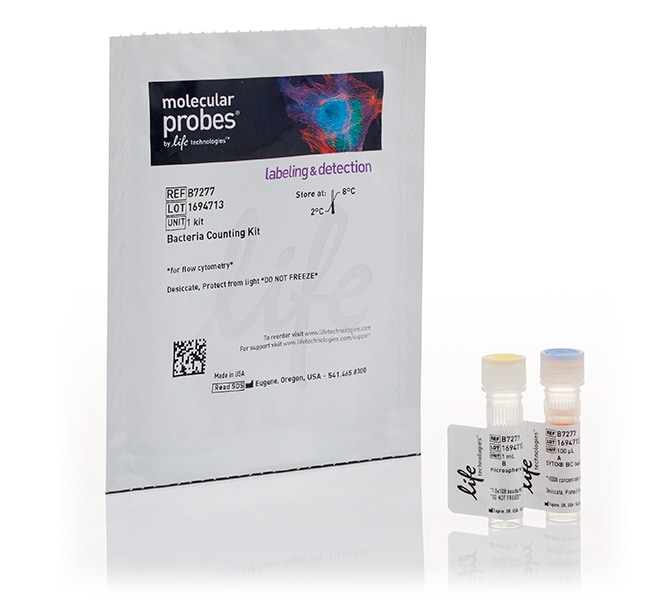
Bacteria Counting Kit, for flow cytometry
細菌カウントキットは、フローサイトメトリーで細菌を正確にカウントします。このキットには、グラム陰性細菌もグラム陽性細菌も簡単に染色し、きわめて明るい緑色蛍光シグナルを発する親和性の高い核酸染色剤のSYTO™ BC が含まれています(別売り。カタログ番号S34855)詳細を見る
| 製品番号(カタログ番号) | 数量 |
|---|---|
| B7277 | 1 kit |
製品番号(カタログ番号) B7277
価格(JPY)
72,700
Each
数量:
1 kit
細菌カウントキットは、フローサイトメトリーで細菌を正確にカウントします。このキットには、グラム陰性細菌もグラム陽性細菌も簡単に染色し、きわめて明るい緑色蛍光シグナルを発する親和性の高い核酸染色剤のSYTO™ BC が含まれています(別売り。カタログ番号S34855)。このキットには、ポリスチレン製ミクロスフェアの校正済み懸濁液も含まれています。染色された細菌とビーズのシグナルは、どちらも緑色蛍光チャネルで簡単に検出できる上、前方散乱光と蛍光のプロット上で区別できます。サンプル中の細菌の密度は、サイトグラムに現れる細菌のシグナルとミクロスフェアのシグナル比で測定できます。
すべてのフローサイトメトリー用微生物学アッセイに関する追加情報を表示します。
すべてのフローサイトメトリー用微生物学アッセイに関する追加情報を表示します。
研究用にのみ使用できます。診断用には使用いただけません。
仕様
検出法蛍光
直径(メートル法)ビーズ6 µm
使用対象(アプリケーション)フローサイトメトリー
使用対象 (装置)フローサイトメーター
内容BC細菌染色剤、ミクロスフェア標準
数量1 kit
サンプルタイプ細菌
出荷条件室温
製品タイプ細菌カウントキット
Unit SizeEach
組成および保存条件
SYTO™ BC細菌染色剤1バイアル(DMSOで100 µL、1,000x)、ミクロスフェア標準1バイアル(1 mL、6 µm)を含みます。
冷蔵庫(2~8℃)に保存し、遮光。
冷蔵庫(2~8℃)に保存し、遮光。
よくあるご質問(FAQ)
Is the SYTO BC bacteria stain from the Bacteria Counting Kit available as a standalone product?
When using the Live/Dead BacLight Bacterial Viability and Counting Kit, for flow cytometry, some cells seem to have both red and green signal. Are these cells dead or alive or dying?
How can I count my bacteria by flow cytometry?
What bacterial parameters can I look at by flow cytometry?
I am using counting beads to count cells, but I cannot find the beads on my scatter plots. What do I do?
引用および参考文献 (4)
引用および参考文献
Abstract
Comparison of blue nucleic acid dyes for flow cytometric enumeration of bacteria in aquatic systems.
Journal:Appl Environ Microbiol
PubMed ID:9572943
'Seven blue nucleic acid dyes from Molecular Probes Inc. (SYTO-9, SYTO-11, SYTO-13, SYTO-16, SYTO-BC, SYBR-I and SYBR-II) were compared with the DAPI (4'',6-diamidino-2-phenylindole) method for flow cytometric enumeration of live and fixed bacteria in aquatic systems. It was shown that SYBR-II and SYTO-9 are the most appropriate dyes for bacterial
The beta-catenin--TCF-1 pathway ensures CD4(+)CD8(+) thymocyte survival.
Journal:Nat Immunol
PubMed ID:11477404
The association of trans-acting T cell factors (TCFs) or lymphoid enhancer factor 1 (LEF-1) with their coactivator beta-catenin mediates transient transcriptional responses to extracellular Wnt signals. We show here that T cell maturation depends on the presence of the beta-catenin--binding domain in TCF-1. This domain is necessary to mediate the
Fluorescence staining and flow cytometry for monitoring microbial cells.
Journal:J Immunol Methods
PubMed ID:10986415
Large numbers of microbiological samples are analysed annually using traditional culture-based techniques. These techniques take hours to days to yield a result, are tedious and are not suitable for non-culturable microorganisms. Further, culture-based techniques do not provide real-time information on the physiological status of the organism in situ which is
Flow cytometry and cell sorting of heterogeneous microbial populations: the importance of single-cell analyses.
Journal:Microbiol Rev
PubMed ID:8987359
The most fundamental questions such as whether a cell is alive, in the sense of being able to divide or to form a colony, may sometimes be very hard to answer, since even axenic microbial cultures are extremely heterogeneous. Analyses that seek to correlate such things as viability, which is