Search


Citations & References (13)
Invitrogen™
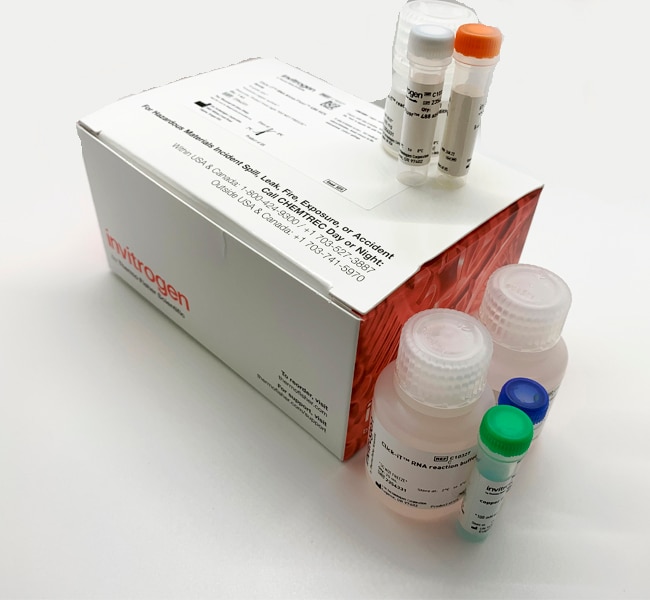
Click-iT™ RNA Alexa Fluor™ 594 Imaging Kit
Click-iT™ RNA Alexa Fluor™ 594イメージングキットを使用すると、細胞および組織(PNAS(2008)105:15779-84)中のグローバルRNAの転写を時間的および空間的に検出できます詳細を見る
| 製品番号(カタログ番号) | 数量 |
|---|---|
| C10330 | 1 kit |
製品番号(カタログ番号) C10330
価格(JPY)
121,900
Each
数量:
1 kit
Click-iT™ RNA Alexa Fluor™ 594イメージングキットを使用すると、細胞および組織(PNAS(2008)105:15779-84)中のグローバルRNAの転写を時間的および空間的に検出できます。新たに合成されたRNAや、疾患、環境損傷、薬物治療に起因するRNAレベルの変化を検出する能力は、毒性プロファイリングの重要な側面です。アルキン修飾ヌクレオシド、5-エチニルウリジン(EU)、強力なクリックケミストリーを利用することで、新たに合成されたRNAを、放射活性や抗体を用いずにシンプルな2ステップの手順で検出できます。ステップ1では、アルキンを含むヌクレオシドが細胞や動物に供給され、新生RNAに活発に取り込まれます。タグの分子量が低いため、修飾されたヌクレオシドをRNAに効率的に取り入れることができますが、DNAには取り入れられません。検出には、アジドとアルキンの間の化学選択的ライゲーションまたは「クリック」反応を利用します。この反応では、対応するアジド含有色素によって修飾されたRNAが検出されます。Click-iT™の検出分子は分子量が低いため、複雑なサンプルでも容易に侵入できるほか、RNA相互作用タンパク質を検出する抗体など、他のプローブを用いたマルチプレックス解析の可能性が生まれるため、より深い生物学的洞察がもたらされます。
研究用にのみ使用できます。診断用には使用いただけません。
仕様
色Red
励起/発光590/617
使用対象 (装置)共焦点顕微鏡, 蛍光顕微鏡
製品ラインAlexa Fluor、Click-iT、Molecular Probes
製品タイプ新しいRNA合成アッセイ
数量1 kit
出荷条件室温
検出法蛍光
フォーマットスライド
標識または色素Alexa Fluor™ 594
Unit SizeEach
組成および保存条件
このキットには、18×18カバースリップ25枚分の材料が含まれています。2~6℃で保管し、湿気を避け、光から保護してください。
よくあるご質問(FAQ)
Can the components of the Click-iT Plus EdU Alexa Fluor Imaging Kits be used for labeling samples for flow cytometry?
Can any type of cell incorporate EU?
What is the approximate fluorescence excitation/emission maxima for Alexa Fluor 594 azide?
引用および参考文献 (13)
引用および参考文献
Abstract
Visualization of actin filaments and monomers in somatic cell nuclei.
Journal:Mol Biol Cell
PubMed ID:23447706
'In addition to its long-studied presence in the cytoplasm, actin is also found in the nuclei of eukaryotic cells. The function and form (monomer, filament, or noncanonical oligomer) of nuclear actin are hotly debated, and its localization and dynamics are largely unknown. To determine the distribution of nuclear actin in
Bookmarking by specific and nonspecific binding of FoxA1 pioneer factor to mitotic chromosomes.
Journal:Genes Dev
PubMed ID:23355396
While most transcription factors exit the chromatin during mitosis and the genome becomes silent, a subset of factors remains and
Visualizing coronavirus RNA synthesis in time by using click chemistry.
Journal:J Virol
PubMed ID:22438542
Coronaviruses induce in infected cells the formation of replicative structures, consisting of double-membrane vesicles (DMVs) and convoluted membranes, where viral RNA synthesis supposedly takes place and to which the nonstructural proteins (nsp's) localize. Double-stranded RNA (dsRNA), the presumed intermediate in RNA synthesis, is localized to the DMV interior. However, as
Dynamics and Spatial Genomics of the Nascent Transcriptome by Intron seqFISH.
Journal:Cell
PubMed ID:29887381
Topoisomerase II-Induced Chromosome Breakage and Translocation Is Determined by Chromosome Architecture and Transcriptional Activity.
Journal:Mol Cell
PubMed ID:31202577