Search


Citations & References (4)
Invitrogen™
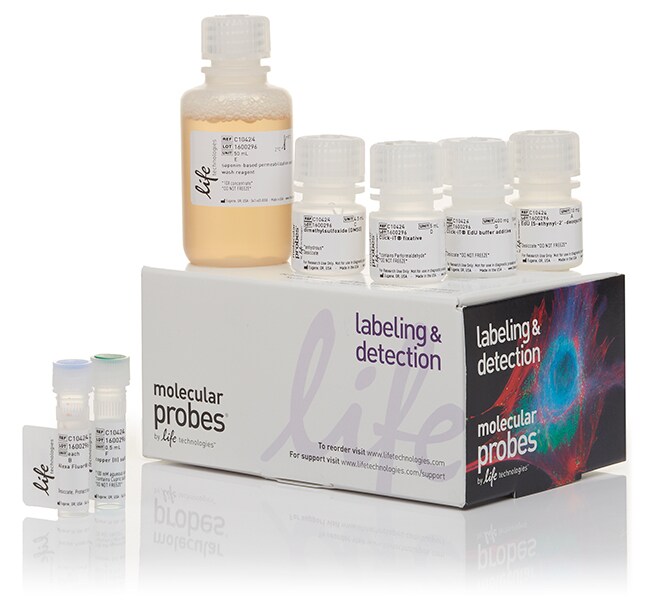
Click-iT™ EdU Alexa Fluor™ 647 Flow Cytometry Assay Kit
Click-iT™ EdU Alexa Fluor™ 647フローサイトメトリーアッセイキットにより、従来のBrdU法と比較して、増殖細胞におけるDNA複製を分析するためのシンプルで堅牢なアッセイが可能となります。新たに合成されたDNAは、フローサイトメーターの633/5 nmレーザーを使用して解析されます詳細を見る


製品番号(カタログ番号) C10424
価格(JPY)
147,500
Each
数量:
50 assays
Click-iT™ EdU Alexa Fluor™ 647フローサイトメトリーアッセイキットにより、従来のBrdU法と比較して、増殖細胞におけるDNA複製を分析するためのシンプルで堅牢なアッセイが可能となります。新たに合成されたDNAは、フローサイトメーターの633/5 nmレーザーを使用して解析されます。
•正確--BrdUアッセイより優れた結果を提示
• 高速--わずか90分で解析が完了
• 経済的--
キットあたりのアッセイ数の増加フローサイトメトリー用の すべてのClick-iT™ EdUおよびClick-iT™ Plus EdUアッセイの選択ガイドを表示。
BrdUより優れた結果が得られる先進的な方法
増殖解析のもっとも正確な方法は、DNA合成の直接測定です。当初は、放射性ヌクレオシド、すなわち 、3H-チミジンを組み込むことで実施されていました。この方法は、ヌクレオシドアナログブロモデオキシウリジン(BrdU)の抗体ベースの検出に置き換えられました。Click-iT™ EdUフローサイトメトリーアッセイキットは、BrdUアッセイに代わる新しいアッセイキットです。EdU(5-エチニル-2´-デオキシウリジン)は、活性DNA合成の際にDNAに取り込まれるチミジンアナログです。検出は、クリックケミストリー(銅触媒を用いたアジドとアルキンの共有結合反応)に基づいています。このアプリケーションでは、アルキンはEdU のエチニル部位に、アジドはAlexa Fluor™ 488色素、Alexa Fluor™ 647色素、またはPacific BlueTM色素に結合しています。標準的なフローサイトメトリー法は、集団中のS期細胞の割合を決定するために使用されます(図1)。
穏やかな条件で、細胞周期色素や抗体を使用可能
Click-iT™ EdU標識の利点は、アッセイを実行している間に明らかになります(図2)。アジ化色素のサイズは小さいため、穏やかな条件下で組み込まれたEdUを効率的に検出できます。また、標準的なアルデヒドベースの固定および界面活性剤の浸透は、Click-It™検出試薬でDNAにアクセスするのに十分です。これは、抗BrdU抗体で検出できるようにBrdUを露出させるためにDNAの変性(HCl、熱、またはDNaseによる消化)を必要とするBrdUアッセイとは対照的です。BrdUアッセイのサンプル処理は、HCl法を使用した場合、細胞周期分布のシグナル変化や抗原認識部位の破壊を引き起こす可能性があります。対照的に、使いやすいEdU細胞増殖キットは、細胞周期色素に対応しています。このEdUアッセイキットは、表面マーカーや細胞内マーカーに対する抗体とのマルチプレックス化も可能です。
迅速でシンプルなプロトコル
Click-iT™ EdUプロトコルは、免疫組織化学的抗体標識のためのアルデヒド固定と洗剤浸透ステップに基づいていますが、EdUはサポニンやメタノールを含む他の
固定/浸透剤と互換性があります。わずか5ステップで細胞増殖データを分析できます。
•細胞のEdUM処理
• 細胞の固定および浸透処理
•Click-iT™検出カクテルでS期細胞を30分間検出
•1回の洗浄
• 分析
正確な結果を経済的に取得
キットあたりのアッセイ数を増やすことで、Click-IT™ EdU Alexa Fluor™ 647フローサイトメトリーアッセイキットは従来のBrdUアッセイよりも安価で、大規模な実験に最適です。
研究用途にのみご使用ください。ヒトおよび動物の治療または診断用には使用できません。
•正確--BrdUアッセイより優れた結果を提示
• 高速--わずか90分で解析が完了
• 経済的--
キットあたりのアッセイ数の増加フローサイトメトリー用の すべてのClick-iT™ EdUおよびClick-iT™ Plus EdUアッセイの選択ガイドを表示。
BrdUより優れた結果が得られる先進的な方法
増殖解析のもっとも正確な方法は、DNA合成の直接測定です。当初は、放射性ヌクレオシド、すなわち 、3H-チミジンを組み込むことで実施されていました。この方法は、ヌクレオシドアナログブロモデオキシウリジン(BrdU)の抗体ベースの検出に置き換えられました。Click-iT™ EdUフローサイトメトリーアッセイキットは、BrdUアッセイに代わる新しいアッセイキットです。EdU(5-エチニル-2´-デオキシウリジン)は、活性DNA合成の際にDNAに取り込まれるチミジンアナログです。検出は、クリックケミストリー(銅触媒を用いたアジドとアルキンの共有結合反応)に基づいています。このアプリケーションでは、アルキンはEdU のエチニル部位に、アジドはAlexa Fluor™ 488色素、Alexa Fluor™ 647色素、またはPacific BlueTM色素に結合しています。標準的なフローサイトメトリー法は、集団中のS期細胞の割合を決定するために使用されます(図1)。
穏やかな条件で、細胞周期色素や抗体を使用可能
Click-iT™ EdU標識の利点は、アッセイを実行している間に明らかになります(図2)。アジ化色素のサイズは小さいため、穏やかな条件下で組み込まれたEdUを効率的に検出できます。また、標準的なアルデヒドベースの固定および界面活性剤の浸透は、Click-It™検出試薬でDNAにアクセスするのに十分です。これは、抗BrdU抗体で検出できるようにBrdUを露出させるためにDNAの変性(HCl、熱、またはDNaseによる消化)を必要とするBrdUアッセイとは対照的です。BrdUアッセイのサンプル処理は、HCl法を使用した場合、細胞周期分布のシグナル変化や抗原認識部位の破壊を引き起こす可能性があります。対照的に、使いやすいEdU細胞増殖キットは、細胞周期色素に対応しています。このEdUアッセイキットは、表面マーカーや細胞内マーカーに対する抗体とのマルチプレックス化も可能です。
迅速でシンプルなプロトコル
Click-iT™ EdUプロトコルは、免疫組織化学的抗体標識のためのアルデヒド固定と洗剤浸透ステップに基づいていますが、EdUはサポニンやメタノールを含む他の
固定/浸透剤と互換性があります。わずか5ステップで細胞増殖データを分析できます。
•細胞のEdUM処理
• 細胞の固定および浸透処理
•Click-iT™検出カクテルでS期細胞を30分間検出
•1回の洗浄
• 分析
正確な結果を経済的に取得
キットあたりのアッセイ数を増やすことで、Click-IT™ EdU Alexa Fluor™ 647フローサイトメトリーアッセイキットは従来のBrdUアッセイよりも安価で、大規模な実験に最適です。
研究用途にのみご使用ください。ヒトおよび動物の治療または診断用には使用できません。
研究用にのみ使用できます。診断用には使用いただけません。
仕様
検出法蛍光
染色剤タイプAlexa Fluor™ 647
フォーマットチューブ
数量50 assays
出荷条件室温
放射波長範囲650⁄670
使用対象 (装置)フローサイトメーター
製品ラインClick-iT
製品タイプFlow Cytometry Assay Kit
Unit SizeEach
組成および保存条件
EdU(5-エチニル-2'-デオキシウリジン)、Alexa Fluor™ 647アジド、無水ジメチルスルホキシド(DMSO)、Click-iT™固定剤、Click-iT™サポニンベースの透過処理および洗浄バッファー、銅(II)硫酸、Click-iT™ EdU添加バッファーを含みます。2℃~8℃で保存してください 乾燥した状態で、遮光してください。
よくあるご質問(FAQ)
Click-iT® EdU kitを用いて 細胞増殖アッセイを行っています。 どのポイントで途中停止をかけられますか? あるいは、全てのステップを連続して行う必要がありますか?
Click-iT Plus EdU Imaging Kit は、今までの Click-iT EdU Imaging Kit と何が異なるのですか?
I will be performing a cell proliferation assay using Click-iT EdU kit. At what point can I stop overnight, or do I have to perform all the steps continuously?
Can I combine Click-iT or Click-iT Plus reactions with phalloidin conjugates used for actin staining?
Are the Alexa Fluor azides from Click-iT EdU kits available separately?
引用および参考文献 (4)
引用および参考文献
Abstract
Polybrene inhibits human mesenchymal stem cell proliferation during lentiviral transduction.
Journal:PLoS One
PubMed ID:21887340
'Human mesenchymal stem cells (hMSCs) can be engineered to express specific genes, either for their use in cell-based therapies or to track them in vivo over long periods of time. To obtain long-term expression of these genes, a lentivirus- or retrovirus-mediated cell transduction is often used. However, given that the
Identifying disruptors of male germ cell development by small molecule screening in ex vivo gonad cultures.
Journal:BMC Res Notes
PubMed ID:23631647
'Germ cell development involves formation of the spermatogenic or oogenic lineages from the bipotential primordial germ cells. Signaling mechanisms in the fetal testis and ovary determine whether germ cells enter the male or female developmental pathway, respectively. These signaling processes underpin an important phase of germ cell development, disruption of
Constitutive phosphorylation of GATA-1 at serine²6 attenuates the colony-forming activity of erythrocyte-committed progenitors.
Journal:
PubMed ID:23717580
We previously reported that IL-3 signaling induces phosphorylation of GATA-1 at the serine²6 position, which contributes to IL-3-mediated anti-apoptotic response. Here, we demonstrate that phosphorylation of GATA-1 at serine²6 is also transiently induced in cells of the erythroid lineage (primary erythroblasts and erythrocyte-committed progenitors [EPs]) by erythropoietin (EPO), the principal
Aeroallergen challenge promotes dendritic cell proliferation in the airways.
Journal:J Immunol
PubMed ID:23267021
Aeroallergen provocation induces the rapid accumulation of CD11c(+)MHC class II (MHC II)(+) dendritic cells (DCs) in the lungs, which is driven by an increased recruitment of blood-derived DC precursors. Recent data show, however, that well-differentiated DCs proliferate in situ in various tissues. This may also contribute to their allergen-induced expansion;