Search


Citations & References (26)
Invitrogen™
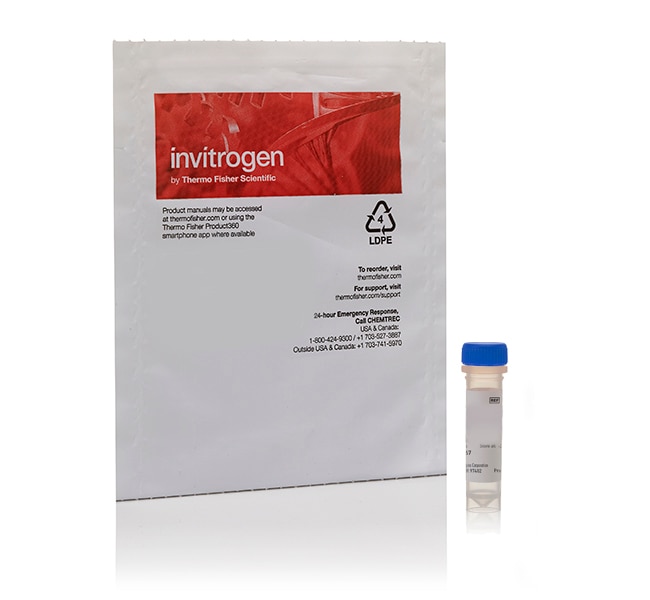
CellLight™ ER-GFP, BacMam 2.0
CellLight™ ER-GFP、BacMam 2.0は、生細胞中の緑色蛍光タンパク質(GFP)で小胞体(ER)を標識する簡単な方法を提供します。試薬を細胞に添加し詳細を見る
| 製品番号(カタログ番号) | 数量 |
|---|---|
| C10590 | 1バイアル |
製品番号(カタログ番号) C10590
価格(JPY)
54,000
Each
数量:
1バイアル
CellLight™ ER-GFP、BacMam 2.0は、生細胞中の緑色蛍光タンパク質(GFP)で小胞体(ER)を標識する簡単な方法を提供します。試薬を細胞に添加し、一晩インキュベートするだけで、翌朝にはイメージングの準備が整います。
他の細胞構造をラベリングするには?CellLight™蛍光タンパク質標識ツールについて詳しくはこちら
このすぐに使用可能なコンストラクトをBacMam 2.0テクノロジーを用いて細胞に導入し、GFPをCalreticulinおよびKDEL(ER保持シグナル)のERシグナルシーケンスに融合させ、細胞破壊を最小限に抑えます。蛍光イメージングを使用し、他の蛍光タンパク質や有機色素と多重化することで、生細胞におけるER-GFPの挙動を観察できます。
CellLight™コンストラクトを発現する細胞をホルムアルデヒドで固定し、免疫細胞化学技術を用いたマルチプレックスイメージングを行うこともできます。
CellLight™テクノロジーとは:
•迅速で便利:CellLight試薬™を細胞に添加し、アッセイに対応した凍結細胞を一晩インキュベートし、イメージング—または保存するだけで、後で使用できるようになります。
• 高効率:初代細胞、幹細胞、神経細胞など、さまざまな哺乳類細胞株の最大90%の形質導入。
• 柔軟性:マルチプレックス実験や共局在研究向けに複数のBacMam試薬を共輸送。線量を簡単に変化させることで、発現レベルを厳密に制御します。
• 低毒性:CellLight™試薬は哺乳類細胞では複製されず、バイオセーフティレベル(BSL)1の取り扱いに適しています。
BacMamテクノロジー
CellLight™ ER-GFP、BacMam 2.0は、CalreticulinおよびKDEL(ER保持シグナル)とemGFPの融合コンストラクトで、細胞のER-GFPを正確かつ特異的に標的にします。この融合コンストラクトは昆虫ウイルスであるバキュロウイルスにパッケージされており、ヒト細胞では再現されず、ほとんどのラボで生物学的安全レベル(BSL)1で使用することが安全であると指定されています。BacMam技術により、ほとんどの哺乳類細胞タイプが、高効率かつ最小限の毒性で形質導入およびトランスフェクションされます。この一過性トランスフェクションは、一晩のインキュベーション後に最大5日間検出できます—ほとんどの動的細胞分析を実行するのに十分な期間です。あらゆるトランスフェクションおよび形質導入技術と同様に、BacMam法はすべての細胞を同等の効率でトランスフェクション/形質導入しないため、細胞集団研究または自動イメージングおよび自動カウントにはあまり適していません。CellLight™試薬は、細胞または細胞内の共局方化が必要な実験や、特別な分解能を必要とする細胞機能研究に最適です。
他の細胞構造をラベリングするには?CellLight™蛍光タンパク質標識ツールについて詳しくはこちら
このすぐに使用可能なコンストラクトをBacMam 2.0テクノロジーを用いて細胞に導入し、GFPをCalreticulinおよびKDEL(ER保持シグナル)のERシグナルシーケンスに融合させ、細胞破壊を最小限に抑えます。蛍光イメージングを使用し、他の蛍光タンパク質や有機色素と多重化することで、生細胞におけるER-GFPの挙動を観察できます。
CellLight™コンストラクトを発現する細胞をホルムアルデヒドで固定し、免疫細胞化学技術を用いたマルチプレックスイメージングを行うこともできます。
CellLight™テクノロジーとは:
•迅速で便利:CellLight試薬™を細胞に添加し、アッセイに対応した凍結細胞を一晩インキュベートし、イメージング—または保存するだけで、後で使用できるようになります。
• 高効率:初代細胞、幹細胞、神経細胞など、さまざまな哺乳類細胞株の最大90%の形質導入。
• 柔軟性:マルチプレックス実験や共局在研究向けに複数のBacMam試薬を共輸送。線量を簡単に変化させることで、発現レベルを厳密に制御します。
• 低毒性:CellLight™試薬は哺乳類細胞では複製されず、バイオセーフティレベル(BSL)1の取り扱いに適しています。
BacMamテクノロジー
CellLight™ ER-GFP、BacMam 2.0は、CalreticulinおよびKDEL(ER保持シグナル)とemGFPの融合コンストラクトで、細胞のER-GFPを正確かつ特異的に標的にします。この融合コンストラクトは昆虫ウイルスであるバキュロウイルスにパッケージされており、ヒト細胞では再現されず、ほとんどのラボで生物学的安全レベル(BSL)1で使用することが安全であると指定されています。BacMam技術により、ほとんどの哺乳類細胞タイプが、高効率かつ最小限の毒性で形質導入およびトランスフェクションされます。この一過性トランスフェクションは、一晩のインキュベーション後に最大5日間検出できます—ほとんどの動的細胞分析を実行するのに十分な期間です。あらゆるトランスフェクションおよび形質導入技術と同様に、BacMam法はすべての細胞を同等の効率でトランスフェクション/形質導入しないため、細胞集団研究または自動イメージングおよび自動カウントにはあまり適していません。CellLight™試薬は、細胞または細胞内の共局方化が必要な実験や、特別な分解能を必要とする細胞機能研究に最適です。
研究用にのみ使用できます。診断用には使用いただけません。
仕様
色Green
検出法蛍光
染色剤タイプGFP(EmGFP)
発光可視
励起波長域488⁄510
使用対象 (装置)共焦点顕微鏡, 蛍光顕微鏡
形状液体
製品ラインCellLight
数量1バイアル
出荷条件湿氷
技術蛍光強度
標識タイプ蛍光タンパク質
製品タイプ小胞体
Sub Cellular Localization小胞体
Unit SizeEach
組成および保存条件
2°C∼6°Cで保管し、遮光してください。冷凍しないでください。
よくあるご質問(FAQ)
CellLight や Premo FUCCI cell cycle sensor などの BacMam 2.0試薬にて、どのようにすれば形質転換効率を上げることができますか?
How can I increase the transduction efficiency with the BacMam 2.0 reagents such as the the CellLight and Premo products?
Is there any way to preserve the CellLights labeling beyond 5 days?
Are the CellLights products toxic to cells?
For how long will the CellLights products label my cells?
引用および参考文献 (26)
引用および参考文献
Abstract
Mutations in ABCD4 cause a new inborn error of vitamin B12 metabolism.
Journal:Nat Genet
PubMed ID:22922874
Inherited disorders of vitamin B12 (cobalamin) have provided important clues to how this vitamin, which is essential for hematological and neurological function, is transported and metabolized. We describe a new disease that results in failure to release vitamin B12 from lysosomes, which mimics the cblF defect caused by LMBRD1 mutations.
Intracellular trafficking of Clostridium perfringens iota-toxin b.
Journal:Infect Immun
PubMed ID:22825447
'Clostridium perfringens iota-toxin is composed of an enzymatic component (Ia) and a binding component (Ib). Ib binds to a cell surface receptor, undergoes oligomerization in lipid rafts, and binds Ia. The resulting complex is then endocytosed. Here, we show the intracellular trafficking of iota-toxin. After the binding of the Ib
Single-cell redox imaging demonstrates a distinctive response of dopaminergic neurons to oxidative insults.
Journal:Antioxid Redox Signal
PubMed ID:21395478
'The study of the intracellular oxido-reductive (redox) state is of extreme relevance to the dopamine (DA) neurons of the substantia nigra pars compacta. These cells possess a distinct physiology intrinsically associated with elevated reactive oxygen species production, and they selectively degenerate in Parkinson''s disease under oxidative stress conditions. To test
Intracellular trafficking mechanism, from intracellular uptake to extracellular efflux, for phospholipid/cholesterol liposomes.
Journal:Biomaterials
PubMed ID:22858002
'Liposomes are widely used as drug delivery vehicles to transfer chemotherapeutic agents, proteins, and nucleic acids into target cells. To improve therapeutic effects and reduce unexpected toxic side-effects, it is necessary to understand the mechanism of liposomal uptake into cells, and the intracellular fate of internalized liposomes. The intracellular fate
Der p2 Internalization by Epithelium Synergistically Augments Toll-like Receptor-Mediated Proinflammatory Signaling.
Journal:
PubMed ID:25749775
'House-dust-mite (HDM) major allergen Der p2 shares homology and function with Toll-like receptor (TLR) signaling protein myeloid differentiation-2 (MD2) and may lead to airway inflammation. Should Der p2 be internalized by human airway epithelium, it has the theoretical propensity to potentiate epithelium activation. This study aimed to demonstrate the internalization