Search


Citations & References (30)
Invitrogen™
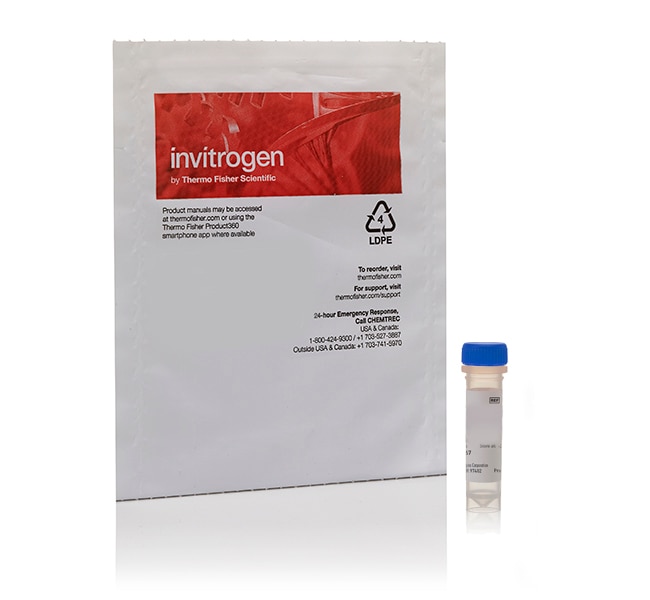
CellLight™ Mitochondria-GFP, BacMam 2.0
CellLight™ミトコンドリアGFP、BacMam 2.0は、生細胞中の緑色蛍光タンパク質(GFP)でミトコンドリアをラベリングする簡単な方法を提供します。試薬を細胞に添加し、一晩インキュベートするだけで、翌朝にはイメージングの準備が整います。他の細胞構造をラベリングするには?CellLight™蛍光タンパク質ラベリングツールの詳細をご覧ください詳細を見る
| 製品番号(カタログ番号) | 数量 |
|---|---|
| C10600 | 1バイアル |
製品番号(カタログ番号) C10600
価格(JPY)
54,000
Each
数量:
1バイアル
CellLight™ミトコンドリアGFP、BacMam 2.0は、生細胞中の緑色蛍光タンパク質(GFP)でミトコンドリアをラベリングする簡単な方法を提供します。試薬を細胞に添加し、一晩インキュベートするだけで、翌朝にはイメージングの準備が整います。
他の細胞構造をラベリングするには?CellLight™蛍光タンパク質ラベリングツールの詳細をご覧ください。
このすぐに使用可能なコンストラクトは、BacMam 2.0技術を使用して細胞にトランスフェクションされ、GFPをE1アルファピルビン酸デヒドロゲナーゼのリーダー配列に融合して発現させます。複数のトラッキング色素またはトレーシング色素を使用して、ミトコンドリア膜の電位やラベルに関係なく、生細胞のミトコンドリアGFPの挙動を観察し、細胞の動的なプロセスをイメージングできます。
CellLight™コンストラクトを発現する細胞は、免疫細胞化学技術を使用したマルチプレックスイメージングのためにホルムアルデヒドで固定することもできます。
CellLight™テクノロジー:
•迅速で便利:CellLight試薬™を細胞に添加し、アッセイに対応した凍結細胞を一晩インキュベートし、イメージング—または保存するだけで、後で使用できるようになります。
• 高効率:初代細胞、幹細胞、神経細胞など、さまざまな哺乳類細胞株の最大90%の形質導入。
• 柔軟性:マルチプレックス実験や共局在研究向けに複数のBacMam試薬を共輸送。線量を簡単に変化させることで、発現レベルを厳密に制御します。
• 低毒性:CellLight™試薬は、哺乳類細胞では非複製であり、生物学的安全レベル(BSL)1の処理には適しています。
BacMam技術
CellLight™ミトコンドリアGFP、BacMam 2.0は、E1アルファピルビン酸デヒドロゲナーゼのリーダー配列とemGFPの融合コンストラクトで、細胞ミトコンドリアGFPに正確かつ特異的な標的を提供します。この融合コンストラクトは昆虫ウイルスであるバキュロウイルスにパッケージされており、ヒト細胞では再現されず、ほとんどのラボで生物学的安全レベル(BSL)1で使用することが安全であると指定されています。BacMam技術により、ほとんどの哺乳類細胞タイプが、高効率かつ最小限の毒性で形質導入およびトランスフェクションされます。この一過性トランスフェクションは、一晩のインキュベーション後に最大5日間検出できます—ほとんどの動的細胞分析を実行するのに十分な期間です。あらゆるトランスフェクションおよび形質導入技術と同様に、BacMam法はすべての細胞を同等の効率でトランスフェクション/形質導入しないため、細胞集団研究または自動イメージングおよび自動カウントにはあまり適していません。CellLight™試薬は、細胞または細胞内の共局方化が必要な実験や、特別な分解能を必要とする細胞機能研究に最適です。
他の細胞構造をラベリングするには?CellLight™蛍光タンパク質ラベリングツールの詳細をご覧ください。
このすぐに使用可能なコンストラクトは、BacMam 2.0技術を使用して細胞にトランスフェクションされ、GFPをE1アルファピルビン酸デヒドロゲナーゼのリーダー配列に融合して発現させます。複数のトラッキング色素またはトレーシング色素を使用して、ミトコンドリア膜の電位やラベルに関係なく、生細胞のミトコンドリアGFPの挙動を観察し、細胞の動的なプロセスをイメージングできます。
CellLight™コンストラクトを発現する細胞は、免疫細胞化学技術を使用したマルチプレックスイメージングのためにホルムアルデヒドで固定することもできます。
CellLight™テクノロジー:
•迅速で便利:CellLight試薬™を細胞に添加し、アッセイに対応した凍結細胞を一晩インキュベートし、イメージング—または保存するだけで、後で使用できるようになります。
• 高効率:初代細胞、幹細胞、神経細胞など、さまざまな哺乳類細胞株の最大90%の形質導入。
• 柔軟性:マルチプレックス実験や共局在研究向けに複数のBacMam試薬を共輸送。線量を簡単に変化させることで、発現レベルを厳密に制御します。
• 低毒性:CellLight™試薬は、哺乳類細胞では非複製であり、生物学的安全レベル(BSL)1の処理には適しています。
BacMam技術
CellLight™ミトコンドリアGFP、BacMam 2.0は、E1アルファピルビン酸デヒドロゲナーゼのリーダー配列とemGFPの融合コンストラクトで、細胞ミトコンドリアGFPに正確かつ特異的な標的を提供します。この融合コンストラクトは昆虫ウイルスであるバキュロウイルスにパッケージされており、ヒト細胞では再現されず、ほとんどのラボで生物学的安全レベル(BSL)1で使用することが安全であると指定されています。BacMam技術により、ほとんどの哺乳類細胞タイプが、高効率かつ最小限の毒性で形質導入およびトランスフェクションされます。この一過性トランスフェクションは、一晩のインキュベーション後に最大5日間検出できます—ほとんどの動的細胞分析を実行するのに十分な期間です。あらゆるトランスフェクションおよび形質導入技術と同様に、BacMam法はすべての細胞を同等の効率でトランスフェクション/形質導入しないため、細胞集団研究または自動イメージングおよび自動カウントにはあまり適していません。CellLight™試薬は、細胞または細胞内の共局方化が必要な実験や、特別な分解能を必要とする細胞機能研究に最適です。
研究用にのみ使用できます。診断用には使用いただけません。
仕様
色Green
検出法蛍光
染色剤タイプGFP(EmGFP)
発光可視
励起波長域488⁄510
使用対象 (装置)共焦点顕微鏡, 蛍光顕微鏡
形状液体
製品ラインCellLight
数量1バイアル
出荷条件湿氷
技術蛍光強度
標識タイプ蛍光タンパク質
製品タイプミトコンドリア
Sub Cellular Localizationミトコンドリア
Unit SizeEach
組成および保存条件
2°C∼6°Cで保管し、遮光してください。冷凍しないでください。
よくあるご質問(FAQ)
CellLight や Premo FUCCI cell cycle sensor などの BacMam 2.0試薬にて、どのようにすれば形質転換効率を上げることができますか?
How can I increase the transduction efficiency with the BacMam 2.0 reagents such as the the CellLight and Premo products?
Is there any way to preserve the CellLights labeling beyond 5 days?
Are the CellLights products toxic to cells?
For how long will the CellLights products label my cells?
引用および参考文献 (30)
引用および参考文献
Abstract
Standardized mitochondrial analysis gives new insights into mitochondrial dynamics and OPA1 function.
Journal:Int J Biochem Cell Biol
PubMed ID:22433900
'Mitochondria form dynamic tubular networks through processes of fission and fusion. Defect in mitochondrial dynamics lead to various pathologies, including several common and some rare neurodegenerative disorders. OPA1 and MFN2 are two key players in mitochondrial fusion associated with Autosomal Dominant Optic Atrophy and Charcot Marie Tooth neuropathy type 2A
Ketamine induces toxicity in human neurons differentiated from embryonic stem cells via mitochondrial apoptosis pathway.
Journal:Curr Drug Saf
PubMed ID:22873495
'Ketamine is widely used for anesthesia in pediatric patients. Growing evidence indicates that ketamine causes neurotoxicity in a variety of developing animal models. Our understanding of anesthesia neurotoxicity in humans is currently limited by difficulties in obtaining neurons and performing developmental toxicity studies in fetal and pediatric populations. It may
Energy metabolism in human pluripotent stem cells and their differentiated counterparts.
Journal:PLoS One
PubMed ID:21698063
'BACKGROUND: Human pluripotent stem cells have the ability to generate all cell types present in the adult organism, therefore harboring great potential for the in vitro study of differentiation and for the development of cell-based therapies. Nonetheless their use may prove challenging as incomplete differentiation of these cells might lead
Nitrite activates protein kinase A in normoxia to mediate mitochondrial fusion and tolerance to ischaemia/reperfusion.
Journal:
PubMed ID:24081164
'Nitrite (NO2(-)), a dietary constituent and nitric oxide (NO) oxidation product, mediates cardioprotection after ischaemia/reperfusion (I/R) in a number of animal models when administered during ischaemia or as a pre-conditioning agent hours to days prior to the ischaemic episode. When present during ischaemia, the reduction of nitrite to bioactive NO
Inhibition of AMP-activated protein kinase a (AMPKa) by doxorubicin accentuates genotoxic stress and cell death in mouse embryonic fibroblasts and cardiomyocytes: role of p53 and SIRT1.
Journal:J Biol Chem
PubMed ID:22267730
'Doxorubicin, an anthracycline antibiotic, is widely used in cancer treatment. Doxorubicin produces genotoxic stress and p53 activation in both carcinoma and non-carcinoma cells. Although its side effects in non-carcinoma cells, especially in heart tissue, are well known, the molecular targets of doxorubicin are poorly characterized. Here, we report that doxorubicin