Search


Citations & References (3)
Invitrogen™
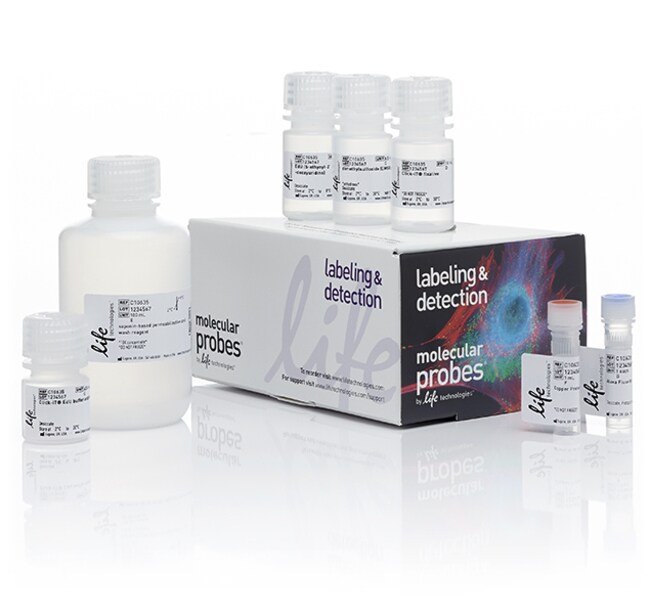
Click-iT™ Plus EdU Alexa Fluor™ 647 Flow Cytometry Assay Kit, 100 rxn(s)
The Click-iT® Plus EdU Alexa Fluor® 647 Flow Cytometry Assay Kit provides a simplified, more robust assay for analyzing DNA詳細を見る
| 製品番号(カタログ番号) | 数量 |
|---|---|
| C10635 | 100 assays |
製品番号(カタログ番号) C10635
価格(JPY)
238,400
Each
数量:
100 assays
The Click-iT® Plus EdU Alexa Fluor® 647 Flow Cytometry Assay Kit provides a simplified, more robust assay for analyzing DNA replication in proliferating cells compared to traditional BrdU methods. Newly synthesized DNA is analyzed using the 647 nm laser of the flow cytometer. The Click-iT® Plus formulation is compatible with standard fluorophores, including R-PE and R-PE tandems, as well as fluorescent proteins.
• Multiplexable—compatible with R-PE (and tandems) and fluorescent proteins
• Accurate—superior results compared to BrdU assays
• Fast—results in as little as 60 minutes
View selection guide for all Click-iT™ EdU and Click-iT™ Plus EdU assays for flow cytometry.
Multiplexable
The Click-iT® Plus formulation provides increased multiplexibility compared to the original Click-iT® EdU Flow Cytometry assays. Click-iT® Plus EdU assays can be used in conjunction with R-PE and R-PE tandems, as well as fluorescent proteins such as GFP and mCherry, without loss of the accuracy or speed of the original Click-iT® EdU assay.
An Advanced Method Giving You Results Superior to BrdU
The most accurate method of proliferation analysis is direct measurement of DNA synthesis. Originally, this was performed through incorporation of radioactive nucleosides. This method was replaced by antibody-based detection of the nucleoside analog bromodeoxyuridine (BrdU). The Click-iT® Plus EdU Flow Cytometry assay is a novel alternative to the BrdU assay. EdU (5-ethynyl-2´-deoxyuridine) is a thymidine analog that is incorporated into DNA during active DNA synthesis. Detection is based on click chemistry, which is a copper-catalyzed covalent reaction between an azide and an alkyne. In this application, the alkyne is found in the ethynyl moiety of EdU, while the azide is coupled to the Alexa Fluor® dye. Standard flow cytometry methods are used for determining the percentage of S-phase cells in the population.
Mild Conditions Allow Use with Cell Cycle Dyes and Antibodies
The small size of the dye azide allows for efficient detection of the incorporated EdU using mild conditions, while standard aldehyde-based fixation and detergent permeabilization are sufficient for the Click-iT® Plus detection reagent to gain access to the DNA. This is in contrast to BrdU assays that require DNA denaturation (using HCl, heat, or digestion with DNase) to expose the BrdU so that it can be detected with an anti-BrdU antibody. Sample processing for the BrdU assay can result in signal alteration of the cell cycle distribution, as well as destruction of antigen recognition sites when using the HCl method. In contrast, the easy-to-use Click-iT® Plus EdU assay is compatible with cell cycle dyes. The Click-iT® Plus EdU assay can also be multiplexed with antibodies against surface and intracellular markers, as well as conjugates labeled with standard fluorophores including R-PE, R-PE tandems, and fluorescent proteins (GFP and mCherry).
Quick and Simple Protocol
The Click-iT® Plus EdU protocol is based on the aldehyde fixation and detergent permeabilization steps for immunohistochemical antibody labeling. However, EdU is compatible with other fixation/permeabilization agents including saponin and methanol. In just five steps you’ll be ready to analyze your cell proliferation data:
1. Treat cells with EdU.
2. Fix and permeabilize cells.
3. Detect S-phase cells with Click-iT® Plus detection cocktail for 30 min.
4. Wash once.
5. Analyze.
Results can be seen in as little as 60 minutes in some circumstances, but we recommend 90 minutes for all applications.
• Multiplexable—compatible with R-PE (and tandems) and fluorescent proteins
• Accurate—superior results compared to BrdU assays
• Fast—results in as little as 60 minutes
View selection guide for all Click-iT™ EdU and Click-iT™ Plus EdU assays for flow cytometry.
Multiplexable
The Click-iT® Plus formulation provides increased multiplexibility compared to the original Click-iT® EdU Flow Cytometry assays. Click-iT® Plus EdU assays can be used in conjunction with R-PE and R-PE tandems, as well as fluorescent proteins such as GFP and mCherry, without loss of the accuracy or speed of the original Click-iT® EdU assay.
An Advanced Method Giving You Results Superior to BrdU
The most accurate method of proliferation analysis is direct measurement of DNA synthesis. Originally, this was performed through incorporation of radioactive nucleosides. This method was replaced by antibody-based detection of the nucleoside analog bromodeoxyuridine (BrdU). The Click-iT® Plus EdU Flow Cytometry assay is a novel alternative to the BrdU assay. EdU (5-ethynyl-2´-deoxyuridine) is a thymidine analog that is incorporated into DNA during active DNA synthesis. Detection is based on click chemistry, which is a copper-catalyzed covalent reaction between an azide and an alkyne. In this application, the alkyne is found in the ethynyl moiety of EdU, while the azide is coupled to the Alexa Fluor® dye. Standard flow cytometry methods are used for determining the percentage of S-phase cells in the population.
Mild Conditions Allow Use with Cell Cycle Dyes and Antibodies
The small size of the dye azide allows for efficient detection of the incorporated EdU using mild conditions, while standard aldehyde-based fixation and detergent permeabilization are sufficient for the Click-iT® Plus detection reagent to gain access to the DNA. This is in contrast to BrdU assays that require DNA denaturation (using HCl, heat, or digestion with DNase) to expose the BrdU so that it can be detected with an anti-BrdU antibody. Sample processing for the BrdU assay can result in signal alteration of the cell cycle distribution, as well as destruction of antigen recognition sites when using the HCl method. In contrast, the easy-to-use Click-iT® Plus EdU assay is compatible with cell cycle dyes. The Click-iT® Plus EdU assay can also be multiplexed with antibodies against surface and intracellular markers, as well as conjugates labeled with standard fluorophores including R-PE, R-PE tandems, and fluorescent proteins (GFP and mCherry).
Quick and Simple Protocol
The Click-iT® Plus EdU protocol is based on the aldehyde fixation and detergent permeabilization steps for immunohistochemical antibody labeling. However, EdU is compatible with other fixation/permeabilization agents including saponin and methanol. In just five steps you’ll be ready to analyze your cell proliferation data:
1. Treat cells with EdU.
2. Fix and permeabilize cells.
3. Detect S-phase cells with Click-iT® Plus detection cocktail for 30 min.
4. Wash once.
5. Analyze.
Results can be seen in as little as 60 minutes in some circumstances, but we recommend 90 minutes for all applications.
研究用途にのみご使用ください。診断目的には使用できません。
仕様
検出法Fluorescence
励起/発光650⁄670
フォーマットTube(s)
標識または色素Alexa Fluor™ 647
製品ラインClick-iT
数量100 assays
出荷条件Room Temperature
使用対象 (装置)フローサイトメーター
製品タイプAssay Kit
Unit SizeEach
組成および保存条件
Contains EdU (5-ethynyl-2' -deoxyuridine), Alexa Fluor™ 647 picolyl azide, anhydrous dimethylsulfoxide (DMSO), Click-iT™ fixative, Click-iT™ saponin-based permeabilization and wash buffer, Copper Protectant, and Click-iT™ EdU buffer additive.Store at 2°C to 8°C Dessicate and protect from light.
よくあるご質問(FAQ)
Click-iT® EdU kitを用いて 細胞増殖アッセイを行っています。 どのポイントで途中停止をかけられますか? あるいは、全てのステップを連続して行う必要がありますか?
Click-iT Plus EdU Imaging Kit は、今までの Click-iT EdU Imaging Kit と何が異なるのですか?
What is the fluorescence excitation and emission maxima of Alexa Fluor 647 dye?
What are the main characteristics of a Click-iT reaction?
I will be performing a cell proliferation assay using Click-iT EdU kit. At what point can I stop overnight, or do I have to perform all the steps continuously?
引用および参考文献 (3)
引用および参考文献
Abstract
Expression of CSF-1-receptor-related proteins in muscular stem cells.
Journal:Oncogene Res
PubMed ID:2524026
We previously reported that consistent levels of c-fms-related transcripts are expressed during the growth of rat myogenic cells as well as in all neoplastic myoblasts. The present study extends this observation to mouse myogenic cells and demonstrates that a tyrosine-kinase-associated gp170, very similar or identical to the receptor for the
A non-conserved miRNA regulates lysosomal function and impacts on a human lysosomal storage disorder.
Journal:
PubMed ID:25524633
Sulfatases are key enzymatic regulators of sulfate homeostasis with several biological functions including degradation of glycosaminoglycans (GAGs) and other macromolecules in lysosomes. In a severe lysosomal storage disorder, multiple sulfatase deficiency (MSD), global sulfatase activity is deficient due to mutations in the sulfatase-modifying factor 1 (SUMF1) gene, encoding the essential
A Genome-Wide Analysis Identifies a Notch-RBP-J?-IL-7Ra Axis That Controls IL-17-Producing ?d T Cell Homeostasis in Mice.
Journal:
PubMed ID:25429074
Notch signaling is an important regulator for the development and function of both aß and ?d T cells, whereas roles of Notch signaling in T cell maintenance remain unclear. We reported previously that the Notch-Hes1 pathway was involved in the intrathymic development of naturally occurring IL-17-producing (IL-17(+)) ?d T cells.