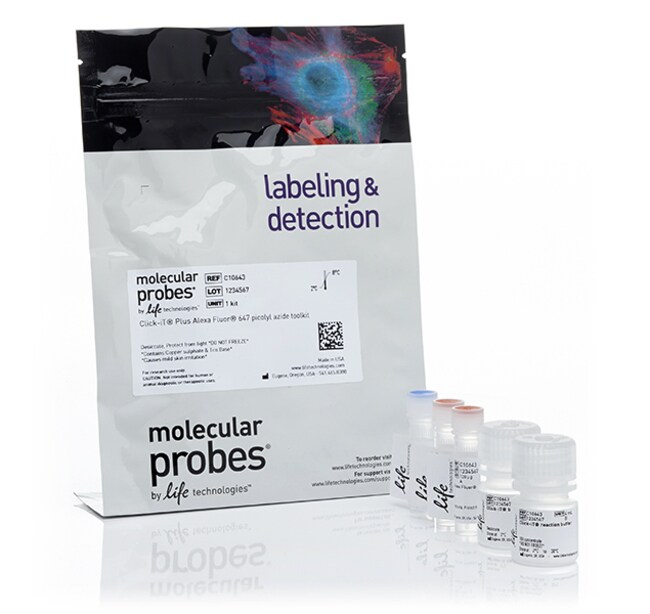
Click-iT™ Plus Alexa Fluor™ 647 Picolyl Azide Toolkit
Invitrogen™

Click-iT™ Plus Alexa Fluor™ 647 Picolyl Azide Toolkit

Click-it™ Plus Alexa Fluor™ピコリルアジドツールキットには、銅に敏感な化合物で銅触媒クリック反応を行うために必要なすべてのものが含まれており、標準的なアジド/アルキンクリック反応のすべての利点を備えています。ピコリルアジドはキレートされた銅と効率的に反応するため、クリック反応における遊離銅を最小限に抑え、タンパク質(GFP詳細を見る
製品番号(カタログ番号)数量
C106431キット
製品番号(カタログ番号) C10643
価格(JPY)
99,600
Each
お問い合わせください ›
数量:
1キット
Click-it™ Plus Alexa Fluor™ピコリルアジドツールキットには、銅に敏感な化合物で銅触媒クリック反応を行うために必要なすべてのものが含まれており、標準的なアジド/アルキンクリック反応のすべての利点を備えています。ピコリルアジドはキレートされた銅と効率的に反応するため、クリック反応における遊離銅を最小限に抑え、タンパク質(GFP、RPEなど)、核酸(RNA、オリゴなど)、さらに小分子(ファロイジンなど)による不要な銅側反応から保護します。

• 柔軟—in vitroまたは細胞および組織サンプル内のアルキン含有生体高分子の検出または標識のために、独自のClick–iT™反応を最適化
• 明るくて高感度—ピコリルアジドの効率性と組み合わせた、優れた蛍光Alexa Flour™色素
• 便利—最適なクリック反応を作成するために必要なバッファーと試薬を装備

各Click-iT™ Plusピコリルアジドツールキットには、100 µgのAlexa Fluor™色素ピコリルアジドと、クリックケミストリーベースの標識または検出アプリケーションで最適な銅およびキレート濃度の反応カクテルを作成するために必要なすべての試薬が含まれています。ピコリルアジド/アルキンのクリック反応を設計および最適化するためのガイドラインは、製品マニュアルに記載されています。さらに、Click-iT™ Plusピコリルアジドは、同一の反応条件を使用した標準的なアジドと比べて感度が向上し、反応時間が短縮されます。
研究用にのみ使用できます。診断用には使用いただけません。
仕様
概要Click-it™プラスAlexa Fluor™ 647ピコリルアジドツールキット、5 mg、固体、650 nm発光、670 nm励起、1年間の有効期限、2~8℃で保管、危険性の低いグリーン機能、標識化学に使用
励起/発光650/670
使用対象(アプリケーション)ラベリング化学, 細胞解析, クリックケミストリー, クリックケミストリーによる糖タンパク質分析, クリックケミストリーによる代謝標識および初期タンパク質合成, クリックケミストリーによる細胞増殖, 初期RNA検出およびクリック操作によるキャプチャー
フォーマット固体
キット内容1 x 100 μg Alexa Fluor™ 色素-ピコリルアジド、1 x 4 mL Click-It™ 反応バッファー、1 x 1.5 mL硫酸銅(II)、1 x 500 μL 銅保護剤、1 Click-It™ バッファー添加剤
製品ラインClick-iT
製品タイプClick-iT™ Plus Alexa Fluor™ 647 Picolyl Azide Toolkit
数量1キット
標識または色素Alexa Fluor 647
Unit SizeEach
組成および保存条件
  • 100 μg Alexa Fluor™ dye-picolyl azide x 1
  • 4 mL Click-iT™反応バッファー x 1
  • 1.5 mL銅(II)硫酸塩 x 1
  • 500 μL銅保護剤 x 1
  • Click-iT™バッファー添加剤 x 1
2℃~8℃で保存

よくあるご質問(FAQ)

What is the fluorescence excitation and emission maxima of Alexa Fluor 647 dye?

Alexa Fluor 647 has an excitation/emission maxima of 650/670 nm.

Find additional tips, troubleshooting help, and resources within our Cell Analysis Support Center.

What are the main characteristics of a Click-iT reaction?

Click reactions have several general characteristics: the reaction is efficient, no extreme temperatures or solvents are required, the reaction is complete within 30 minutes, the components of the reaction are bio-inert, and perhaps most importantly, no side reactions occur-the label and detection tags react selectively and specifically with one another. This final point is a key advantage of this powerful detection technique; it is possible to apply click chemistry-labeled molecules to complex biological samples and detect them with unprecedented sensitivity due to the extremely low background of the reaction.

Find additional tips, troubleshooting help, and resources within our Cell Analysis Support Center.

I will be performing a cell proliferation assay using Click-iT EdU kit. At what point can I stop overnight, or do I have to perform all the steps continuously?

One may store the sample after fixation overnight in PBS at 4oC. For longer storage (<1 week) , store in buffer with 1-2% formaldehyde or in formalin to limit microbial growth. If you use sodium azide as a microbial inhibitor, it must be completely removed prior to the Click-iT reaction.

Find additional tips, troubleshooting help, and resources within our Cell Viability, Proliferation, Cryopreservation, and Apoptosis Support Center.

Can I combine Click-iT or Click-iT Plus reactions with phalloidin conjugates used for actin staining?

We do not recommend using phalloidin conjugates for staining actin in combination with traditional Click-iT or Click-iT Plus reactions since phalloidin is extremely sensitive to the presence of copper.

For staining actin in combination with traditional Click-iT or Click-iT Plus reactions, we recommend using anti-α-actin antibodies for staining actin in the cytoskeleton. You can find a list of our actin antibodies here.

Another option would be to use the Click-iT Plus Alexa Fluor Picolyl Azide Toolkit (Cat. Nos. C10641, C10642, C10643). These Click-iT Plus toolkits provide Copper and Copper protectant separately which makes it easier to titrate the copper concentration to obtain optimal labeling with minimal copper-mediated damage. You may need to optimize the click reaction with the lowest possible concentration of copper and then perform the phalloidin staining.

Find additional tips, troubleshooting help, and resources within our Cell Analysis Support Center.