Search


Citations & References (658)
Invitrogen™
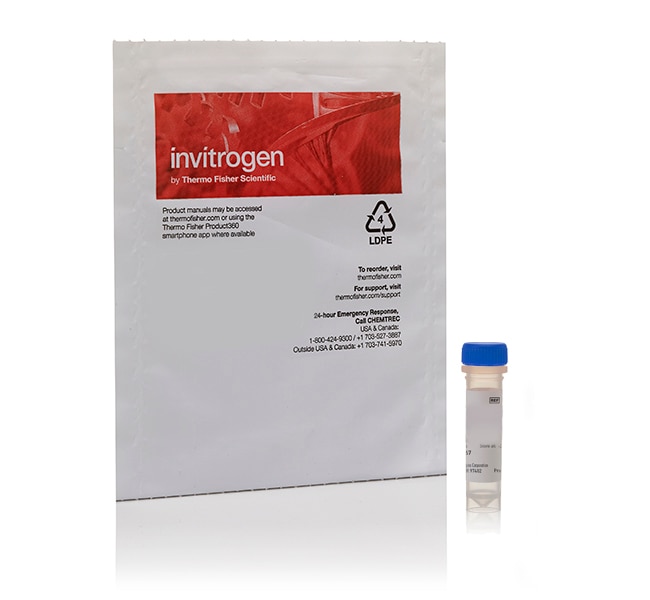
Calcein AM, Cell-permeant Green and Blue Dyes
Calcein AMは細胞を透過させる色素で、ほとんどの真核細胞における細胞生存率の測定に使用できます。生細胞では、非蛍光カルセインAMは、細胞内エステラーゼによるアセトキシメチルエステルの加水分解後に緑色蛍光カルセインに変換されます。この色素は、1 mgの固体(C-1430詳細を見る


製品番号(カタログ番号) C3099
価格(JPY)
86,400
Each
製品タイプ:
色素
数量:
1 mL
色:
Green
Calcein AMは細胞を透過させる色素で、ほとんどの真核細胞における細胞生存率の測定に使用できます。生細胞では、非蛍光カルセインAMは、細胞内エステラーゼによるアセトキシメチルエステルの加水分解後に緑色蛍光カルセインに変換されます。この色素は、1 mgの固体(C-1430)としても使用でき、DMSO(C-3099)で再懸濁します。この色素のより長い波長バージョンについては、新しいCellTraceカルセイン赤-オレンジAM(C-34851)をご確認ください。
研究用にのみ使用できます。診断用には使用いただけません。
仕様
細胞透過性Cell-permeant
濃度1 mg⁄ml
染色剤タイプその他の標識または色素
形状Solution in DMSO
数量1 mL
試薬タイプCell Tracker Compounds、Cell Labeling Reagents
出荷条件室温
標的酵素Esterase
色Green
放射波長範囲517
Excitation Wavelength Range494 nm
使用対象(アプリケーション)Cell Tracing, Cell Tracker
使用対象 (装置)Fluorescence Microscope
製品タイプ色素
Unit SizeEach
組成および保存条件
フリーザー(-5℃~-30℃)に保存。
よくあるご質問(FAQ)
I would like a dye to load in live cells such that it will self-quench at a high concentration, but if the cell dies, the dye will be released and unquenched. Do you have anything like that?
I need to load liposomes with calcein. Should I use the AM form or the non-AM form?
I want to do a cell migration study for around 4 hours and need to fluorescently label the cells with a dye. What do you recommend?
I am doing a Live/Dead assay using Calcein, AM, for live cells and ethidium homodimer-1 for dead cells. Can I fix the cells after labeling and retain the staining?
I need a general cytoplasmic stain that does not overlap with the GFP in my cells. What do you recommend?
引用および参考文献 (658)
引用および参考文献
Abstract
Nitric oxide mediates natural polyphenol-induced Bcl-2 down-regulation and activation of cell death in metastatic B16 melanoma.
Journal:The Journal of biological chemistry
PubMed ID:17135264
Cloning and expression of murine sister of P-glycoprotein reveals a more discriminating transporter than MDR1/P-glycoprotein.
Journal:Molecular pharmacology
PubMed ID:10617675
Deposition of laminin 5 by keratinocytes regulates integrin adhesion and signaling.
Journal:The Journal of biological chemistry
PubMed ID:10926936
Large-scale chemical dissection of mitochondrial function.
Journal:Nature biotechnology
PubMed ID:18297058
Mitochondrial oxidative phosphorylation (OXPHOS) is central to physiology and disease pathogenesis. To systematically investigate its activity and regulation, we performed a wide range of assays of OXPHOS physiology and nuclear and mitochondrial gene expression across 2490 chemical perturbations in muscle cells. Through mining of the resulting compendium, we discovered that:
Modification of the cytoplasmic domain of influenza virus hemagglutinin affects enlargement of the fusion pore.
Journal:Journal of virology
PubMed ID:10906206
The fusion activity of chimeras of influenza virus hemagglutinin (HA) (from A/fpv/Rostock/34; subtype H7) with the transmembrane domain (TM) and/or cytoplasmic tail (CT) either from the nonviral, nonfusogenic T-cell surface protein CD4 or from the fusogenic Sendai virus F-protein was studied. Wild-type or chimeric HA was expressed in CV-1 cells