Search


Citations & References (11)
Invitrogen™
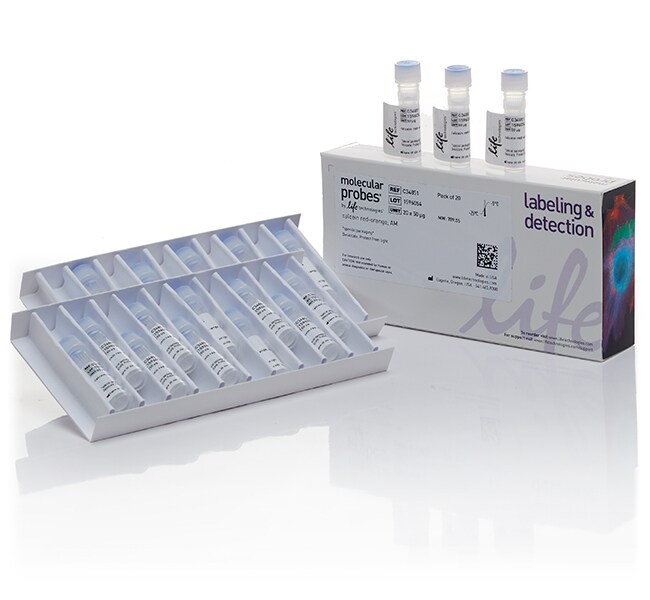
CellTrace™ Calcein Red-Orange, AM - Special Packaging
CellTrace™カルセインレッド-オレンジ、AM - 特殊パッケージ
| 製品番号(カタログ番号) | 数量 |
|---|---|
| C34851 | 20 x 50 μg |
製品番号(カタログ番号) C34851
価格(JPY)
96,800
Each
数量:
20 x 50 μg
CellTraceカルセインレッド-オレンジAMは細胞透過性の色素で、ほとんどの真核細胞における細胞生存率の測定に使用できます。カルセインAM(C-1430、C-3099、C-3100)とは異なり、CellTraceカルセインレッド-オレンジAMは本質的に蛍光です。したがって、細胞によって取り込まれない色素からのバックグラウンド蛍光を最小限に抑えるために、追加の洗浄ステップが必要になる場合があります。ただし、CellTraceカルセインレッド-オレンジ(577/590 nmの最大励起波長/最大発光波長)は、無傷の細胞膜を持つ生細胞に十分に保持されているため、細胞トレーサーや細胞生存率のインジケーターとして有用です。
研究用にのみ使用できます。診断用には使用いただけません。
仕様
細胞透過性Cell-permeant
概要Calcein, Red-Orange, AM - Special Packaging
染色剤タイプその他の標識または色素
形状凍結乾燥
数量20 x 50 μg
試薬タイプCell Tracker Compounds、Cell Labeling Reagents
出荷条件室温
標的酵素Esterase
放射波長範囲577⁄590
Excitation Wavelength Range577 nm
使用対象(アプリケーション)Cell Tracing, Cell Tracker
使用対象 (装置)Fluorescence Microscope
製品ラインCellTrace
製品タイプ色素
Unit SizeEach
組成および保存条件
CellTrace™カルセインレッド-オレンジ(凍結乾燥粉末)のバイアル20本入りです。フリーザー(-5℃~-30℃)に保存し、遮光してください。
よくあるご質問(FAQ)
I need a general cytoplasmic stain that does not overlap with the GFP in my cells. What do you recommend?
How do I reconstitute CellTrace Calcein Red-Orange, AM (Cat. No. C34851)?
I stained two populations of cells, one with CellTracker Green and the other with CellTracker Red, but it looks like there may be crossover of the red dye to the green cells. What is going on?
I stained my cells with Calcein, AM, but the signal went away after I fixed my cells. Why is this?
I'm trying to stain my cells with CellTracker dyes or CFDA SE, but I'm not seeing much signal. What can I do?
引用および参考文献 (11)
引用および参考文献
Abstract
T lymphocytes expressing a CD16 signaling receptor exert antibody-dependent cancer cell killing.
Journal:
PubMed ID:24197131
To expand applications for T-cell-based immunotherapy in cancer, we designed a receptor that binds the Fc portion of human immunoglobulins and delivers activation signals. The construct included the high-affinity CD16 (FCGR3A) V158 variant, CD8a hinge, and transmembrane domains, along with signaling domains from CD3? and 4-1BB (TNFRSF9), forming a chimeric
H2O2-induced endothelial NO production contributes to vascular cell apoptosis and increased permeability in rat venules.
Journal:Am J Physiol Heart Circ Physiol
PubMed ID:23086988
Although elevated levels of H(2)O(2) have been implicated to play important roles in the pathogenesis of various cardiovascular diseases, the underlying mechanisms remain unclear. This study aims to examine the effect of H(2)O(2) on endothelial nitric oxide (NO) production in intact venules, and elucidate the role and mechanisms of NO
Programmed reduction of ABC transporter activity in sea urchin germline progenitors.
Journal:Development
PubMed ID:22274698
ATP-binding cassette (ABC) transporters protect embryos and stem cells from mutagens and pump morphogens that control cell fate and migration. In this study, we measured dynamics of ABC transporter activity during formation of sea urchin embryonic cells necessary for the production of gametes, termed the small micromeres. Unexpectedly, we found
Connexin-43 upregulation in micrometastases and tumor vasculature and its role in tumor cell attachment to pulmonary endothelium.
Journal:BMC Med
PubMed ID:18647409
The modulation of gap junctional communication between tumor cells and between tumor and vascular endothelial cells during tumorigenesis and metastasis is complex. The notion of a role for loss of gap junctional intercellular communication in tumorigenesis and metastasis has been controversial. While some of the stages of tumorigenesis and metastasis,
The cellular mechanisms of neuronal swelling underlying cytotoxic edema.
Journal:
PubMed ID:25910210
Cytotoxic brain edema triggered by neuronal swelling is the chief cause of mortality following brain trauma and cerebral infarct. Using fluorescence lifetime imaging to analyze contributions of intracellular ionic changes in brain slices, we find that intense Na(+) entry triggers a secondary increase in intracellular Cl(-) that is required for