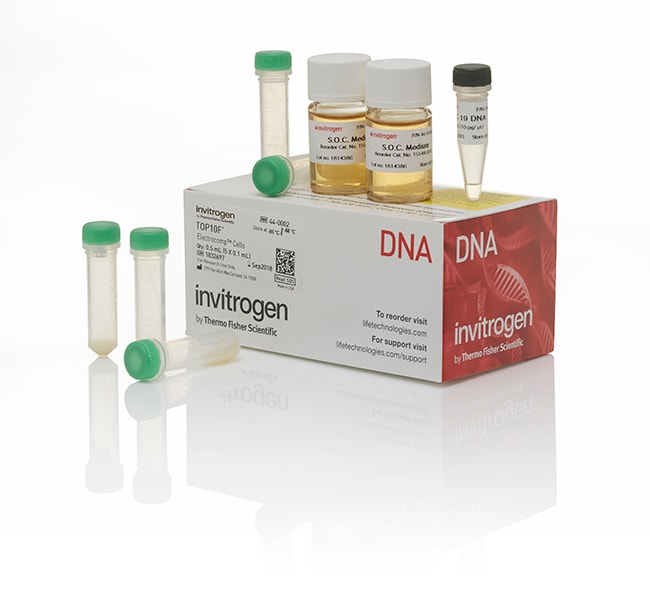
TOP10F' Electrocomp™ Kit
Invitrogen™

TOP10F' Electrocomp™ Kit

TOP10F'ジェノタイプは、F'エピソームを加えたTOP10と同一です。F'エピソームはテトラサイクリン耐性遺伝子を有し、複製元がf1であるベクターから1本鎖DNAを単離できます。さらに、F'には、IPTG を使用したtrc、tac、およびlacプロモーターからの誘導発現用のlacIqリプレッサーがあります詳細を見る
製品番号(カタログ番号)数量
C6651110 x 100 μL
製品番号(カタログ番号) C66511
価格(JPY)
59,300
Online offer
Ends: 26-Dec-2025
98,900
割引額 39,600 (40%)
Each
お問い合わせください ›
数量:
10 x 100 μL
TOP10F'ジェノタイプは、F'エピソームを加えたTOP10と同一です。F'エピソームはテトラサイクリン耐性遺伝子を有し、複製元がf1であるベクターから1本鎖DNAを単離できます。さらに、F'には、IPTG を使用したtrctac、およびlacプロモーターからの誘導発現用のlacIqリプレッサーがあります。TOP10F'では、青/白のカラースクリーニングにIPTG 誘導が必要です。

TOP10F' ジェノタイプは以下の特徴を備えています。

hsdR:PCR増幅から非メチル化DNAを効率的に形質転換
mcrA:ゲノム調製からメチル化DNAを効率的に形質転換
lacZΔM15:組換えクローンの青/白をカラースクリーニング
endA1:DNAをよりクリーンに調製。また、エンドヌクレアーゼIによる非特異的消化の除去によってし、下流アプリケーションでの結果を改善
recA1:クローンDNA中の非特異的な組換えの発生を低減
lacIqリプレッサー:trctac、およびlacプロモーターからの誘導発現用

注:このキットには、25 x 40 µL rxnsまたは50 x 20 µL rxns用の十分なエレクトロコンピテント細胞が含まれています。反応スケールの推奨事項については、製品マニュアルを参照してください。

ジェノタイプ:
F'{lacIqTn10(TetR)} mcrA Δ(mrr-hsdRMS-mcrBC) φ80lacZΔM15 ΔlacX74 recA1 araD139 Δ(ara-leu)7697 galU galK rpsL endA1 nupG
研究用途にのみご使用ください。診断目的には使用できません。
仕様
青/白スクリーニング
メチル化DNAのクローニング
不安定DNAのクローニング不安定なDNAのクローニングには不適
プラスミドの品質を向上
プラスミドプラスミド>20 kb に使用可能
非メチル化DNAの調製非メチル化DNAの調製には適していません
製品ラインElectrocomp
製品タイプElectrocompキット
数量10 x 100 μL
組換えを抑制
出荷条件Dry Ice
形質転換効率レベル高効率(> 10^9 cfu⁄μg)
フォーマットチューブ
E. coli
Unit SizeEach
組成および保存条件
このキットには、20 x 40 μL rxnsまたは40 x 20 μL rxns用の十分なエレクトロコンピテント細胞が含まれています。反応スケールの推奨事項については、製品マニュアルを参照してください。

よくあるご質問(FAQ)

What advantages do your Stbl2 cells offer over other cloning strains?

There are other strains available that may function similarly to Stbl2 cells in stabilizing inserts or vectors with repeated DNA sequences. However, one advantage of Stbl2 cells over many similar strains is that they are sensitive to Kanamycin, so you can use Stbl2 to propagate plasmids containing a Kanamycin resistance marker. 

How do you recommend that I prepare my DNA for successful electroporation of E. coli?

For best results, DNA used in electroporation must have a very low ionic strength and a high resistance. A high-salt DNA sample may be purified by either ethanol precipitation or dialysis.

The following suggested protocols are for ligation reactions of 20ul. The volumes may be adjusted to suit the amount being prepared.

Purifying DNA by Precipitation: Add 5 to 10 ug of tRNA to a 20ul ligation reaction. Adjust the solution to 2.5 M in ammonium acetate using a 7.5 M ammonium acetate stock solution. Mix well. Add two volumes of 100 % ethanol. Centrifuge at 12,000 x g for 15 min at 4C. Remove the supernatant with a micropipet. Wash the pellet with 60ul of 70% ethanol. Centrifuge at 12,000 x g for 15 min at room temperature. Remove the supernatant with a micropipet. Air dry the pellet. Resuspend the DNA in 0.5X TE buffer [5 mM Tris-HCl, 0.5 mM EDTA (pH 7.5)] to a concentration of 10 ng/ul of DNA. Use 1 ul per transformation of 20 ul of cell suspension.

Purifying DNA by Microdialysis: Float a Millipore filter, type VS 0.025 um, on a pool of 0.5X TE buffer (or 10% glycerol) in a small plastic container. Place 20ul of the DNA solution as a drop on top of the filter. Incubate at room temperature for several hours. Withdraw the DNA drop from the filter and place it in a polypropylene microcentrifuge tube. Use 1ul of this DNA for each electrotransformation reaction.

Can encapsulated phagemid DNA or M13 phage be used to infect bacteria?

Single-stranded DNA viral particles like M13 require the presence of an F pilus in order to infect E. coli. This criterion is met by TOP10F', DH5? F'IQ, INV?F', Stbl4, OmniMAX2-T1 and DH12S cells. These cells are not traD mutants, which effectively allows the cells to retain the F' episome. Transforming single-stranded DNA can cause a 100- to 1,000-fold reduction in efficiency compared to viral particles.

When should DMSO, formamide, glycerol and other cosolvents be used in PCR?

Cosolvents may be used when there is a failure of amplification, either because the template contains stable hairpin-loops or the region of amplification is GC-rich. Keep in mind that all of these cosolvents have the effect of lowering enzyme activity, which will decrease amplification yield. For more information see P Landre et al (1995). The use of co-solvents to enhance amplification by the polymerase chain reaction. In: PCR Strategies, edited by MA Innis, DH Gelfand, JJ Sninsky. Academic Press, San Diego, CA, pp. 3-16.

Additionally, when amplifying very long PCR fragments (greater than 5 kb) the use of cosolvents is often recommended to help compensate for the increased melting temperature of these fragments.

Find additional tips, troubleshooting help, and resources within our PCR and cDNA Synthesis Support Center.