Search


Citations & References (8)
Invitrogen™
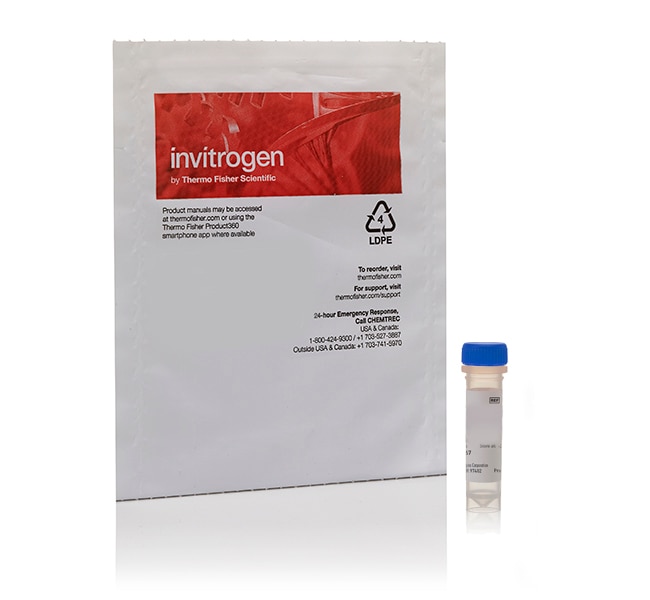
ChromaTide™ Texas Red™-12-dUTP
Molecular Probes™ ChromaTide™色素標識dUTP、OBEA-dCTP、およびUTPヌクレオチドは、有害で高価な放射性同位体標識ヌクレオチドを必要とせずに、標識DNAプローブを合成するために使用できます。これらのヌクレオチドは、標準的な分子生物学テクノロジーを使用して組み込むことができます。標識プローブはその後詳細を見る
| 製品番号(カタログ番号) | 数量 |
|---|---|
| C7631 | 25 μL |
製品番号(カタログ番号) C7631
価格(JPY)
81,900
온라인 행사
Ends: 25-Dec-2026
136,500割引額 54,600 (40%)
Each
数量:
25 μL
Molecular Probes™ ChromaTide™色素標識dUTP、OBEA-dCTP、およびUTPヌクレオチドは、有害で高価な放射性同位体標識ヌクレオチドを必要とせずに、標識DNAプローブを合成するために使用できます。これらのヌクレオチドは、標準的な分子生物学テクノロジーを使用して組み込むことができます。標識プローブはその後、in situハイブリダイゼーション、マイクロアレイ、またはブロッティングプロトコルに使用できます。ChromaTide™色素標識ヌクレオチドは、さまざまな蛍光色で提供されており、マルチカラー分析を容易にします。
ChromaTide™標識ヌクレオチドの仕様:
•色素の励起/発光:Texas Red™-12-dUTP(595/615 nm)
• アルキルアミノリンカーの長さ:12つの原子
ChromaTideヌクレオチドをプローブに組み込む方法
• ニックトランスレーション
• ランダムプライマー標識化
• 末端デオキシヌクレオチド転移酵素による末端の標識化
• 逆転写酵素
• PCR増幅
これらの各方法に固有のガイドラインについては、ChromaTide™ dUTPの酵素的組み込み法を参照してください。
Alexa Fluor™およびBODIPY™蛍光色素が高度なプローブを実現
標識ヌクレオチドで作成されたプローブは、in situハイブリダイゼーションやアレイへのハイブリダイゼーションなどのマルチカラーテクノロジーに使用できます。当社独自のBODIPY™およびAlexa Fluor™色素コンジュゲートは、非常に明るく、光安定性が高く、本質的にpHに影響しません。BODIPY™色素の狭い発光プロファイルは、スペクトルのオーバーラップを最小限に抑えます。Alexa Fluor™色素は、これらから作成されるDNAプローブと同様に水溶性が高く、蛍光in situハイブリダイゼーションに最適な標識です。
長いリンカーにより性能が向上
ChromaTide™ dUTPおよびUTPヌクレオチドは、独自のアルキルアミノリンカーを介して、ウリジンのC-5位置で修飾されます。これによって、ヌクレオチドと色素の間にスペーサーが提供され、それらの相互作用が低減します。製品名の数字(例えば、fluorescein-12-dUTPの“12”)は、原子におけるスペーサーの正味長を示します。これらのスペーサーにより、二次検出試薬のコンジュゲートが明るくなり、ハプテンへのアクセス性が向上します。
当社のChromaTide™試薬の完全なリストについては、以下をご覧ください。Molecular Probes ChromaTide™およびAHA標識ヌクレオチド—表8.5
これらの標識試薬の詳細については、Molecular Probes™ハンドブックのオリゴヌクレオチドと核酸の標識化—セクション 8.2を参照してください。
研究用途にのみご使用ください。ヒトまたは動物の治療もしくは診断用には使用できません。
ChromaTide™標識ヌクレオチドの仕様:
•色素の励起/発光:Texas Red™-12-dUTP(595/615 nm)
• アルキルアミノリンカーの長さ:12つの原子
ChromaTideヌクレオチドをプローブに組み込む方法
• ニックトランスレーション
• ランダムプライマー標識化
• 末端デオキシヌクレオチド転移酵素による末端の標識化
• 逆転写酵素
• PCR増幅
これらの各方法に固有のガイドラインについては、ChromaTide™ dUTPの酵素的組み込み法を参照してください。
Alexa Fluor™およびBODIPY™蛍光色素が高度なプローブを実現
標識ヌクレオチドで作成されたプローブは、in situハイブリダイゼーションやアレイへのハイブリダイゼーションなどのマルチカラーテクノロジーに使用できます。当社独自のBODIPY™およびAlexa Fluor™色素コンジュゲートは、非常に明るく、光安定性が高く、本質的にpHに影響しません。BODIPY™色素の狭い発光プロファイルは、スペクトルのオーバーラップを最小限に抑えます。Alexa Fluor™色素は、これらから作成されるDNAプローブと同様に水溶性が高く、蛍光in situハイブリダイゼーションに最適な標識です。
長いリンカーにより性能が向上
ChromaTide™ dUTPおよびUTPヌクレオチドは、独自のアルキルアミノリンカーを介して、ウリジンのC-5位置で修飾されます。これによって、ヌクレオチドと色素の間にスペーサーが提供され、それらの相互作用が低減します。製品名の数字(例えば、fluorescein-12-dUTPの“12”)は、原子におけるスペーサーの正味長を示します。これらのスペーサーにより、二次検出試薬のコンジュゲートが明るくなり、ハプテンへのアクセス性が向上します。
当社のChromaTide™試薬の完全なリストについては、以下をご覧ください。Molecular Probes ChromaTide™およびAHA標識ヌクレオチド—表8.5
これらの標識試薬の詳細については、Molecular Probes™ハンドブックのオリゴヌクレオチドと核酸の標識化—セクション 8.2を参照してください。
研究用途にのみご使用ください。ヒトまたは動物の治療もしくは診断用には使用できません。
研究用にのみ使用できます。診断用には使用いただけません。
仕様
標識法直接標識
標識または色素Texas Red™
数量25 μL
出荷条件湿氷
濃度1 mM
製品ラインChromaTide、Texas Red, Texas Red
Unit SizeEach
組成および保存条件
フリーザー(-5∼-30度)に保存し、遮光してください。
よくあるご質問(FAQ)
I'm getting high background after labeling with ChromaTide nucleotides. What do you recommend I do?
The nucleic acid probe is not fluorescent after labeling with ChromaTide nucleotides. What do you recommend I try?
Can ChromaTide nucleotides be used for labeling nucleic acids in live cells?
How do I determine the incorporation efficiency of the ChromaTide Labeling Nucleotides after enzymatic incorporation?
What is the average dye to base incorporation rate when enzymatically incorporating ChromaTide nucleotides?
引用および参考文献 (8)
引用および参考文献
Abstract
Condensation of plasmid DNA with polylysine improves liposome-mediated gene transfer into established and primary muscle cells.
Journal:Gene Ther
PubMed ID:9156800
'Cationic liposomes provide a means to introduce genes into cells both ex vivo and in vivo. In the past few years their use has been described in several tissues, e.g. lungs, liver, endothelium, brain. In this study we evaluated a commercially available poly-cationic liposome formulation in delivering a reporter gene
Inheritance of a pre-inactivated paternal X chromosome in early mouse embryos.
Journal:Nature
PubMed ID:14661031
'In mammals, dosage compensation ensures equal X-chromosome expression between males (XY) and females (XX) by transcriptionally silencing one X chromosome in XX embryos. In the prevailing view, the XX zygote inherits two active X chromosomes, one each from the mother and father, and X inactivation does not occur until after
Substantial background reduction in ligase-based apoptosis detection using newly designed hairpin oligonucleotide probes.
Journal:Biotechniques
PubMed ID:10631490
DNA methylation promotes Aurora-B-driven phosphorylation of histone H3 in chromosomal subdomains.
Journal:J Cell Sci
PubMed ID:17164288
Confinement of enzymatic reactions to nuclear and chromosomal subdomains regulates functional organization of the nucleus. Aurora-B kinase regulates cell-cycle-dependent phosphorylation of chromosomal substrates through sequential localization to a series of sites on chromosomes and the mitotic spindle. In G2 nuclei, Aurora-B recruitment to heterochromatin restricts histone H3S10 phosphorylation to a
Spectral karyotyping combined with locus-specific FISH simultaneously defines genes and chromosomes involved in chromosomal translocations.
Journal:Genes Chromosomes Cancer
PubMed ID:10719373
Genes that play roles in malignant transformation have often been found proximate to cancer-associated chromosomal breakpoints. Identifying genes that flank chromosomal reconfigurations is thus essential for cancer cytogenetics. To simplify and expedite this identification, we have developed a novel approach, based on simultaneous spectral karyotyping and fluorescence in situ hybridization