Search


Citations & References (22)
Invitrogen™
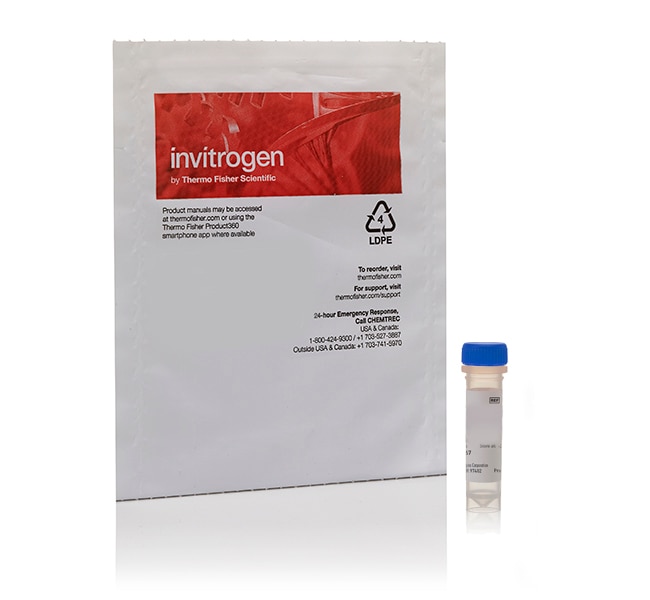
DQ™ Collagen, type I From Bovine Skin, Fluorescein Conjugate
天然基質の類似体
| 製品番号(カタログ番号) | 数量 |
|---|---|
| D12060 | 1 mg |
製品番号(カタログ番号) D12060
価格(JPY)
57,200
Online offer
Ends: 25-Sep-2026
81,800割引額 24,600 (30%)
Each
数量:
1 mg
蛍光性のあるDQ™コラーゲンは、コラーゲンの活性を直接モニタリングする目的で使用できます。DQ™基質は天然基質の類似体であり、蛍光シグナルがほとんど存在しなくなるように、過剰な数の蛍光色素が結合されています。このようなシグナルの消光効果は、インタクトな基質上の色素が近接していることが原因で発生します。酵素作用によって基質が加水分解されると色素が互いに分離し、蛍光シグナルが増加します。
研究用にのみ使用できます。診断用には使用いただけません。
仕様
製品ラインDQ
数量1 mg
出荷条件室温
基質プロテアーゼ基質
検出法蛍光
形状凍結乾燥
Substrate Propertiesタンパク質ベースの基質
Target Enzymeメタロプロテイナーゼ
Unit SizeEach
組成および保存条件
フリーザー(-5~-30度)に保存し、遮光してください。
引用および参考文献 (22)
引用および参考文献
Abstract
The roles of substrate thermal stability and P2 and P1' subsite identity on matrix metalloproteinase triple-helical peptidase activity and collagen specificity.
Journal:J Biol Chem
PubMed ID:17065155
'The hydrolysis of collagen (collagenolysis) is one of the committed steps in extracellular matrix turnover. Within the matrix metalloproteinase (MMP) family distinct preferences for collagen types are seen. The substrate determinants that may guide these specificities are unknown. In this study, we have utilized 12 triple-helical substrates in combination with
Type I collagen contains at least 14 cryptic fibronectin binding sites of similar affinity.
Journal:Arch Biochem Biophys
PubMed ID:12413494
'There is uncertainty in the literature regarding the number and location of fibronectin binding sites on denatured collagen. Although most attention has focused on a single site near the collagenase-sensitive region of each alpha chain, there is evidence for additional sites in other regions. We treated bovine type I collagen
TGF-beta1 + EGF-initiated invasive potential in transformed human keratinocytes is coupled to a plasmin/MMP-10/MMP-1-dependent collagen remodeling axis: role for PAI-1.
Journal:Cancer Res
PubMed ID:19383899
'The phenotypic switching called epithelial-to-mesenchymal transition is frequently associated with epithelial tumor cell progression from a comparatively benign to an aggressive, invasive malignancy. Coincident with the emergence of such cellular plasticity is an altered response to transforming growth factor-beta (TGF-beta) as well as epidermal growth factor (EGF) receptor amplification. TGF-beta
Vascular endothelial growth factor-C and C-C chemokine receptor 7 in tumor cell-lymphatic cross-talk promote invasive phenotype.
Journal:Cancer Res
PubMed ID:19118020
'Most carcinomas spread to distant sites through lymphatic vessels. Several preclinical and clinical studies have shown a positive correlation between the incidence of lymph node metastasis and secretion of the lymphatic growth factor vascular endothelial growth factor-C (VEGF-C) by tumor cells, suggesting tumor lymphangiogenesis as an escape mechanism. However, recent
Metabolic mapping of proteinase activity with emphasis on in situ zymography of gelatinases: review and protocols.
Journal:J Histochem Cytochem
PubMed ID:15150280
'Proteases are essential for protein catabolism, regulation of a wide range of biological processes, and in the pathogenesis of many diseases. Several techniques are available to localize activity of proteases in tissue sections or cell preparations. For localization of the activity of matrix metalloproteinases, in situ zymography was introduced some