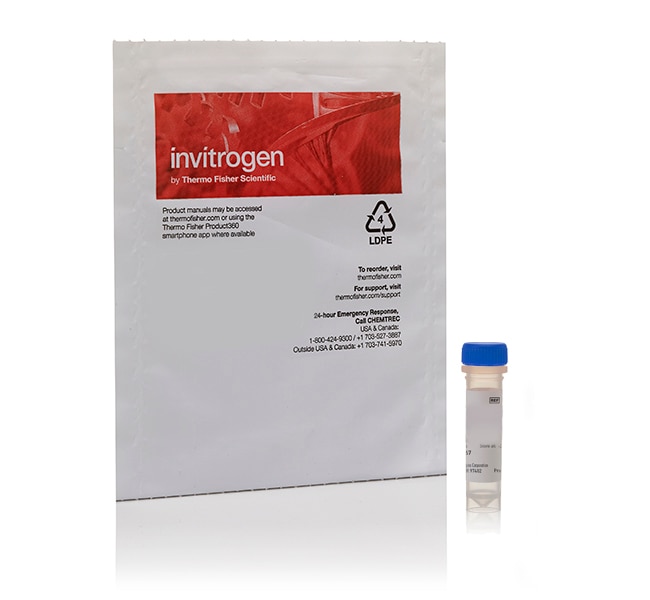
EU (5-Ethynyl Uridine)
Invitrogen™

EU (5-Ethynyl Uridine)

修飾ヌクレオチドであるエチニルウリジン(EU)(E10345)を使用して、またはClick-iT新生RNAキャプチャキット(C-10365)を使用して、in vitroとin詳細を見る
製品番号(カタログ番号)数量
E103455 mg
製品番号(カタログ番号) E10345
価格(JPY)
40,000
온라인 행사
Ends: 27-Mar-2026
66,700
割引額 26,700 (40%)
Each
お問い合わせください ›
数量:
5 mg
修飾ヌクレオチドであるエチニルウリジン(EU)(E10345)を使用して、またはClick-iT新生RNAキャプチャキット(C-10365)を使用して、in vitroとin vivoの両方でRNA転写全体を時間的、空間的に検出できます。
どちらのアプローチでも、強力なクリックケミストリー検出による、シンプルで堅牢な2ステップの技術を使用します。最初のステップでは、アルキンを含む生体高分子が細胞または動物に投与され、RNA内に積極的に取り込まれます。次の検出ステップでは、アジドとアルキン間の化学選択的ライゲーション、いわゆるクリック反応を利用します。この反応では、Click-iT™細胞反応バッファーキットを使用することで、対応するアジド含有色素またはハプテンで標識された修飾タンパク質が検出されます。細胞の分析には、蛍光顕微鏡、フローサイトメトリー、またはハイコンテントイメージングおよび分析(HCS)を使用できます。
Click-iT新生RNAキャプチャキットを使用すると、新生RNAプールを単離し、RNAシーケンス、ΔCT、RNAターンオーバー、核のランオンおよびランオフアッセイ、アレイ解析など、さまざまなトランスクリプトーム解析を実施できます。Click-iT新生RNAキャプチャキットの詳細については、 こちらをクリックしてください。
研究用にのみ使用できます。診断用には使用いただけません。
仕様
標識法RNAラベリング
標識または色素EU
製品タイプEU(5-エチニルウリジン)
数量5 mg
出荷条件室温
製品ラインClick-iT、Molecular Probes, Molecular Probes
Unit SizeEach
組成および保存条件
≦-20℃で保存n

よくあるご質問(FAQ)

I am observing no signal or very low specific signal for my click-labeled samples. What can I do to improve the signal?

The click reaction is only effective when copper is in the appropriate valency. Azides and alkynes will not react with each other without copper. Make sure that the click reaction mixture is used immediately after preparation when the copper (II) concentration is at its highest.
Do not use additive buffer that has turned yellow; it must be colorless to be active.
Cells need to be adequately fixed and permeabilized for the TdT enzyme and click reagents to have access to the nucleus. Tissue samples require digestion with proteinase K or other proteolytic enzymes for sufficient TdT access.
Some reagents can bind copper and reduce its effective concentration available to catalyze the click reaction. Do not include any metal chelator (e.g., EDTA, EGTA, citrate, etc.) in any buffer or reagent prior to the click reaction. Avoid buffers or reagents that include other metal ions that may be o xidized or reduced. It may be help to include extra wash steps on the cell or tissue sample before performing the click reaction.
You can repeat the click reaction with fresh reagents to try to improve signal. Increasing the click reaction time longer than 30 minutes will not improve a low signal. Performing a second, 30 minute incubation with fresh click reaction reagents is more effective at improving labeling.
Your cells may not be apoptotic. Prepare a DNase I-treated positive control to verify that the TdT enzymatic reaction and click labeling reaction are working correctly.

Find additional tips, troubleshooting help, and resources within our Labeling Chemistry Support Center.

I am observing high non-specific background when I image my Click-iT EdU TUNEL-labeled samples. What is causing this and what can I do to reduce the background?

The click reaction is very selective between an azide and alkyne. No other side reactions are possible in a biological system. Any non-specific background is due to non-covalent binding of the dye to various cellular components. The Select FX Signal Enhancer is not effective at reducing non-specific charge-based binding of dyes following the click reaction; we do not recommend its use with the Click-iT detection reagents. The best method to reduce background is to increase the number of BSA washes. You should always do a no-dye or no-click reaction control under the same processing and detection conditions to verify that the background is actually due to the dye and not autofluorescence. You should also perform the complete click reaction on a no-TdT enzyme control sample to verify the specificity of the click reaction signal.

Find additional tips, troubleshooting help, and resources within our Cell Analysis Support Center.

I notice that when I post-stain my cells with DAPI after performing the click reaction to detect EdU incorporation, my DAPI signal is lower compared to my no-click reaction control samples. What causes the reduction in DAPI signal?

The copper in the click reaction denatures DNA to a small extent (although not as much as is required for efficient BrdU detection), which can affect the binding affinity of DNA dyes including DAPI and Hoechst stain. This effect should only be apparent with the classic EdU kits and not the Click-iT Plus EdU kits, which use a lower copper concentration.

Find additional tips, troubleshooting help, and resources within our Cell Viability, Proliferation, Cryopreservation, and Apoptosis Support Center.

I am observing no signal or very low signal for my click-labeled samples. What can I do to improve the signal?

The click reaction is only effective when copper is in the appropriate valency. Except for the DIBO alkyne-azide reaction, azides and alkynes will not react with each other without copper. Make sure that the click reaction mixture is used immediately after preparation when the copper (II) concentration is at its highest.
Do not use additive buffer that has turned yellow; it must be colorless to be active.
Cells need to be adequately fixed and permeabilized for the click reagents to have access to intracellular components that have incorporated the click substrate(s).
Some reagents can bind copper and reduce its effective concentration available to catalyze the click reaction. Do not include any metal chelator (e.g., EDTA, EGTA, citrate, etc.) in any buffer or reagent prior to the click reaction. Avoid buffers or reagents that include other metal ions that may be oxidized or reduced. It may be help to include extra wash steps on the cell or tissue sample before performing the click reaction.
You can repeat the click reaction with fresh reagents to try to improve signal. Increasing the click reaction time longer than 30 minutes will not improve a low signal. Performing a second, 30 minute incubation with fresh click reaction reagents is more effective at improving labeling.
Low signal can also be due to low incorporation of EdU, EU, or other click substrates. Other click substrates (e.g., AHA, HPG, palmitic acid, azide, etc.) incorporated into cellular components may have been lost if not adequately cross-linked in place or if the wrong fixative was used. For click substrates that are incorporated into the membrane or lipids, you should avoid the use of alcohol or acetone fixatives and permeabilizing agents.
The incorporated click substrate must be accessible at the time of the click reaction; labeling of incorporated amino acid analogs may be lower in native proteins relative to denatured proteins.
You may need to optimize the metabolic labeling conditions including analog incubation time or concentration. Cells that are healthy, not too high of a passage number and not too crowded may incorporate the analog better. You may create a positive control by including extra doses of the click substrate during multiple time points during an incubation time that spans or closely spans the doubling time of the cell type of interest.

Find additional tips, troubleshooting help, and resources within our Cell Analysis Support Center.

I am observing high background when I analyze my click-labeled samples. What is causing this and what can I do to reduce the background?

The click reaction is very selective between an azide and alkyne. No other side reactions are possible in a biological system. Any non-specific background is due to non-covalent binding of the dye to various cellular components. The Select FX Signal Enhancer is not effective at reducing non-specific charge-based binding of dyes following the click reaction; we do not recommend its use with the Click-iT detection reagents. The best method to reduce background is to increase the number of BSA washes. You should always do a no-dye or no-click reaction control under the same processing and detection conditions to verify that the background is actually due to the dye and not autofluorescence. You can also perform the complete click reaction on a carrier solvent-only, no EdU or no-EU control to verify the specificity of the click reaction signal.

Find additional tips, troubleshooting help, and resources within our Cell Viability, Proliferation, Cryopreservation, and Apoptosis Support Center.

引用および参考文献 (14)

引用および参考文献
Abstract
EU-RNA-seq for in vivo labeling and high throughput sequencing of nascent transcripts.
Authors:Palozola KC,Donahue G,Zaret KS
Journal:STAR protocols
PubMed ID:34485932
The protocol allows for labeling nascent RNA without isolating nuclei. The cell-permeable uridine analog, 5-ethynyluridine (EU), is added to media to allow in vivo labeling of nascent transcripts. Cells are lysed, total RNA is collected, and biotin is conjugated to EU-labeled RNAs. Custom biotin RNAs are added and biotinylated RNAs ... More
METTL14 is a chromatin regulator independent of its RNA N6-methyladenosine methyltransferase activity.
Authors:Dou X,Huang L,Xiao Y,Liu C,Li Y,Zhang X,Yu L,Zhao R,Yang L,Chen C,Yu X,Gao B,Qi M,Gao Y,Shen B,Sun S,He C,Liu J
Journal:Protein & cell
PubMed ID:37030005
METTL3 and METTL14 are two components that form the core heterodimer of the main RNA m6A methyltransferase complex (MTC) that installs m6A. Surprisingly, depletion of METTL3 or METTL14 displayed distinct effects on stemness maintenance of mouse embryonic stem cell (mESC). While comparable global hypo-methylation in RNA m6A was observed in ... More
Exploring RNA transcription and turnover in vivo by using click chemistry.
Authors:Jao CY, Salic A,
Journal:Proc Natl Acad Sci U S A
PubMed ID:18840688
We describe a chemical method to detect RNA synthesis in cells, based on the biosynthetic incorporation of the uridine analog 5-ethynyluridine (EU) into newly transcribed RNA, on average once every 35 uridine residues in total RNA. EU-labeled cellular RNA is detected quickly and with high sensitivity by using a copper ... More
Topoisomerase IIß deficiency enhances camptothecin-induced apoptosis.
Authors:Lin RK, Ho CW, Liu LF, Lyu YL,
Journal:J Biol Chem
PubMed ID:23344961
Camptothecin (CPT), a topoisomerase (Top) I-targeting drug that stabilizes Top1-DNA covalent adducts, can induce S-phase-specific cytotoxicity due to the arrest of progressing replication forks. However, CPT-induced non-S-phase cytotoxicity is less well characterized. In this study, we have identified topoisomerase IIß (Top2ß) as a specific determinant for CPT sensitivity, but not ... More
Click chemistry and bioorthogonal reactions: unprecedented selectivity in the labeling of biological molecules.
Authors:Best MD,
Journal:Biochemistry
PubMed ID:19485420
In recent years, a number of bioorthogonal reactions have been developed, exemplified by click chemistry, that enable the efficient formation of a specific product, even within a highly complex chemical environment. While the exquisite selectivity and reliability of these transformations have led to their broad application in diverse research areas, ... More