Search


Citations & References (4)
Invitrogen™
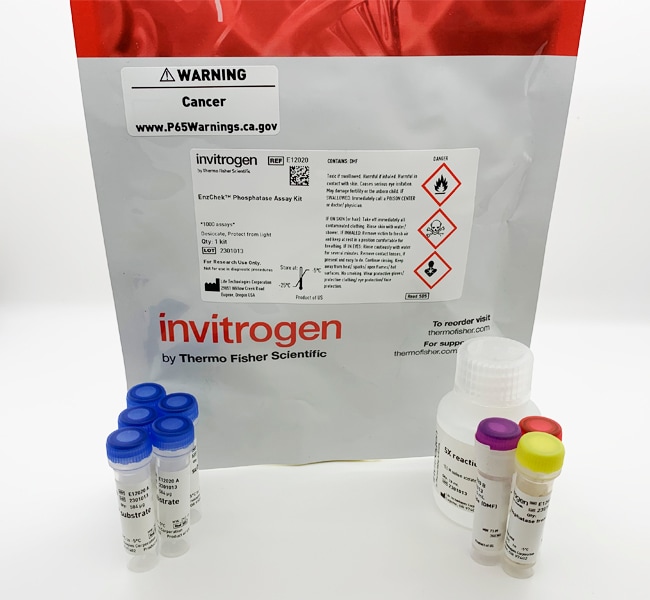
EnzChek™ Phosphatase Assay Kit
EnzChekホスファターゼアッセイキットを使用すると、中性または酸性pHでもホスファターゼ活性の連続モニタリングが可能です。このキットには、Molecular Probesの特許取得済み6,8-ジフルオロ-4-メチルウンベリフェリルリン酸(DiFMUP)基質(D6567)が含まれています。DiFMUPは詳細を見る
| 製品番号(カタログ番号) | 数量 |
|---|---|
| E12020 | 1000 Assays |
製品番号(カタログ番号) E12020
価格(JPY)
42,200
Offre exceptionnelle en ligne
Ends: 25-Sep-2026
70,400割引額 28,200 (40%)
Each
数量:
1000 Assays
EnzChekホスファターゼアッセイキットを使用すると、中性または酸性pHでもホスファターゼ活性の連続モニタリングが可能です。このキットには、Molecular Probesの特許取得済み6,8-ジフルオロ-4-メチルウンベリフェリルリン酸(DiFMUP)基質(D6567)が含まれています。DiFMUPは、pH 5.5での前立腺酸性ホスファターゼにおいて、4-メチルウンベリフェリルリン酸(MUP)の約100倍の感度を示します。このキットは、前立腺酸性ホスファターゼやタンパク質ホスファターゼ1のほか、MUPや4-ニトロフェニルリン酸(PNPP)などの非タンパク質ベースの基質を使用してアッセイできるほぼすべてのホスファターゼの連続アッセイに最適です。各キットには、アッセイあたり100 μLの反応量を使用した場合に、約1,000回分のアッセイに対応できる基質が含まれています。蛍光強度(最大励起/最大発光は約358/455 nm)は、蛍光マイクロプレートリーダーまたは標準的なフルオロメーターで測定できます。
研究用にのみ使用できます。診断用には使用いただけません。
仕様
検出法蛍光
染色剤タイプDiFMU
数量1000 Assays
出荷条件室温
基質DiFMUP
基質特性化学基質
基質タイプホスファターゼ基質
標的酵素ホスファターゼ
色青色
放射波長範囲360⁄460
使用対象(アプリケーション)ホスファターゼアッセイ
使用対象 (装置)マイクロプレートリーダー
製品ラインEnzChek
製品タイプホスファターゼアッセイ
Unit SizeEach
組成および保存条件
フリーザー(-5°C~-30°C)に保存し、遮光してください。
よくあるご質問(FAQ)
What is the reaction product excitation/emission maxima when using the EnzChek Phosphatase Assay kit?
引用および参考文献 (4)
引用および参考文献
Abstract
Plectin scaffolds recruit energy-controlling AMP-activated protein kinase (AMPK) in differentiated myofibres.
Journal:J Cell Sci
PubMed ID:16608880
'Plectin, a cytolinker protein greater than 500 kDa in size, has an important role as a mechanical stabiliser of cells. It interlinks the various cytoskeletal filament systems and anchors intermediate filaments to peripheral junctional complexes. In addition, there is increasing evidence that plectin acts as a scaffolding platform that controls
The Down syndrome critical region protein RCAN1 regulates long-term potentiation and memory via inhibition of phosphatase signaling.
Journal:J Neurosci
PubMed ID:18045910
'Regulator of calcineurin 1 (RCAN1/MCIP1/DSCR1) regulates the calmodulin-dependent phosphatase calcineurin. Because it is located on human chromosome 21, RCAN1 has been postulated to contribute to mental retardation in Down syndrome and has been reported to be associated with neuronal degeneration in Alzheimer''s disease. The studies herein are the first to
Adenovirus-facilitated nuclear translocation of adeno-associated virus type 2.
Journal:J Virol
PubMed ID:12388712
'We examined cytoplasmic trafficking and nuclear translocation of adeno-associated virus type 2 (AAV) by using Alexa Fluor 488-conjugated wild-type AAV, A20 monoclonal antibody immunocytochemistry, and subcellular fractionation techniques followed by DNA hybridization. Our results indicated that in the absence of adenovirus (Ad), AAV enters the cell rapidly and escapes from
Redox modulation of global phosphatase activity and protein phosphorylation in intact skeletal muscle.
Journal:J Physiol
PubMed ID:19841000
Skeletal muscles produce transient reactive oxygen species (ROS) in response to intense stimulation, disuse atrophy, heat stress, hypoxia, osmotic stress, stretch and cell receptor activation. The physiological significance is not well understood. Protein phosphatases (PPases) are known to be highly sensitive to oxidants and could contribute to many different signalling