Search


Citations & References (28)
Invitrogen™
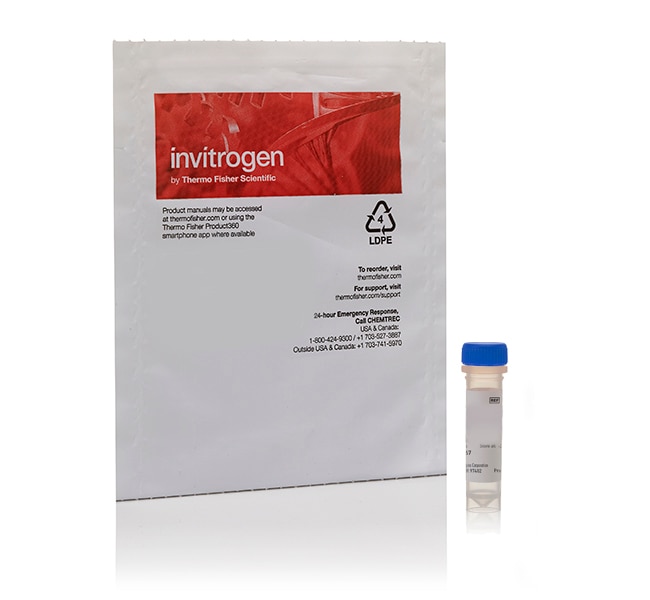
ER-Tracker™ Red (BODIPY™ TR Glibenclamide), for live-cell imaging
ER-Tracker™ Red色素は細胞透過性の生細胞染色で、提供されたプロトコルを使用して染色すると、ホルムアルデヒドで固定した後に染色パターンが部分的に保持されるため、小胞体(ER)に対して高い選択性を示します。この染色剤は、緑色蛍光を示すBODIPY™ TR色素とグリベンクラミドで構成されています詳細を見る
| 製品番号(カタログ番号) | 数量 |
|---|---|
| E34250 | 100 μg |
製品番号(カタログ番号) E34250
価格(JPY)
93,500
Each
数量:
100 μg
ER-Tracker™ Red色素は細胞透過性の生細胞染色で、提供されたプロトコルを使用して染色すると、ホルムアルデヒドで固定した後に染色パターンが部分的に保持されるため、小胞体(ER)に対して高い選択性を示します。この染色剤は、緑色蛍光を示すBODIPY™ TR色素とグリベンクラミドで構成されています。グリアンクラミド(グリブリド)は、ER上で顕著になるATP感受性K+チャネルのサルフォルユアリア受容体に結合します。グリベンクラミドの薬理活性はER機能に影響を及ぼす可能性があります。特定の特殊な細胞タイプでサルフォルユアリア受容体の発現が変動すると、非ER標識が生じる場合があります。
研究用にのみ使用できます。診断用には使用いただけません。
仕様
色Red
検出法蛍光
励起波長域587⁄615
使用対象 (装置)蛍光顕微鏡
製品ラインBODIPY, ER-Tracker
数量100 μg
出荷条件室温
標識タイプBODIPY Dyes
製品タイプ色素
Sub Cellular Localization小胞体
Unit SizeEach
組成および保存条件
フリーザー(-5°C∼-30°C)に保存し、遮光してください。
よくあるご質問(FAQ)
Why don't I see a significant change in signal for my live-cell fluorescent indicator dye?
引用および参考文献 (28)
引用および参考文献
Abstract
Binding of guanylyl cyclase activating protein 1 (GCAP1) to retinal guanylyl cyclase (RetGC1). The role of individual EF-hands.
Journal:J Biol Chem
PubMed ID:18541533
'Guanylyl cyclase activating protein 1 (GCAP1), after substitution of Ca(2+) by Mg(2+) in its EF-hands, stimulates photoreceptor guanylyl cyclase, RetGC1, in response to light. We inactivated metal binding in individual EF-hands of GCAP1 tagged with green fluorescent protein to assess their role in GCAP1 binding to RetGC1 in co-transfected HEK293
Imaging secretory vesicles by fluorescent protein insertion in propeptide rather than mature secreted peptide.
Journal:Traffic
PubMed ID:12047554
'We combined confocal and live-cell imaging with a novel molecular strategy aimed at revealing mechanisms underlying glucose-regulated insulin vesicle secretion. The ''Ins-C-GFP'' reporter monitors secretory peptide targeting, trafficking, and exocytosis without directly tagging the mature secreted peptide. We trapped a green fluorescent protein (GFP) reporter in equimolar quantity within the
Faecal excretion of ciprofloxacin after a single oral dose and its effect on faecal bacteria in healthy volunteers.
Journal:J Antimicrob Chemother
PubMed ID:2211433
'High concentrations of ciprofloxacin have been shown to persist in the faeces of volunteers for several days after a week of oral treatment with this drug, which was also found to have a prolonged effect on aerobic Gram-negative intestinal bacteria. To determine whether a shorter course of ciprofloxacin would have
Insulin-like growth factor I enhances the expression of aromatase P450 by inhibiting autophagy.
Journal:Endocrinology
PubMed ID:20668023
'Aromatase, a key enzyme of estrogen biosynthesis, is transcriptionally regulated by many growth factors. IGF-I enhances aromatase activity in a variety of cells, but the mechanism of action has not been determined. We herein report our finding of a novel mechanism of action for IGF-I. IGF-I enhanced the dexamethasone (DEX)-induced
Essential requirement for sphingosine kinase 2 in a sphingolipid apoptosis pathway activated by FTY720 analogues.
Journal:J Biol Chem
PubMed ID:17400555
'The clinical immunosuppressant FTY720 is a sphingosine analogue that, once phosphorylated by sphingosine kinase 2 (Sphk2), is an agonist of multiple receptor subtypes for sphingosine 1-phosphate. Short exposures to FTY720 afford long term protection in lymphoproliferative and autoimmune disease models, presumably by inducing apoptosis in subsets of cells essential for