Search


Citations & References (19)
Invitrogen™
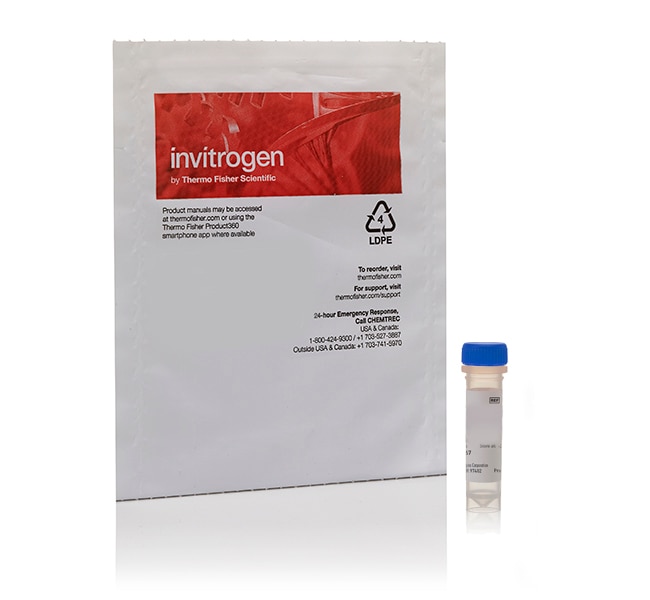
Epidermal Growth Factor, Biotinylated, complexed to Alexa Fluor™ 555 Streptavidin (Alexa Fluor™ 555 EGF complex)
細胞内のEGF受容体の検出に有用な上皮増殖因子のいくつかのコンジュゲートを提供しています。蛍光標識されたEGFにより、科学者は受容体と膜の相互作用の調査、受容体の分布の研究、EGFとその受容体との相互作用の速度定数の計算などが可能になりました。フルオレセイン(FITC)、Oregon Green™詳細を見る
| 製品番号(カタログ番号) | 数量 |
|---|---|
| E35350 または、製品番号E-35350 | 100 μg |
製品番号(カタログ番号) E35350
または、製品番号E-35350
価格(JPY)
66,100
Online offer
Ends: 25-Sep-2026
110,300割引額 44,200 (40%)
Each
数量:
100 μg
細胞内のEGF受容体の検出に有用な上皮増殖因子のいくつかのコンジュゲートを提供しています。蛍光標識されたEGFにより、科学者は受容体と膜の相互作用の調査、受容体の分布の研究、EGFとその受容体との相互作用の速度定数の計算などが可能になりました。フルオレセイン(FITC)、Oregon Green™ 514、およびテトラメチルローダミンを組み込んだコンジュゲートは、EGFに直接付着した色素で構成されています。Alexa Fluor™色素およびTexas Red™色素を用いたEGFのコンジュゲートは、染料ストレプトアビジン分子およびビオチン化EGFの複合体です。ビオチン化コンジュゲートは、EGF受容体に対するプローブの親和性を高めるように設計された長いスペーサーアームを含むビオチン-XXを利用しています。
上皮増殖因子コンジュゲートの仕様:
• EGF分子:53アミノ酸、MW = 6,045 Da
• 標識(Ex/Em):Alexa Fluor™ 555 ストレプトアビジンと複合体を形成したビオチン-XX (∼555/565 nm)
• EGF分子あたりの蛍光体分子数:約2~3
• 蛍光は通常、フローサイトメーター、蛍光顕微鏡、または蛍光光度計を使用して監視します
その他の受容体結合およびファゴサイトーシスのプローブ製品
当社は、受容体を介したエンドサイトーシスを研究するための蛍光標識プローブ、エンドサイトーシスとエキソサイトーシスの膜マーカー、および内部移行した蛍光リガンドを検出する方法を多数提供しています。これらの製品の詳細については、「Molecular Probes™ハンドブック」の受容体結合と食作用を追跡するためのプローブ — セクション16.1を参照してください。
研究目的のみに使用できます。ヒトまたは動物の治療もしくは診断目的には使用できません。
上皮増殖因子コンジュゲートの仕様:
• EGF分子:53アミノ酸、MW = 6,045 Da
• 標識(Ex/Em):Alexa Fluor™ 555 ストレプトアビジンと複合体を形成したビオチン-XX (∼555/565 nm)
• EGF分子あたりの蛍光体分子数:約2~3
• 蛍光は通常、フローサイトメーター、蛍光顕微鏡、または蛍光光度計を使用して監視します
その他の受容体結合およびファゴサイトーシスのプローブ製品
当社は、受容体を介したエンドサイトーシスを研究するための蛍光標識プローブ、エンドサイトーシスとエキソサイトーシスの膜マーカー、および内部移行した蛍光リガンドを検出する方法を多数提供しています。これらの製品の詳細については、「Molecular Probes™ハンドブック」の受容体結合と食作用を追跡するためのプローブ — セクション16.1を参照してください。
研究目的のみに使用できます。ヒトまたは動物の治療もしくは診断目的には使用できません。
研究用にのみ使用できます。診断用には使用いただけません。
仕様
細胞タイプMammalian Cells
検出法Fluorescence
標識または色素Alexa Fluor Dyes
製品ラインAlexa Fluor
数量100 μg
出荷条件Wet Ice
形状Lyophilized
製品タイプGrowth Factor
Unit SizeEach
組成および保存条件
Store in freezer (-5 to -30°C) and protect from light.
引用および参考文献 (19)
引用および参考文献
Abstract
Regulation of endocytosis via the oxygen-sensing pathway.
Journal:Nat Med
PubMed ID:19252501
'Tumor hypoxia is associated with disease progression, resistance to conventional cancer therapies and poor prognosis. Hypoxia, by largely unknown mechanisms, leads to deregulated accumulation of and signaling via receptor tyrosine kinases (RTKs) that are critical for driving oncogenesis. Here, we show that hypoxia or loss of von Hippel-Lindau protein--the principal
Human ESCRT-II complex and its role in human immunodeficiency virus type 1 release.
Journal:J Virol
PubMed ID:16973552
'The budding of many enveloped RNA viruses, including human immunodeficiency virus type 1 (HIV-1), requires some of the same cellular machinery as vesicle formation at the multivesicular body (MVB). In Saccharomyces cerevisiae, the ESCRT-II complex performs a central role in MVB protein sorting and vesicle formation, as it is recruited
Two di-leucine motifs regulate trafficking of mucolipin-1 to lysosomes.
Journal:Traffic
PubMed ID:16497227
'Mutations in the mucolipin-1 gene have been linked to mucolipidosis type IV, a lysosomal storage disorder characterized by severe neurological and ophthalmologic abnormalities. Mucolipin-1 is a membrane protein containing six putative transmembrane domains with both its N- and C-termini localized facing the cytosol. To gain information on the sorting motifs
Rab14 is part of the early endosomal clathrin-coated TGN microdomain.
Journal:FEBS Lett
PubMed ID:16962593
'Rab14 localizes to the Golgi/TGN and to early endosomes, but its biological function remains unclear. By structural modeling, we identified Rab14-specific residues and established a close relationship between the Rab2/Rab4/Rab14, Rab11/25 and Rab39 sub-groups within the Rab protein family. By quantitative confocal microscopy and by density centrifugation we show that
Interactions of TOM1L1 with the multivesicular body sorting machinery.
Journal:J Biol Chem
PubMed ID:15611048
'Tom1L1 (Tom1-like1) and related proteins Tom1 (Target of Myb1) and Tom1L2 (Tom1-like2) constitute a new protein family characterized by the presence of a VHS (Vps27p/Hrs/Stam) domain in the N-terminal portion followed by a GAT (GGA and Tom) domain. Recently it was demonstrated that the GAT domain of both Tom1 and