Search


Citations & References (1)
Invitrogen™
E-PAGE™ Midi Protein Gels, 3.7 mm
E-PAGE™ゲルは内蔵型のプレキャストゲルで、ディスポーザブルカセット内にゲルマトリックスと電極がパッケージされています。


製品番号(カタログ番号) EP09606
価格(JPY)
62,300
Online offer
Ends: 25-Dec-2026
103,900割引額 41,600 (40%)
Each
ウェル:
96ウェル
ゲル濃度:
6%
E-PAGE™ゲルは内蔵型のプレキャストゲルで、ディスポーザブルカセット内にゲルマトリックスと電極がパッケージされています。E-PAGE™ゲルでタンパク質を分離するには、中∼高スループットの電気泳動用に設計されたコンパクトで自動化されたプラットフォームであるEBase™統合デバイス(EBM03)が必要です。
各E-PAGE™ 48 8%ゲルには、48個のサンプルレーンと4つのマーカーレーンが含まれます(分離長は3.2 cm)。E-PAGE™ 48ゲルには、12または8チャンネルピペット、4または8チップロボットシステムを装着できます(図1)。
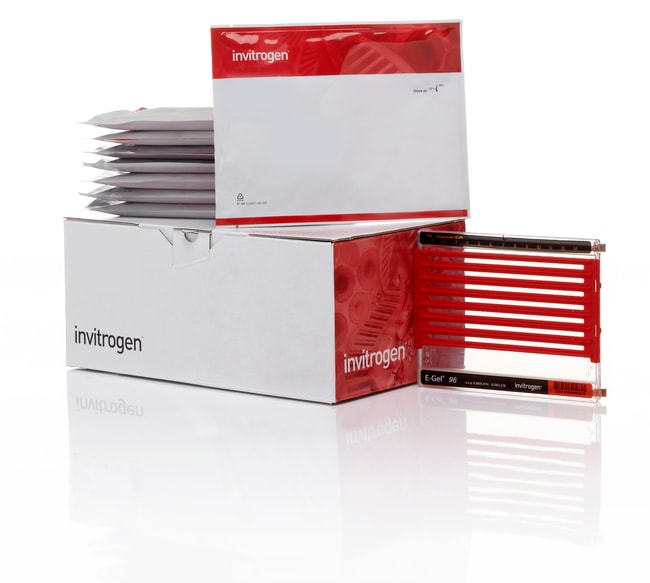
各E-PAGE™;96 6%ゲルには、96個のサンプルレーンと1.6 cmの分離長を持つ8つのマーカーレーンが含まれています。E-PAGE™ 96カセットのウェル開口部は、標準的な96ウェルプレートフォーマットに対応しており、マルチチャンネルピペット、8、12、または96チップの液体処理ロボットデバイスを簡単に装着できます(図2)。
E-PAGE™ 48および96カセットを開いて、後工程での染色またはブロッティングのためにゲルを除去できます(図3および4)。さらに、各カセットにはそれぞれバーコードが付いているため、市販のバーコードリーダーでゲルを容易に識別できます。
E-PAGE™プレキャストゲルシステムの詳細
E-PAGE™プレキャストゲルシステムは、高速で手間のかからない中スループットおよびハイスループットのタンパク質電気泳動用に設計されています。この製品は、E-PAGE™プレキャストゲル、ゲルを泳動するためのE-Base™統合デバイス、および画像分析用の無料E-Editor™ 2.0ソフトウェアで構成されています。
E-Base™統合デバイスは、基板と電源を1つのデバイスに統合します。最大3つの「Daughter」E-Base™デバイス(A10573)を1つの上位E-Base™に接続して、同一のパラメーターを使用して複数のゲルを同時に泳動することができます。E-Base™統合デバイスは、Society for Biomolecules Screening(SBS)標準プレートサイズに適合し、液体処理ロボットデッキに簡単に装着できます。
各E-PAGE™;96 6%ゲルには、96個のサンプルレーンと1.6 cmの分離長を持つ8つのマーカーレーンが含まれています。E-PAGE™ 96カセットのウェル開口部は、標準的な96ウェルプレートフォーマットに対応しており、マルチチャンネルピペット、8、12、または96チップの液体処理ロボットデバイスを簡単に装着できます(図2)。
E-PAGE™ 48および96カセットを開いて、後工程での染色またはブロッティングのためにゲルを除去できます(図3および4)。さらに、各カセットにはそれぞれバーコードが付いているため、市販のバーコードリーダーでゲルを容易に識別できます。
E-PAGE™プレキャストゲルシステムの詳細
E-PAGE™プレキャストゲルシステムは、高速で手間のかからない中スループットおよびハイスループットのタンパク質電気泳動用に設計されています。この製品は、E-PAGE™プレキャストゲル、ゲルを泳動するためのE-Base™統合デバイス、および画像分析用の無料E-Editor™ 2.0ソフトウェアで構成されています。
E-Base™統合デバイスは、基板と電源を1つのデバイスに統合します。最大3つの「Daughter」E-Base™デバイス(A10573)を1つの上位E-Base™に接続して、同一のパラメーターを使用して複数のゲルを同時に泳動することができます。E-Base™統合デバイスは、Society for Biomolecules Screening(SBS)標準プレートサイズに適合し、液体処理ロボットデッキに簡単に装着できます。
For Research Use Only. Not for use in diagnostic procedures.
仕様
使用対象 (装置)E-Base
Gel Thickness3.7 mm
長さ(メートル法)13.5 cm
分離モード分子量
数量8ゲル/箱
サンプル充填量最大20 µL
品質保持期間9カ月
出荷条件室温
保存要件室温で保存し、室温が4℃未満や40℃を超えないようにしてください
幅(メートル法)10.8 cm
ゲル濃度6%
ゲルサイズミディ
ゲルタイプE-PAGE™
製品ラインE-PAGE
分離範囲10~300 kDa
分離タイプ変性
ウェル96ウェル
Unit SizeEach
よくあるご質問(FAQ)
Are there robotic scripts for running E-Gel 48/96 or E-PAGE 48/96 gels?
What is the difference between the EG and EP program for the E-Base system?
What sample loading buffer should be used for E-PAGE gels?
Where can I download the latest version of the E-Gel 96 analysis software?
Are the E-PAGE Gels (example Cat. No. EP09606) compatible with the iBlot3 device (Cat. O. IB31001)?
引用および参考文献 (1)
引用および参考文献
Abstract
Detection of tetracysteine-tagged proteins using a biarsenical fluorescein derivative through dry microplate array gel electrophoresis.
Journal:Electrophoresis
PubMed ID:15300761
The design of an extended-run 96-well sodium dodecyl sulfate-polyacrylamide gel electrophoresis (SDS-PAGE) system and the development of protein detection technology based upon fluorescein derivatives that bind to peptide epitope tags, allows the creation of a truly high-throughput analysis of protein expression, where less than 20 min are needed to separate