Search


Citations & References (10)
Invitrogen™
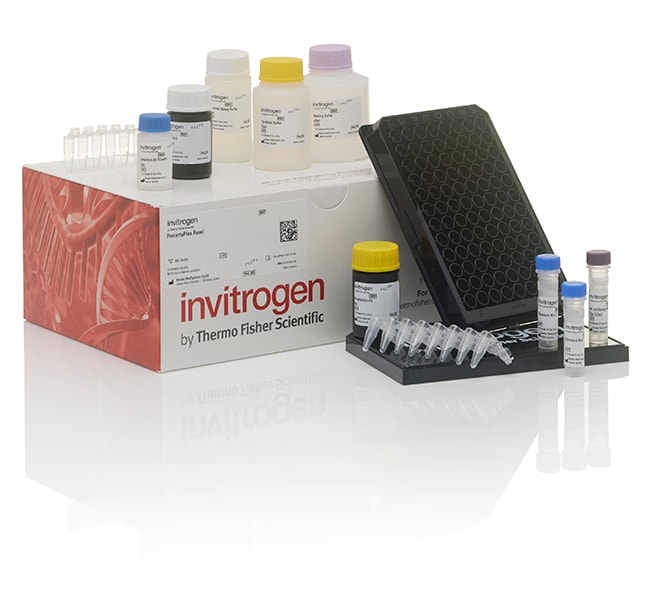
ProcartaPlex™ Human Immuno-Oncology Checkpoint Panel 1, 14plex
ヒト免疫腫瘍チェックポイント14-Plex ProcartaPlex1パネルは、研究者がLuminex xMAPテクノロジーを使用して、1つのウェルで14個のタンパク質ターゲットを分析することで、がん研究を可能にします。
| 製品番号(カタログ番号) | 数量 |
|---|---|
| EPX14A-15803-901 | 96テスト |
製品番号(カタログ番号) EPX14A-15803-901
価格(JPY)
558,200
Each
数量:
96テスト
ヒト免疫腫瘍チェックポイント14-Plex ProcartaPlex1パネルは、研究者がLuminex xMAPテクノロジーを使用して、1つのウェルで14個のタンパク質ターゲットを分析することで、がん研究を可能にします。このパネルを使用すると、T細胞の調整において重要な役割を果たす可溶型のタンパク質を同時に検出でき、T細胞の枯渇または刺激につながるため、抗腫瘍免疫応答が修正されます。これらの可溶性バイオマーカーの分析は、経路の生物学上の光を放出するのに役立ちます。このパネルは、同じ研究領域で23の追加タンパク質ターゲットを提供する免疫腫瘍チェックポイント14-Plex ProcartaPlexパネル2(カタログ番号EPX140-15815-901)および免疫腫瘍チェックポイント9-Plex ProcartaPlexパネル3(カタログ番号EPX090-15820-901)を補完するものです。
ProcartaPlex事前設定済みパネルは、検体の組み合わせ性、干渉、交差反応性について広範にテストされており、最高レベルの検証と精度を提供します。すべての ProcartaPlex パネルには、アッセイの実行に必要な試薬が付属しています。
ターゲットリスト[ビーズ領域]:
免疫刺激:CD27 [27]、CD28 [15]、CD137(4-1BB)[26]、GITR [57]、HVEM [36]
免疫抑制:BTLA[52]、CD80 [61]、CD152(CTLA4)[33]、IDO [46]、LAG-3 [47]、PD-1 [65]、PD-L1 [66]、PD-L2 [67]、TIM-3 [14]
Luminexプラットフォーム用ProcartaPlexアッセイについて
ProcartaPlexイムノアッセイは、サンドイッチELISAの原則に基づいており、1つのタンパク質の複数のエピトープに結合した2つの特異的抗体を使用して、すべてのタンパク質ターゲットを同時に定量化します。ProcartaPlex マルチプレックスアッセイは、わずか 25 μL の血漿または血清、あるいは 50 μL の細胞培養上清のみを必要とし、分析結果を得るために要する時間もわずか 4 時間です。
次の特長があります。
• 再現性と信頼性の高い結果 — タンパク質標的の結合性および交差反応性試験など、業界最高水準のパネルとして検証済み
• サンプルあたりの結果の増加 — 25~50 μLのサンプル1つで複数のタンパク質標的を同時に測定
• 確立されたLuminex技術 - タンパク質の検出と定量化のための高度に参照されたマルチプレックスプラットフォーム
ProcartaPlexアッセイは、血漿、血清、細胞培養上清、およびその他の体液からの25~50 μLの単一サンプルで最大65のタンパク質標的を同時に検出および定量するためにLuminex xMAP(多項目同時測定プロファイリング)利用しています。
ProcartaPlex アッセイの Luminex ビーズは、赤および赤外フルオロフォアの正確な比率で内部染色されており、Luminex xMAP 検出システム(Luminex 200、FLEXMAP 3D、MAGPIX など)により識別できるスペクトル的に固有なシグネチャを生じます。サンドイッチ ELISA と同様に、ProcartaPlex アッセイはマッチした抗体ペアを使用して目的のタンパク質を同定します。マルチプレックスアッセイでは、スペクトル的に固有な各ビーズは単一の標的タンパク質に特異的な抗体で標識され、結合タンパク質がビオチン化抗体およびストレプトアビジン–R-フィコエリトリン(RPE)で同定されます。タンパク質特異的抗体の特異的なビーズへの結合により、1 つのウェルで複数のターゲットの分析が可能になります。
ProcartaPlexアッセイとELISAの最も大きな違いは、ProcartaPlexアッセイのキャプチャー抗体がビーズに結合され、マイクロプレートウェルに吸着されないことです。そのため、ProcartaPlexアッセイ試薬は溶液中で自由に浮遊します。
研究用途にのみご使用ください。診断目的には使用できません。
仕様
アッセイ範囲分析証明書を参照
アッセイ感度15%未満
検出法Fluorescence
使用対象 (装置)Luminex™ 装置
フォーマットMultiplex Kit
製品ラインProcartaPlex
サンプルタイプ血清、血漿、細胞培養上清, Plasma, Cell Culture Supernatants
サンプル量血清、血漿:25 μL、CCS:50 μL
出荷条件湿氷
CombinabilityCombinable
製品タイプマルチプレックスパネル
数量96テスト
Research AreaImmunology, Oncology
種Human
Unit SizeEach
組成および保存条件
- ヒト標準ミックスL(凍結乾燥)バイアル2本
- キャプチャービーズミックス(1X)バイアル1本
- ビオチン化検出抗体ミックス(50X)バイアル1本
- 読み取りバッファー(1X)ボトル1本
- 洗浄バッファー(10X)ボトル1本
- ストレプトアビジン-PE(1X)ボトル1本
- ユニバーサルアッセイバッファー(1X)ボトル1本
- 検出抗体希釈液(1X)ボトル1本
- 8チューブストリップ
- 接着フィルム
- 平底96ウェルプレート、黒
- 2℃~8℃で保存してください
よくあるご質問(FAQ)
What is the size of the Luminex beads you currently use?
I am interested in performing Luminex assays using BioSource kits, and I have a Luminex xMAP system. Besides the kits and system, what other reagents and equipment will I need?
Do the Luminex beads require special care in handling?
Why would the Luminex acquisition software display "Sample Empty" messages during analysis?
What are the Luminex beads made of?
引用および参考文献 (10)
引用および参考文献
Abstract
Immune monitoring of trabectedin therapy in refractory soft tissue sarcoma patients - the IMMUNYON study.
Journal:Frontiers in immunology
PubMed ID:40007535
Soft tissue sarcomas (STS) encompass over 50 histologic subtypes, representing more than 1% of solid tumors. Standard treatments include surgical resection and therapies such as anthracyclines or trabectedin for advanced cases, though challenges persist due to the tumor microenvironmentâs complexity and limited immune profiling data. This study evaluates Trabectedin therapy
Soluble lymphocyte activation gene-3 (sLAG3) and CD4/CD8 ratio dynamics as predictive biomarkers in patients undergoing immune checkpoint blockade for solid malignancies.
Journal:British Journal of Cancer
PubMed ID:38233492
The search for biomarkers to identify suitable candidates for immune checkpoint inhibitor (ICI) therapy remains ongoing. We evaluate how soluble levels of the next generation immune checkpoint Lymphocyte Activation Gene-3 (sLAG-3) and its association with circulating T lymphocyte subsets could pose as a novel biomarker to predict outcome to ICI
3D microfluidic ex vivo culture of organotypic tumor spheroids to model immune checkpoint blockade.
Journal:Lab Chip
PubMed ID:30183789
Microfluidic culture has the potential to revolutionize cancer diagnosis and therapy. Indeed, several microdevices are being developed specifically for clinical use to test novel cancer therapeutics. To be effective, these platforms need to replicate the continuous interactions that exist between tumor cells and non-tumor cell elements of the tumor microenvironment
PD-L1 is expressed on human platelets and is affected by immune checkpoint therapy.
Journal:Oncotarget
PubMed ID:29937998
Cancer immunotherapy has been revolutionised by drugs that enhance the ability of the immune system to detect and fight tumors. Immune checkpoint therapies that target the programmed death-1 receptor (PD-1), or its ligand (PD-L1) have shown unprecedented rates of durable clinical responses in patients with various cancer types. However, there
Soluble immune checkpoint-related proteins as predictors of tumor recurrence, survival, and T cell phenotypes in clear cell renal cell carcinoma patients.
Journal:J Immunother Cancer
PubMed ID:31783776
Immune checkpoint inhibitors have achieved unprecedented success in cancer immunotherapy. With the exception of a few candidate biomarkers, the prognostic role of soluble immune checkpoint-related proteins in clear cell renal cell cancer (ccRCC) patients is largely uninvestigated.