Search


Citations & References (4)
Invitrogen™
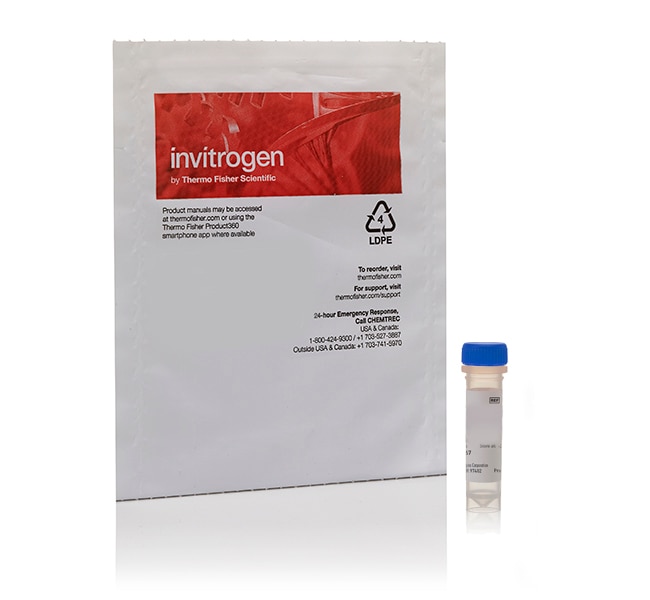
FluoSpheres™ Biotin-Labeled Microspheres, 0.04 μm, yellow-green fluorescent (505/515), 1% solids
ミクロスフェア(ラテックスビーズまたはラテックス粒子とも呼ばれる)は、ポリスチレンなどの非晶質ポリマーから形成されるコロイドサイズ範囲の球状粒子です。当社の Molecular Probes™ FluoSpheres™ビーズは、高品質で超清浄なポリスチレンを使用して製造されており、当社独自のさまざまな色素を使用して詳細を見る
| 製品番号(カタログ番号) | 数量 |
|---|---|
| F8766 または、製品番号F-8766 | 0.4 mL |
製品番号(カタログ番号) F8766
または、製品番号F-8766
価格(JPY)
122,000
Each
数量:
0.4 mL
ミクロスフェア(ラテックスビーズまたはラテックス粒子とも呼ばれる)は、ポリスチレンなどの非晶質ポリマーから形成されるコロイドサイズ範囲の球状粒子です。当社の Molecular Probes™ FluoSpheres™ビーズは、高品質で超清浄なポリスチレンを使用して製造されており、当社独自のさまざまな色素を使用して、蛍光顕微鏡に必要な強い照射で励起した場合でも、通常はほとんどまたは全く光退色しない強い蛍光ビーズを作成します。さまざまな分子やタンパク質をビーズ表面に結合させるために、さまざまな表面修飾を利用できます。
FluoSpheres™ミクロスフェアの仕様
• ラベル(Ex/Em):黄緑色蛍光(505/515)
• 公称ビーズ直径:0.04 µm
• 表面修飾:ビオチン
• 固体:1%
FluoSpheres™の各種結合表面の特性
• カルボン酸修飾FluoSpheres™ビーズは、表面にカルボン酸が高密度で張り出しているため、EDACなどの水溶性カルボジイミド試薬を使用したタンパク質やその他のアミン含有生体分子の共有結合に適しています。
• 硫酸塩FluoSpheres™ビーズは比較的疎水性の高い粒子で、アルブミン、IgG、アビジン、ストレプトアビジンなど、ほとんどすべてのタンパク質を受動的かつほぼ不可逆的に吸着します。
• アルデヒド硫酸塩FluoSpheres™ビーズは、表面にアルデヒド基が付加されており、非常に穏やかな条件下でタンパク質やその他のアミンと反応するように設計されています。
•Amine-modified FluoSpheres™ビーズは、水溶性カルボジイミドを使用して、ハプテンや薬物のスクシンイミジルエステルやイソチオシアネート、タンパク質のカルボン酸など、さまざまなアミン反応性分子に結合させることができます。
ミクロスフェアの主なアプリケーション
•機器のキャリブレーション(フローサイトメトリー、顕微鏡検査、HTS、HCS)
•フローテスト(マイクロフルイディクス、血流、水流、および空気流)
•細胞生物学用トレーサー(細胞分化および細胞トレーシング)
•イムノアッセイ(凝集試験、ELISA、粒子捕捉、およびコントラスト試薬)
FluoSpheresの選択™Fluorescent Microspheres
蛍光ミクロスフェアの全製品の中から、これらのバリエーションに富んだビーズを選ぶことができます。
•10種類の蛍光色
• 10種類の公称ビーズ直径:0.02 µm、0.04 µm、0.1 µm、0.2 µm、0.5 µm、1.0 µm、2.0 µm、4.0 µm、10.0 µm、および15.0 µm
•タンパク質結合の4つの表面修飾:カルボキシル基、硫酸、アルデヒド硫酸、アミン
•ストレプトアビジン、ニュートラアビジン、ビオチン、ユーロピウム、およびプラチナと追加的に結合したミクロスフェア
未染色のミクロスフェアの選択肢
研究および商業アプリケーション用に、UltraClean™浄界面活性剤フリーミクロスフェアを多数ご用意しています。
ミクロスフェア製品をご注文に応じてお作りします。
ご要望に応じてカスタムオーダーでご用意いたします。たとえば、FluoSpheres™ビーズは、当社の通常の選択よりも低い強度で調製できます。これは、一部のマルチカラーアプリケーションに適した機能です。当社のカスタム結合サービスは、効率的で機密性が確保されており、品質が保証されています。当社はISO 9001:2000の認証を取得済みです。
研究用途にのみ使用できます。動物またはヒトの治療または診断用途には使用できません。
FluoSpheres™ミクロスフェアの仕様
• ラベル(Ex/Em):黄緑色蛍光(505/515)
• 公称ビーズ直径:0.04 µm
• 表面修飾:ビオチン
• 固体:1%
FluoSpheres™の各種結合表面の特性
• カルボン酸修飾FluoSpheres™ビーズは、表面にカルボン酸が高密度で張り出しているため、EDACなどの水溶性カルボジイミド試薬を使用したタンパク質やその他のアミン含有生体分子の共有結合に適しています。
• 硫酸塩FluoSpheres™ビーズは比較的疎水性の高い粒子で、アルブミン、IgG、アビジン、ストレプトアビジンなど、ほとんどすべてのタンパク質を受動的かつほぼ不可逆的に吸着します。
• アルデヒド硫酸塩FluoSpheres™ビーズは、表面にアルデヒド基が付加されており、非常に穏やかな条件下でタンパク質やその他のアミンと反応するように設計されています。
•Amine-modified FluoSpheres™ビーズは、水溶性カルボジイミドを使用して、ハプテンや薬物のスクシンイミジルエステルやイソチオシアネート、タンパク質のカルボン酸など、さまざまなアミン反応性分子に結合させることができます。
ミクロスフェアの主なアプリケーション
•機器のキャリブレーション(フローサイトメトリー、顕微鏡検査、HTS、HCS)
•フローテスト(マイクロフルイディクス、血流、水流、および空気流)
•細胞生物学用トレーサー(細胞分化および細胞トレーシング)
•イムノアッセイ(凝集試験、ELISA、粒子捕捉、およびコントラスト試薬)
FluoSpheresの選択™Fluorescent Microspheres
蛍光ミクロスフェアの全製品の中から、これらのバリエーションに富んだビーズを選ぶことができます。
•10種類の蛍光色
• 10種類の公称ビーズ直径:0.02 µm、0.04 µm、0.1 µm、0.2 µm、0.5 µm、1.0 µm、2.0 µm、4.0 µm、10.0 µm、および15.0 µm
•タンパク質結合の4つの表面修飾:カルボキシル基、硫酸、アルデヒド硫酸、アミン
•ストレプトアビジン、ニュートラアビジン、ビオチン、ユーロピウム、およびプラチナと追加的に結合したミクロスフェア
未染色のミクロスフェアの選択肢
研究および商業アプリケーション用に、UltraClean™浄界面活性剤フリーミクロスフェアを多数ご用意しています。
ミクロスフェア製品をご注文に応じてお作りします。
ご要望に応じてカスタムオーダーでご用意いたします。たとえば、FluoSpheres™ビーズは、当社の通常の選択よりも低い強度で調製できます。これは、一部のマルチカラーアプリケーションに適した機能です。当社のカスタム結合サービスは、効率的で機密性が確保されており、品質が保証されています。当社はISO 9001:2000の認証を取得済みです。
研究用途にのみ使用できます。動物またはヒトの治療または診断用途には使用できません。
研究用にのみ使用できます。診断用には使用いただけません。
仕様
製品ラインFLUOSPHERES
数量0.4 mL
出荷条件室温
表面修飾その他の修飾またはラベル
色黄-緑
直径(メートル法)0.04 μm
材料ポリスチレン
製品タイプミクロスフェア
Unit SizeEach
組成および保存条件
冷蔵庫(2∼8°C)に保存し、遮光。
よくあるご質問(FAQ)
What is the warranty for FluoSpheres microspheres?
After washing and centrifugation, there was only a very small pellet left of my microsphere beads and the solution was transparent. Why is this?
I've had my microspheres for over a year, and I'm wondering if they're still good to use. What are some good ways to check their functionality?
I accidentally froze my microspheres; can I still use them?
My protein-coated microspheres appear to be non-specifically binding in my experimental system. Do you have a product that can help reduce these non-specific interactions?
引用および参考文献 (4)
引用および参考文献
Abstract
Nanoparticles as fluorescence labels: is size all that matters?
Journal:Biophys J
PubMed ID:18390610
'Fluorescent labels are often used in bioassays as a means to detect and characterize ligand-receptor binding. This is due in part to the inherently high sensitivity of fluorescence-based technology and the relative accessibility of the technique. There is often little concern raised as to whether or not the fluorescent label
Selective aluminum passivation for targeted immobilization of single DNA polymerase molecules in zero-mode waveguide nanostructures.
Journal:Proc Natl Acad Sci U S A
PubMed ID:18216253
Optical nanostructures have enabled the creation of subdiffraction detection volumes for single-molecule fluorescence microscopy. Their applicability is extended by the ability to place molecules in the confined observation volume without interfering with their biological function. Here, we demonstrate that processive DNA synthesis thousands of bases in length was carried out
A contiguous compartment functions as endoplasmic reticulum and endosome/lysosome in Giardia lamblia.
Journal:Eukaryot Cell
PubMed ID:19749174
The dynamic evolution of organelle compartmentalization in eukaryotes and how strictly compartmentalization is maintained are matters of ongoing debate. While the endoplasmic reticulum (ER) is classically envisioned as the site of protein cotranslational translocation, it has recently been proposed to have pluripotent functions. Using transfected reporter constructs, organelle-specific markers, and
Different domains of the AMPA receptor direct stargazin-mediated trafficking and stargazin-mediated modulation of kinetics.
Journal:J Biol Chem
PubMed ID:16793768
Stargazin is an accessory protein of AMPA receptors that enhances surface expression and also affects the biophysical properties of the receptor. AMPA receptor domains necessary for either of these two processes have not yet been identified. Here, we used confocal imaging and electrophysiology of heterologously expressed, fluorophore-tagged GluR1, GluR2, and