Search



Citations & References (5)
Invitrogen™
HCS NuclearMask™ Stains
Easily identify cell nuclei and other features of interest during high-content screening (HCS) assays with the versatile HCS NuclearMask Blue, Red, and Deep Red stains, which can be used with live and fixed cells and in multiparametric analyses.


製品番号(カタログ番号) H10326
価格(JPY)
52,600
Each
色:
Red
Easily identify cell nuclei in high-content screening (HCS) assays with the versatile HCS NuclearMask Blue, Red, and Deep Red stains, which survive standard formaldehyde-based fixation and detergent-based permeabilization methods and can be applied to live and fixed cells. Because their dyes are easily discriminated from other fluorophores, the HCS NuclearMask stains can be used in multiparametric analyses. They can also label the entire cell (i.e., cytoplasm and nucleus) and provide an accurate backdrop against which to assess the features of interest.
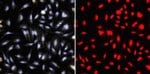
The versatile HCS NuclearMask Blue, HCS NuclearMask Red, and HCS NuclearMask Deep Red stains can be used to measure DNA content and perform cell demarcation with formaldehyde-fixed cells on high content imaging and analysis (HCS) platforms. HCS NuclearMask Blue, HCS NuclearMask Red, and HCS NuclarMask Deep Red stains have excitation/emission maxima of 355/460 nm, 622/645 nm, and 638/686 nm, respectively, when bound to DNA. HCS NuclearMask Blue stain is easily discriminated from visible- and near-IR wavelength fluorophores, HCS NuclearMask Red stain is easily discriminated from green- and even orange-fluorescent fluorophores, and HCS NuclearMask Deep Red is easily discriminated from visible wavelength fluorophores when used in multiparametric analyses.
If total cell staining is desired, HCS CellMask stains label the entire cell (cytoplasm and nucleus) and provide an accurate backdrop against which the features of interest can be assessed. HCS CellMask stains are available in a choice of colors for multiplexing flexibility. Sufficient volume quantities are provided to stain ten 96-well plates using an assay volume of 100 μL per well.
If total cell staining is desired, HCS CellMask stains label the entire cell (cytoplasm and nucleus) and provide an accurate backdrop against which the features of interest can be assessed. HCS CellMask stains are available in a choice of colors for multiplexing flexibility. Sufficient volume quantities are provided to stain ten 96-well plates using an assay volume of 100 μL per well.
For Research Use Only. Not for human or animal therapeutic or diagnostic use.
仕様
色Red
概要HCS NuclearMask™ Red Stain
検出法蛍光
発光可視
励起波長域622⁄645
使用対象 (装置)ハイコンテント装置
製品ラインMolecular Probes
数量125 μL
出荷条件室温
標識タイプFluorescent Dye
製品タイプ染色
Sub Cellular Localization核、核酸, Nucleus
Unit SizeEach
組成および保存条件
125 μLの1000X濃縮液で、合計10枚の96ウェルマイクロプレートを染色するのに十分な容量です。遮光し、-20°C以下で、乾燥した場所に保存。
引用および参考文献 (5)
引用および参考文献
Abstract
CD40L induces functional tunneling nanotube networks exclusively in dendritic cells programmed by mediators of type 1 immunity.
Journal:
PubMed ID:25548234
The ability of dendritic cells (DC) to mediate CD4(+) T cell help for cellular immunity is guided by instructive signals received during DC maturation, as well as the resulting pattern of DC responsiveness to the Th signal, CD40L. Furthermore, the professional transfer of antigenic information from migratory DC to lymph
Overcoming Adaptive Resistance to KRAS and MEK Inhibitors by Co-targeting mTORC1/2 Complexes in Pancreatic Cancer.
Journal:Cell Rep Med
PubMed ID:33294856
Genome-wide synthetic lethal screen unveils novel CAIX-NFS1/xCT axis as a targetable vulnerability in hypoxic solid tumors.
Journal:Sci Adv
PubMed ID:34452919
cAMP and EPAC Signaling Functionally Replace OCT4 During Induced Pluripotent Stem Cell Reprogramming.
Journal:Mol Ther
PubMed ID:25666918
A medium-throughput analysis of signaling pathways involved in early stages of stem cell reprogramming.
Journal:Biotechnol Bioeng
PubMed ID:25065366