Search
 元素の検索
元素の検索 構造の検索
構造の検索


Thermo Scientific Chemicals
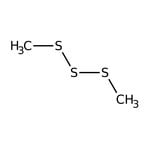
Dimethyl trisulfide, 98%
CAS: 3658-80-8 | C2H6S3 | 126.25 g/mol



化学物質識別子
CAS3658-80-8
IUPAC Namedimethyltrisulfane
Molecular FormulaC2H6S3
InChI KeyYWHLKYXPLRWGSE-UHFFFAOYSA-N
SMILESCSSSC
さらに表示
仕様 スペックシート
スペックシートAppearance (Color)Clear colorless to yellow
Assay (GC)≥97.5%
Refractive Index1.5995-1.6035 @ 20°C
FormLiquid
Dimethyl trisulfide is reported as a major aroma component in cooked Brassicaceous vegetables. Trap baits containing dimethyl trisulfide have been used to capture Calliphora loewi and other blowflies. Dimethyl trisulfide along with dimethyl sulfide and dimethyl disulfide have been confirmed as volatile compounds given off by the fly-attracting plant known as dead-horse arum (Helicodiceros muscivorus). These flies are attracted to the odor of fetid meat and help pollinate this plant.
This Thermo Scientific Chemicals brand product was originally part of the Alfa Aesar product portfolio. Some documentation and label information may refer to the legacy brand. The original Alfa Aesar product / item code or SKU reference has not changed as a part of the brand transition to Thermo Scientific Chemicals.
Applications
Dimethyl trisulfide is reported as a major aroma component in cooked Brassicaceous vegetables. Trap baits containing dimethyl trisulfide have been used to capture Calliphora loewi and other blowflies. Dimethyl trisulfide along with dimethyl sulfide and dimethyl disulfide have been confirmed as volatile compounds given off by the fly-attracting plant known as dead-horse arum (Helicodiceros muscivorus). These flies are attracted to the odor of fetid meat and help pollinate this plant.
Solubility
Insoluble in water.
Notes
Store in cool place. Keep container tightly closed in a dry and well-ventilated place. Store away from strong oxidizing agents. Store at 4°C. Store in an air-tight and light-resistant container.
Dimethyl trisulfide is reported as a major aroma component in cooked Brassicaceous vegetables. Trap baits containing dimethyl trisulfide have been used to capture Calliphora loewi and other blowflies. Dimethyl trisulfide along with dimethyl sulfide and dimethyl disulfide have been confirmed as volatile compounds given off by the fly-attracting plant known as dead-horse arum (Helicodiceros muscivorus). These flies are attracted to the odor of fetid meat and help pollinate this plant.
Solubility
Insoluble in water.
Notes
Store in cool place. Keep container tightly closed in a dry and well-ventilated place. Store away from strong oxidizing agents. Store at 4°C. Store in an air-tight and light-resistant container.
RUO – Research Use Only
General References:
- Maruyama FT. Identification of dimethyl trisulfide as a major aroma component of cooked brassicaceous vegetables. Maruyama. J. Food Sci. 1970, 35(5), 540-543.
- Mika Shirasu et. al,; Shunji Nagai,; Ryuichi Hayashi,; Atsushi Ochiai,; Kazushige Touhara. Dimethyl trisulfide as a characteristic odor associated with fungating cancer wounds. Bioscience, Biotechnology, and Biochemistry,. 2009, 73(9), 2117-2120.