Search
 元素の検索
元素の検索 構造の検索
構造の検索

Thermo Scientific Chemicals
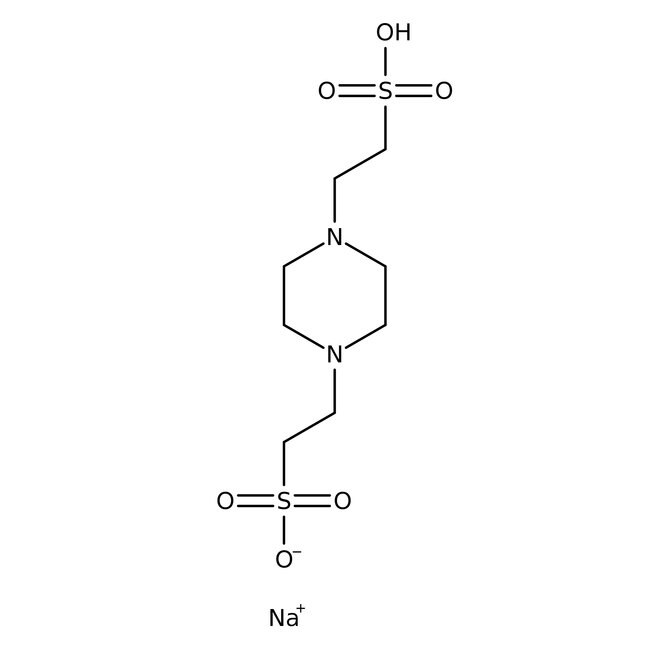
PIPES, 0.5M buffer soln., pH 6.5
CAS: 5625-37-6 | C8H18N2O6S2 | 302.36 g/mol



仕様
CAS5625-37-6
ChEBICHEBI:44933
化学物質名または材質PIPES buffer soln.
色Colorless
IUPAC名2-[4-(2-sulfoethyl)piperazin-1-yl]ethanesulfonic acid
さらに表示
PIPES can be used in a wide array of biological applications, including as a component in media formulations. Specific applications include buffers for cell culture and diagnostic reagent production. It is used to buffer glutaraldehyde fixative solutions when fixing plant and/or animal tissue tissue samples. This will help prevent the loss of lipids. It is used to buffer glutaraldehyde and formaldehyde when fixing fungal zoospores for fluorescence microscopy and electron microscopy.
This Thermo Scientific Chemicals brand product was originally part of the Alfa Aesar product portfolio. Some documentation and label information may refer to the legacy brand. The original Alfa Aesar product / item code or SKU reference has not changed as a part of the brand transition to Thermo Scientific Chemicals.
Applications
PIPES can be used in a wide array of biological applications, including as a component in media formulations. Specific applications include buffers for cell culture and diagnostic reagent production. It is used to buffer glutaraldehyde fixative solutions when fixing plant and/or animal tissue tissue samples. This will help prevent the loss of lipids. It is used to buffer glutaraldehyde and formaldehyde when fixing fungal zoospores for fluorescence microscopy and electron microscopy.
Solubility
Fully miscible in water.
Notes
Stable under recommended storage conditions. Incompatible with oxidizing agents, reducing agents, bases and heat.
PIPES can be used in a wide array of biological applications, including as a component in media formulations. Specific applications include buffers for cell culture and diagnostic reagent production. It is used to buffer glutaraldehyde fixative solutions when fixing plant and/or animal tissue tissue samples. This will help prevent the loss of lipids. It is used to buffer glutaraldehyde and formaldehyde when fixing fungal zoospores for fluorescence microscopy and electron microscopy.
Solubility
Fully miscible in water.
Notes
Stable under recommended storage conditions. Incompatible with oxidizing agents, reducing agents, bases and heat.
RUO – Research Use Only
General References:
- Kalina Makowiecki; Alan R.Harvey; Rachel M.Sherrard; Jennifer Rodger. Low-intensity repetitive transcranial magnetic stimulation improves abnormal visual cortical circuit topography and upregulates BDNF in mice. Journal of Neuroscience. 2014, 34,(32), 10780-10792.
- Nicholas Light; Veronique Adoue; Bing Ge; Shu-Huang Chen; Tony Kwan; Tomi Pastinen. Interrogation of allelic chromatin states in human cells by high-density ChIP-genotyping. Epigenetics. 2014, 9,(9), 1238-1251.