Search
 元素の検索
元素の検索 構造の検索
構造の検索

Thermo Scientific Chemicals
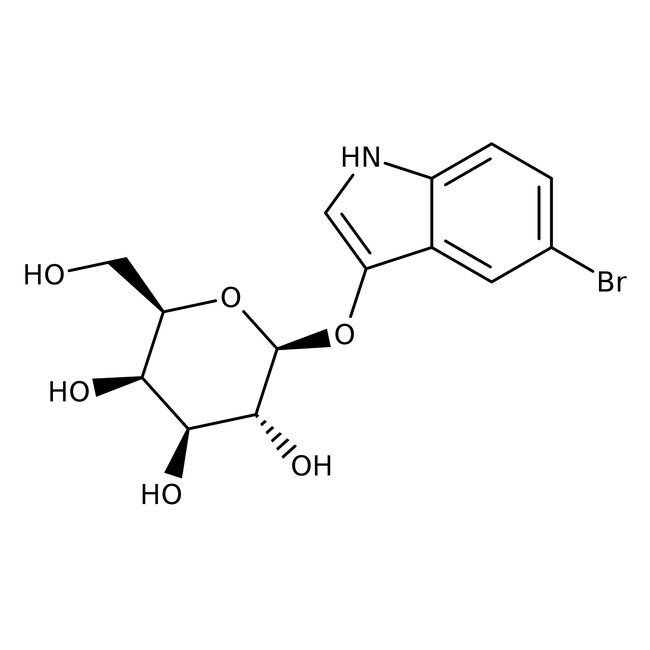
5-Bromo-3-indolyl beta-d-galactopyranoside, 98+%
alpha-Galactosidase substrate for Lac-gene detection systems | CAS: 97753-82-7 | C14H16BrNO6 | 374.19 g/mol



化学物質識別子
CAS97753-82-7
IUPAC Name(2S,3R,4S,5R,6R)-2-[(5-bromo-1H-indol-3-yl)oxy]-6-(hydroxymethyl)oxane-3,4,5-triol
Molecular FormulaC14H16BrNO6
InChI KeyLINMATFDVHBYOS-MBJXGIAVSA-N
SMILESOC[C@H]1O[C@@H](OC2=CNC3=CC=C(Br)C=C23)[C@H](O)[C@@H](O)[C@H]1O
さらに表示
 スペックシート
5-Bromo-3-indolyl-β-D-galactopyranoside is an α-galactosidase substrate which is converted to an insoluble indigo-blue chromophore darker than that released by X-GAL. It is ideal for Lac gene detection systems in immunoblotting, immunocytochemical, and histological applications. Also used as chromogenic substrate that is suitable for identification of lac-(+) bacterial colonies.
This Thermo Scientific Chemicals brand product was originally part of the Alfa Aesar product portfolio. Some documentation and label information may refer to the legacy brand. The original Alfa Aesar product / item code or SKU reference has not changed as a part of the brand transition to Thermo Scientific Chemicals.
Applications
5-Bromo-3-indolyl-β-D-galactopyranoside is an α-galactosidase substrate which is converted to an insoluble indigo-blue chromophore darker than that released by X-GAL. It is ideal for Lac gene detection systems in immunoblotting, immunocytochemical, and histological applications. Also used as chromogenic substrate that is suitable for identification of lac-(+) bacterial colonies.
Solubility
Soluble in dimethylformamide (100 mg/ml), dimethylformamide/water (1:1 v/v) (10 mg/ml - clear, practically colorless solution).
Notes
Store in freezer (-20°C). Keep the container tightly closed. Store away from oxidizing agent.
5-Bromo-3-indolyl-β-D-galactopyranoside is an α-galactosidase substrate which is converted to an insoluble indigo-blue chromophore darker than that released by X-GAL. It is ideal for Lac gene detection systems in immunoblotting, immunocytochemical, and histological applications. Also used as chromogenic substrate that is suitable for identification of lac-(+) bacterial colonies.
Solubility
Soluble in dimethylformamide (100 mg/ml), dimethylformamide/water (1:1 v/v) (10 mg/ml - clear, practically colorless solution).
Notes
Store in freezer (-20°C). Keep the container tightly closed. Store away from oxidizing agent.
RUO – Research Use Only
General References:
- Leslie M Stone; Seong-Seng Tan; Patrick P L Tam; Thomas E Finger. Analysis of cell lineage relationships in taste buds. Journal of Neuroscience, 2002,22(11), 4522-4529.
- Kyoji Horie et. al. Characterization of Sleeping Beauty transposition and its application to genetic screening in mice. Molecular and Cellular Biology., 2003,23(24), 9189-9207.