Search


Citations & References (3)
Invitrogen™
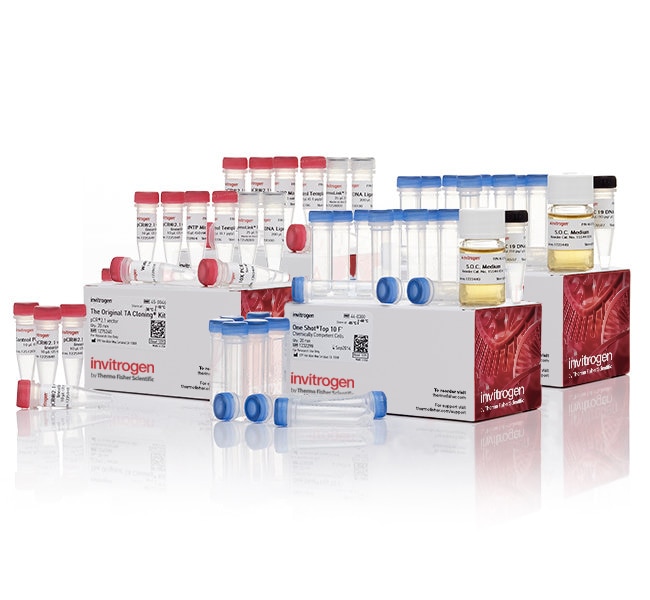
TA Cloning™ Kit, with pCR™2.1 Vector and One Shot™ TOP10F' Chemically Competent E. coli
PCR™2.1ベクター付きTAクローニング™キットは、Taq増幅PCR産物をプラスミドベクターに直接挿入するための迅速なワンステップクローニング戦略を実現します。TAクローニングキットは、PCR™2.1クローニングベクターとExpressLink T4 DNAリガーゼを使用して、15分間の室温でのライゲーションステップでライゲーション産物を生成します。反応では通常、インサートを含む>80%の組み換え体を生成します。pCR™2.1ベクター付きTA詳細を見る


製品番号(カタログ番号) K203040
価格(JPY)
190,200
Each
反応数:
40反応
PCR™2.1ベクター付きTAクローニング™キットは、Taq増幅PCR産物をプラスミドベクターに直接挿入するための迅速なワンステップクローニング戦略を実現します。TAクローニングキットは、PCR™2.1クローニングベクターとExpressLink T4 DNAリガーゼを使用して、15分間の室温でのライゲーションステップでライゲーション産物を生成します。反応では通常、インサートを含む>80%の組み換え体を生成します。
pCR™2.1ベクター付きTA Cloning™キットの特長:
•高速で便利—室温での15分間のライゲーション
• 効率的—青/白スクリーニングおよび正しいインサートを使用した80%を超えるクローン
• 柔軟性—カナマイシン耐性またはアンピシリン耐性を選択できるため、抗生物質の選択が柔軟です
• 手間なし—PCR産物の酵素的修飾を排除します
• 合理化—制限部位を含むPCRプライマーを使用する必要はありません
pCR™2.1ベクターの特長:
• Taq増幅PCR産物の直接ライゲーションのための3'-Tオーバーハング
• in vitro RNA転写およびシーケンシング用のT7プロモーター
• インサート配列を簡単に切り出すためのEcoR I部位に隣接する多用途ポリリンカーシーケンス用の Taq 増幅PCR産物 T7 プロモーターの直接ライゲーションに使用
• シーケンシング用のM13フォワード/リバースプライマー部位
TAクローニング™の仕組み
Taqポリメラーゼにはテンプレートに依存しない活性があり、単一のデオキシアデノシン(A)をPCR産物の3'末端に付加します。このキットで提供される線形化ベクターには、単一の3'デオキシアデノシン(T)残基があります。PCRインサートでベクターによって効率的にライゲーションできます
キット構成
TAクローニング™キットは、さまざまな構成で提供されます:コンピテントセルなし(K2020-20および K2020-40)、One Shot™ INVFのケミカルコンピテント大腸菌あり(K2000-01およびK2000-40)、One Shot™ TOP10Fのケミカルコンピテント大腸菌あり(K2030-01およびK2030-40)、One Shot™ TOP10ケミカルコンピテント大腸菌あり(K2040-01およびK2040-40)、20-と40-の反応キット。
pCR™2.1ベクター付きTA Cloning™キットの特長:
•高速で便利—室温での15分間のライゲーション
• 効率的—青/白スクリーニングおよび正しいインサートを使用した80%を超えるクローン
• 柔軟性—カナマイシン耐性またはアンピシリン耐性を選択できるため、抗生物質の選択が柔軟です
• 手間なし—PCR産物の酵素的修飾を排除します
• 合理化—制限部位を含むPCRプライマーを使用する必要はありません
pCR™2.1ベクターの特長:
• Taq増幅PCR産物の直接ライゲーションのための3'-Tオーバーハング
• in vitro RNA転写およびシーケンシング用のT7プロモーター
• インサート配列を簡単に切り出すためのEcoR I部位に隣接する多用途ポリリンカーシーケンス用の Taq 増幅PCR産物 T7 プロモーターの直接ライゲーションに使用
• シーケンシング用のM13フォワード/リバースプライマー部位
TAクローニング™の仕組み
Taqポリメラーゼにはテンプレートに依存しない活性があり、単一のデオキシアデノシン(A)をPCR産物の3'末端に付加します。このキットで提供される線形化ベクターには、単一の3'デオキシアデノシン(T)残基があります。PCRインサートでベクターによって効率的にライゲーションできます
キット構成
TAクローニング™キットは、さまざまな構成で提供されます:コンピテントセルなし(K2020-20および K2020-40)、One Shot™ INVFのケミカルコンピテント大腸菌あり(K2000-01およびK2000-40)、One Shot™ TOP10Fのケミカルコンピテント大腸菌あり(K2030-01およびK2030-40)、One Shot™ TOP10ケミカルコンピテント大腸菌あり(K2040-01およびK2040-40)、20-と40-の反応キット。
研究用途にのみご使用ください。診断目的には使用できません。
仕様
菌株または酵母株TOP10F
細胞タイプケミカリーコンピテント大腸菌
クローニング法TAクローニング
使用対象(アプリケーション)PCRクローニング
反応数40反応
製品ラインOne Shot
製品タイプCloning Kit
プロモーターT7
数量40 reactions
ベクターpCR2.1
フォーマットキット
Unit SizeEach
組成および保存条件
TA Cloning™キットには、線形化PCR™ 2.1ベクター、ExpressLink™ T4 DNAリガーゼ、5X ExpressLink™ T4 DNAライゲーションバッファー、dNTP、10X PCRバッファー、滅菌水、およびコントロールが含まれています。コンピテントセルキットには、One Shot™ケミカルコンピテント大腸菌、S.O.C.培地、スーパーコイルコントロールプラスミドが含まれています。
One Shot™大腸菌は-80℃で保管します。その他のすべての成分を-20°℃で保管してください。すべての試薬は、適切な保管条件であれば、6カ月間安定していることが保証されています。
One Shot™大腸菌は-80℃で保管します。その他のすべての成分を-20°℃で保管してください。すべての試薬は、適切な保管条件であれば、6カ月間安定していることが保証されています。
よくあるご質問(FAQ)
Can I use TOP10F' competent cells for transformation of my TOPO vector that contains the ccdB gene?
引用および参考文献 (3)
引用および参考文献
Abstract
Isolation, cloning, and localization of rat PV-1, a novel endothelial caveolar protein.
Journal:J Cell Biol
PubMed ID:10366592
'By using an immunoisolation procedure (Stan, R.-V., W.G. Roberts, K. Ihida, D. Predescu, L. Saucan, L. Ghitescu, and G.E. Palade. 1997. Mol. Biol. Cell. 8:595-605) developed in our laboratory, we have isolated a caveolar subfraction from rat lung endothelium and we have partially characterized the proteins of this subfraction which
Identification and functional analysis of the rat caspase-3 gene promoter.
Journal:J Biol Chem
PubMed ID:11773055
Caspase-3 is the major effector in apoptosis triggered by various stimuli. Previous studies demonstrated a significant increase in transcriptional activity of the caspase-3 gene during neuronal apoptosis. Recent findings suggest that differential expression of the caspase-3 gene may underlie the regulation of apoptotic susceptibility during brain development and after acute
Immunogene therapy of tumors with vaccine based on Xenopus homologous vascular endothelial growth factor as a model antigen.
Journal:Proc Natl Acad Sci U S A
PubMed ID:11553767
Overcoming immune tolerance of the growth factors associated with tumor growth should be a useful approach to cancer therapy by active immunity. We used vascular endothelial growth factor (VEGF) as a model antigen to explore the feasibility of the immunogene tumor therapy with a vaccine based on a single xenogeneic