Search
 元素の検索
元素の検索 構造の検索
構造の検索

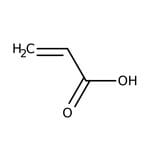
.png-150.jpg)

Thermo Scientific Chemicals
Acrylic acid, 97%, stab. with ca 200ppm 4-methoxyphenol
CAS: 79-10-7 | C3H4O2 | 72.063 g/mol



化学物質識別子
CAS79-10-7
IUPAC Nameprop-2-enoic acid
Molecular FormulaC3H4O2
InChI KeyNIXOWILDQLNWCW-UHFFFAOYSA-N
SMILESOC(=O)C=C
さらに表示
仕様 スペックシート
スペックシートAppearance (Color)Clear colorless
FormLiquid
Assay (GC)≥97.0%
Identification (FTIR)Conforms
Impurity contentDimer, diacrylic acid: ≤3.0%
さらに表示
Acrylic acid acts as a precursor in the production of 3-hydroxypropionic acid. It is used in the preparation of water-absorbent resins. It reacts with alcohols to prepare the corresponding esters. Its esters are used as raw materials for synthetic resins, rubbers, coating adhesives, water-based paints, floor polishes and adhesives. It is also used to prepare forming homopolymers or copolymers by reacting with other monomers like acrylamides, acrylonitrile, vinyl, styrene, and butadiene.
This Thermo Scientific Chemicals brand product was originally part of the Alfa Aesar product portfolio. Some documentation and label information may refer to the legacy brand. The original Alfa Aesar product / item code or SKU reference has not changed as a part of the brand transition to Thermo Scientific Chemicals.
Applications
Acrylic acid acts as a precursor in the production of 3-hydroxypropionic acid. It is used in the preparation of water-absorbent resins. It reacts with alcohols to prepare the corresponding esters. Its esters are used as raw materials for synthetic resins, rubbers, coating adhesives, water-based paints, floor polishes and adhesives. It is also used to prepare forming homopolymers or copolymers by reacting with other monomers like acrylamides, acrylonitrile, vinyl, styrene, and butadiene.
Solubility
Miscible with water.
Notes
Hygroscopic. Light and air sensitive. Incompatible with strong oxidizing agents, strong bases, oxygen, polymerizing initiators, amines and peroxides.
Acrylic acid acts as a precursor in the production of 3-hydroxypropionic acid. It is used in the preparation of water-absorbent resins. It reacts with alcohols to prepare the corresponding esters. Its esters are used as raw materials for synthetic resins, rubbers, coating adhesives, water-based paints, floor polishes and adhesives. It is also used to prepare forming homopolymers or copolymers by reacting with other monomers like acrylamides, acrylonitrile, vinyl, styrene, and butadiene.
Solubility
Miscible with water.
Notes
Hygroscopic. Light and air sensitive. Incompatible with strong oxidizing agents, strong bases, oxygen, polymerizing initiators, amines and peroxides.
RUO – Research Use Only
General References:
- Börjesson, M.; Richardson, G.; Westman, G. UV Radiation of Cellulose Fibers and Acrylic Acid Modified Cellulose Fibers for Improved Stiffness in Paper. Bioresources 2015, 10 (2), 3056-3069.
- Yamaguchi, H.; Nakanishi, S.; Iba, H.; Itoh, T. Amorphous polymeric anode materials from poly(acrylic acid) and tin(II) oxide for lithium ion batteries. J. Power Sources 2015, 275, 1-5.