Search
 元素の検索
元素の検索 構造の検索
構造の検索


Thermo Scientific Chemicals
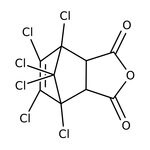
Chlorendic anhydride, 95%, may cont. up to 3% chlorendic acid
CAS: 115-27-5 | C9H2Cl6O3 | 370.812 g/mol



化学物質識別子
CAS115-27-5
IUPAC Name1,7,8,9,10,10-hexachloro-4-oxatricyclo[5.2.1.0²,⁶]dec-8-ene-3,5-dione
Molecular FormulaC9H2Cl6O3
InChI KeyFLBJFXNAEMSXGL-UHFFFAOYNA-N
SMILESClC1=C(Cl)C2(Cl)C3C(C(=O)OC3=O)C1(Cl)C2(Cl)Cl
さらに表示
仕様 スペックシート
スペックシートAppearance (Color)White
FormPowder and/or Lumps
Assay (Titration ex Anhydride)>94.0 to <106.0%
Chlorendic anhydride is used in the synthesis of polymers, used in production of fiberglass-reinforced resins for chemical industry equipment. It can be used to make alkyd resins for use in special inks and paints. It is used as a hardening agent in epoxy resins used in manufacture of printed circuit boards
This Thermo Scientific Chemicals brand product was originally part of the Alfa Aesar product portfolio. Some documentation and label information may refer to the legacy brand. The original Alfa Aesar product / item code or SKU reference has not changed as a part of the brand transition to Thermo Scientific Chemicals.
Applications
Chlorendic anhydride is used in the synthesis of polymers, used in production of fiberglass-reinforced resins for chemical industry equipment. It can be used to make alkyd resins for use in special inks and paints. It is used as a hardening agent in epoxy resins used in manufacture of printed circuit boards
Solubility
Insoluble in water.
Notes
Moisture Sensitive. Keep container tightly closed. Store in cool, dry conditions in well sealed containers.
Chlorendic anhydride is used in the synthesis of polymers, used in production of fiberglass-reinforced resins for chemical industry equipment. It can be used to make alkyd resins for use in special inks and paints. It is used as a hardening agent in epoxy resins used in manufacture of printed circuit boards
Solubility
Insoluble in water.
Notes
Moisture Sensitive. Keep container tightly closed. Store in cool, dry conditions in well sealed containers.
RUO – Research Use Only
General References:
- Hans Weiss. Anhydride Curing Agents for Epoxy Resins. Ind. Eng. Chem. 1957, 49, (7), 1089-1090.
- P.A. Cusack.; M.S. Heer.; A.W. Monk. Zinc hydroxystannate as an alternative synergist to antimony trioxide in polyester resins containing halogenated flame retardants. Polymer Degradation and Stability. 1997, 58, (1-2), 229-237.