Search
 元素の検索
元素の検索 構造の検索
構造の検索


Thermo Scientific Chemicals
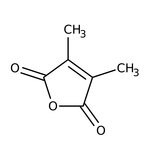
2,3-Dimethylmaleic anhydride, 97%
CAS: 766-39-2 | C6H6O3 | 126.111 g/mol



化学物質識別子
CAS766-39-2
IUPAC Namedimethyl-2,5-dihydrofuran-2,5-dione
Molecular FormulaC6H6O3
InChI KeyMFGALGYVFGDXIX-UHFFFAOYSA-N
SMILESCC1=C(C)C(=O)OC1=O
さらに表示
仕様 スペックシート
スペックシートFormCrystals or powder or crystalline powder or flakes
Melting Point (clear melt)89.0-99.0?C
Assay (GC)≥96.0%
Appearance (Color)White to cream to brown to gray
2,3-Dimethylmaleic anhydride acts as a reagent in the preparation of maleimides. It is also employed as an amino group protecting agent for superoxide dismutase. Further, it serves as a reactant in the dissociation of ribosomal proteins. In addition to this, it is used in the preparation of dimethylmaleic acid dimethyl ester.
This Thermo Scientific Chemicals brand product was originally part of the Alfa Aesar product portfolio. Some documentation and label information may refer to the legacy brand. The original Alfa Aesar product / item code or SKU reference has not changed as a part of the brand transition to Thermo Scientific Chemicals.
Applications
2,3-Dimethylmaleic anhydride acts as a reagent in the preparation of maleimides. It is also employed as an amino group protecting agent for superoxide dismutase. Further, it serves as a reactant in the dissociation of ribosomal proteins. In addition to this, it is used in the preparation of dimethylmaleic acid dimethyl ester.
Solubility
Soluble in ethanol, ether and chloroform. Slightly soluble in water.
Notes
Moisture sensitive. Incompatible with strong oxidizing agents, strong acids and strong bases.
2,3-Dimethylmaleic anhydride acts as a reagent in the preparation of maleimides. It is also employed as an amino group protecting agent for superoxide dismutase. Further, it serves as a reactant in the dissociation of ribosomal proteins. In addition to this, it is used in the preparation of dimethylmaleic acid dimethyl ester.
Solubility
Soluble in ethanol, ether and chloroform. Slightly soluble in water.
Notes
Moisture sensitive. Incompatible with strong oxidizing agents, strong acids and strong bases.
RUO – Research Use Only
General References:
- Does not undergo Diels-Alder reactions with furan, but does react with 1,3-Diphenyl isobenzofuran, L00101, to give benzocantharadin: J. Org. Chem., 47, 4011 (1982).
- The use of the dimethylmaleoyl (DMM) group has been investigated for amino group protection in oligosaccharide synthesis. The DMM group is introduced using triethylamine as base. It promotes ß -linkage by neighboring group participation and is stable to acids and non-nucleophilic bases. Cleavage can be brought about by treatment with dilute aqueous NaOH: Eur. J. Org. Chem., 2305 (1998).
- Zhang, M. H.; Gu, Z. P.; Zhang, X.; Fan, M. M. pH-sensitive ternary nanoparticles for nonviral gene delivery. RSC Adv. 2015, 5 (55), 44291-44298.
- Yang, K.; Feng, L.; Liu, Z. The advancing uses of nano-graphene in drug delivery. Expert Opin. Drug Deliv. 2015, 12 (4), 601-612.