Search
 元素の検索
元素の検索 構造の検索
構造の検索


Thermo Scientific Chemicals
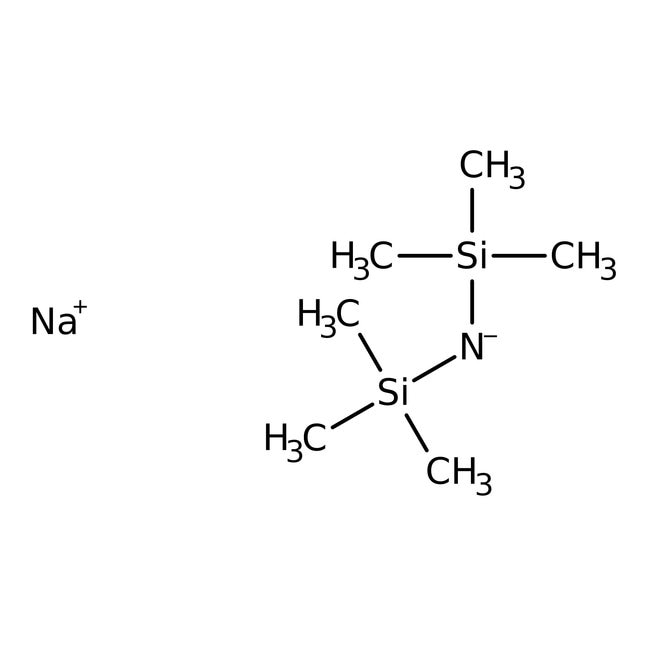
Sodium bis(trimethylsilyl)amide, 2M soln. in THF
CAS: 1070-89-9 | C6H18NNaSi2 | 183.377 g/mol



化学物質識別子
CAS1070-89-9
IUPAC Namesodium bis(trimethylsilyl)azanide
Molecular FormulaC6H18NNaSi2
InChI KeyWRIKHQLVHPKCJU-UHFFFAOYSA-N
SMILES[Na+].C[Si](C)(C)[N-][Si](C)(C)C
さらに表示
仕様 スペックシート
スペックシートFormLiquid
Appearance (Color)Clear or slightly hazy yellow to orange or yellow-brown
Assay from Supplier's CofA1.95-2.05M
This Thermo Scientific Chemicals brand product was originally part of the Alfa Aesar product portfolio. Some documentation and label information may refer to the legacy brand. The original Alfa Aesar product / item code or SKU reference has not changed as a part of the brand transition to Thermo Scientific Chemicals.
Applications
Sodium bis(trimethylsilyl)amide is a strong base used in organic synthesis for deprotonation reactions and base catalyzed reaction. It is also used to enhance the polymerization of pheneylacetylene in conjunction with rhodium(I) catalysis. It is involved in the generation of enolates, Wittig reagents and carbenes.
Solubility
Miscible with benzene and toluene.
Notes
Moisture sensitive. Keep the container tightly closed in a dry and well-ventilated place. Incompatible with oxidizing agents, strong oxidizing agents and oxygen. Dry residue is explosive.
Sodium bis(trimethylsilyl)amide is a strong base used in organic synthesis for deprotonation reactions and base catalyzed reaction. It is also used to enhance the polymerization of pheneylacetylene in conjunction with rhodium(I) catalysis. It is involved in the generation of enolates, Wittig reagents and carbenes.
Solubility
Miscible with benzene and toluene.
Notes
Moisture sensitive. Keep the container tightly closed in a dry and well-ventilated place. Incompatible with oxidizing agents, strong oxidizing agents and oxygen. Dry residue is explosive.
RUO – Research Use Only
General References:
- Useful sterically hindered base (NaHMDS) for, e.g. generation of enolates, Wittig reagents or carbenes.
- Used as a base for the preparation of ester enolates: J. Am. Chem. Soc., 93, 4945 (1971). Has been found to be superior to LDA for preparation of (Z)-enolates of ketones under thermodynamic control: Tetrahedron Lett., 30, 2779 (1989).
- In the Wittig reaction, gives Li salt-free product distribution patterns, with selective (Z)-alkene formation: Chem. Ber., 109, 1694 (1976); Tetrahedron Lett., 30, 2173 (1989). For formation of anions of benzylic phosphonates and subsequent ɑɑ-difluorination, see N-Fluorobenzenesulfonimide, L13955.
- Found to give better yields than LiHMDS or KHMDS for the carbenoid reactions with Dibromomethane, A10456: Synthesis, 201 (1972); Angew. Chem. Int. Ed., 11, 326 (1972).
- Sufficiently nucleophilic to act as a protected form of ammonia in the synthesis of primary amines from halides and tosylates: Chem. Ber., 117, 1250 (1984).
- Lis, A. V.; Tsyrendorzhieva, I. P.; Albanov, A. I.; Shainyan, B. A.; Rakhlin, V. I. Reaction of sodium bis(trimethylsilyl) amide with bromotoluenes. Russ. J. Org. Chem. 2015, 51 (3), 335-340.
- Block, M.; Bette, M.; Wagner, C.; Schmidt, J.; Steinborn, D. Rhodium(I) complexes with κP coordinated ω-phosphinofunctionalized alkyl phenyl sulfide, sulfoxide and sulfone ligands and their reactions with sodium bis (trimethylsilyl) amide and Ag [BF4]. J. Org. Chem. 2011, 696 (9), 1768-1781.