Search


Citations & References (12)
Invitrogen™
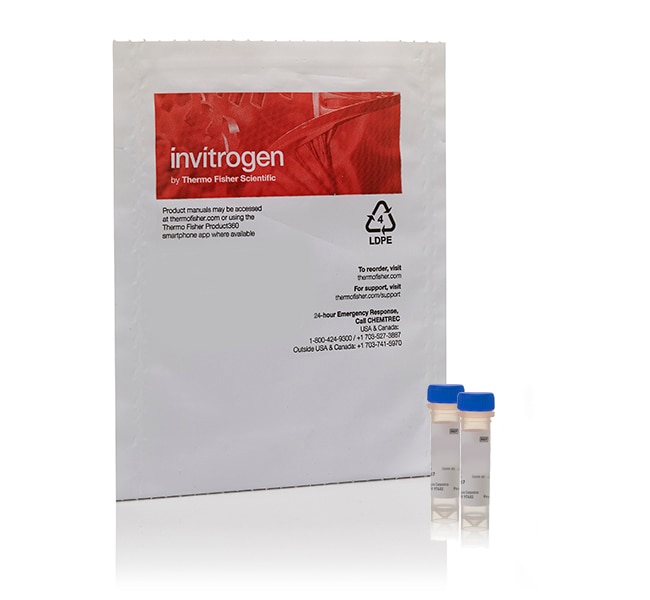
LIVE/DEAD™ Yeast Viability Kit
LIVE/DEAD酵母生存率キットは、酵母の生存率を調べるための新しい2色蛍光プローブであるFUN™ 1、真菌表面を標識する蛍光試薬であるCalcofluor™ White M2Rの組み合わせです。細胞内で黄色~緑色蛍光を示すFUN™ 1の染色は、原形質膜の完全性および真菌の代謝機能が存在する場合にのみ、赤色~橙色蛍光の液胞内構造に変換されます詳細を見る
| 製品番号(カタログ番号) | 数量 |
|---|---|
| L7009 | 1 kit |
製品番号(カタログ番号) L7009
価格(JPY)
135,100
Each
数量:
1 kit
LIVE/DEAD酵母生存率キットは、酵母の生存率を調べるための新しい2色蛍光プローブであるFUN™ 1、真菌表面を標識する蛍光試薬であるCalcofluor™ White M2Rの組み合わせです。細胞内で黄色~緑色蛍光を示すFUN™ 1の染色は、原形質膜の完全性および真菌の代謝機能が存在する場合にのみ、赤色~橙色蛍光の液胞内構造に変換されます。Calcofluor White M2Rは代謝の状態に関係なく、細胞壁キチンを青色蛍光で標識します。
研究用にのみ使用できます。診断用には使用いただけません。
仕様
細胞タイプ酵母細胞
概要LIVE/DEAD™ Yeast Viability Kit
検出法蛍光
染色剤タイプその他の標識または色素
放射波長530/620, 500/550
励起波長485, 450 nm
フォーマットチューブ、96ウェルプレート、スライド
数量1 kit
出荷条件室温
色Yellow-Green, Red-Orange, Blue
使用対象(アプリケーション)生存率アッセイ
使用対象 (装置)蛍光顕微鏡, フルオロメータ, フローサイトメーター, マイクロプレートリーダー
製品ラインLIVE/DEAD
製品タイプYeast Viability Kit
Unit SizeEach
組成および保存条件
フリーザー(-5℃~-30℃)に保存し、遮光してください。
よくあるご質問(FAQ)
Which species of yeast/fungi can I use with the LIVE/DEAD Yeast Viability Kit?
How do I prepare dead cell controls for LIVE/DEAD cell viability assays?
Can FUN 1 stained cells be examined by flow cytometry?
Live, metabolically active fungi transport FUN 1 into vacuoles to give a red-shifted fluorescence versus green/yellow fluorescence in the nucleus and cytoplasm of dead or metabolically-inactive cells. Is this a reliable indicator of fungal viability?
引用および参考文献 (12)
引用および参考文献
Abstract
In vitro growth and analysis of Candida biofilms.
Journal:Nat Protoc
PubMed ID:19180075
'Evaluation of fungal biofilm formation can be performed using several techniques. In this protocol, we describe methods used to form Candida biofilms on three different medical device substrates (denture strips, catheter disks and contact lenses) to quantify them and to evaluate their architecture and drug susceptibility. Biofilm formation involves adhesion
Mechanistic aspects in the generation of apparent ultrahigh efficiencies for colloidal (microbial) electrokinetic separations.
Journal:Anal Chem
PubMed ID:12433083
'Under specific experimental conditions, the electrokinetic separation of certain microorganisms can produce peaks of very high apparent efficiencies (approximately 10(6)-10(10) theoretical plates/m). This is unusual in that no deliberate focusing mechanism was employed. To investigate this process further, the separation was monitored in real time using a charge-coupled device (CCD)
Pleiotropic effects of HIV-1 protein R (Vpr) on morphogenesis and cell survival in fission yeast and antagonism by pentoxifylline.
Journal:Virology
PubMed ID:9657945
'Expression of HIV-1 Vpr causes cell cycle G2 arrest, change in cell shape, and cell death over a large evolutionary distance ranging from human to yeast cells. As a step toward understanding these highly conserved Vpr functions, we have examined the effect of Vpr on cytoskeletal elements and the viability
Mechanism of fluconazole resistance in Candida albicans biofilms: phase-specific role of efflux pumps and membrane sterols.
Journal:Infect Immun
PubMed ID:12874310
'Candida albicans biofilms are formed through three distinct developmental phases and are associated with high fluconazole (FLU) resistance. In the present study, we used a set of isogenic Candida strains lacking one or more of the drug efflux pumps Cdr1p, Cdr2p, and Mdr1p to determine their role in FLU resistance
Adaptation of FUN-1 and Calcofluor white stains to assess the ability of viable and nonviable yeast to adhere to and be internalized by cultured mammalian cells.
Journal:J Microbiol Methods
PubMed ID:15369865
'The FUN-1 and Calcofluor white stains can be used in concert to assess the ability of viable and nonviable yeast to adhere to, and be internalized by, host mammalian cells in vitro. With this method, only extracellular yeast stain with Calcofluor, dead yeast cells have diffuse cytoplasmic yellow-green fluorescence, and