Search


Citations & References (4)
Invitrogen™
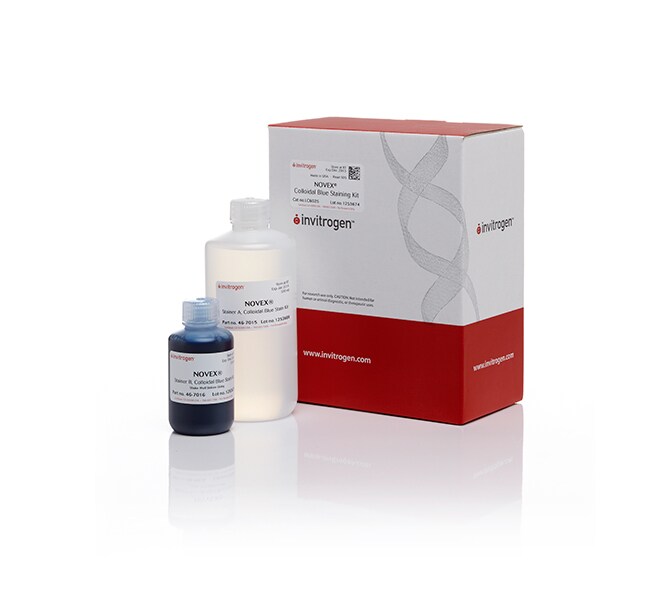
Colloidal Blue Staining Kit
コロイドブルー染色キットを使用することで、最小限の労力で1Dまたは2D PAGEゲル内のタンパク質をナノグラムレベルで検出できます。脱染に必要なのは水のみです。コロイドブルー染色はコロイド化学を使用しており、溶液中の遊離色素を減らし、タンパク質と色素の結合比を改善します。サンプルは3時間以内に強く染色され、可視化されます。バックグラウンド染色は詳細を見る
| 製品番号(カタログ番号) | 数量 |
|---|---|
| LC6025 | 1 kit |
製品番号(カタログ番号) LC6025
価格(JPY)
54,200
Each
数量:
1 kit
コロイドブルー染色キットを使用することで、最小限の労力で1Dまたは2D PAGEゲル内のタンパク質をナノグラムレベルで検出できます。脱染に必要なのは水のみです。コロイドブルー染色はコロイド化学を使用しており、溶液中の遊離色素を減らし、タンパク質と色素の結合比を改善します。サンプルは3時間以内に強く染色され、可視化されます。バックグラウンド染色は、水で一晩脱色することでほぼ除去されます。このキットは、簡単な溶液調製が1つ必要です。染色手順にはメタノールが必要ですが、キットには含まれていません。
すべてのCoomassie染色を比較›
すべてのCoomassie染色を比較›
研究用にのみ使用できます。診断用には使用いただけません。
仕様
検出位置ゲル内検出
検出法比色法
数量1 kit
品質保持期間6カ月
出荷条件室温
標的分子タンパク質
標識または色素Coomassie
製品タイプタンパク質ゲル染色キット
Unit SizeEach
組成および保存条件
コロイドブルー染色キットには、25のミニゲルを染色するのに十分な染色液Aおよび染色液Bが付属しています。キットは室温で保管してください。本キットは、製品ドキュメントに特に記載されていない限り、適切に保管されている場合は6カ月間保証されます。
よくあるご質問(FAQ)
カスタムオリゴ(TaqMan®プローブ・プライマー)を購入しました。TaqMan® Gene Expression Assayのように20xのワーキングストックを作成したいのですが、どのように調整したらよいでしょうか。
Can I use the Colloidal Blue Staining Kit (Cat. No. LC6025) for membrane staining to detect proteins that are transferred to a membrane?
Why is Coomassie G-250 used as the tracking dye in NuPAGE LDS Sample Buffer instead of bromophenol blue?
Is the SimplyBlue SafeStain the appropriate stain for quantitation by densitometry?
The sensitivity of my SimplyBlue SafeStain seems to be decreasing over time. Why is this?
引用および参考文献 (4)
引用および参考文献
Abstract
SALSA, a variant of yeast SAGA, contains truncated Spt7, which correlates with activated transcription.
Journal:Proc Natl Acad Sci U S A
PubMed ID:12186975
'Spt-Ada-Gcn5 acetyltransferase (SAGA) is a previously described histone acetyltransferase/transcriptional coactivator complex in yeast. At promoters of certain genes (HIS3 and TRP3), SAGA has an inhibitory function involving a nonproductive TATA-binding protein interaction mediated by the Spt3 and Spt8 subunits. Related to this, Spt8-less SAGA is a major form of the
Chromatin deacetylation by an ATP-dependent nucleosome remodelling complex.
Journal:Nature
PubMed ID:9804427
'The dynamic assembly and remodelling of eukaryotic chromosomes facilitate fundamental cellular processes such as DNA replication and gene transcription. The repeating unit of eukaryotic chromosomes is the nucleosome core, consisting of DNA wound about a defined octamer of histone proteins. Two enzymatic processes that regulate transcription by targeting elements of
A family of chromatin remodeling factors related to Williams syndrome transcription factor
Journal:Proc Natl Acad Sci U S A
PubMed ID:10655480
Chromatin remodeling complexes have been implicated in the disruption or reformation of nucleosomal arrays resulting in modulation of transcription, DNA replication, and DNA repair. Here we report the isolation of WCRF, a new chromatin-remodeling complex from HeLa cells. WCRF is composed of two subunits, WCRF135, the human homolog of Drosophila
A method to identify serine kinase substrates. Akt phosphorylates a novel adipocyte protein with a Rab GTPase-activating protein (GAP) domain.
Journal:J Biol Chem
PubMed ID:11994271
This study describes a method for the identification of the substrates of specific serine kinases. An antibody specific for the phosphomotif generated by the kinase is used to isolate phosphorylated substrates by immunoprecipitation, and the isolated proteins are identified by tandem mass spectrometry of peptides. This method was applied to