Search

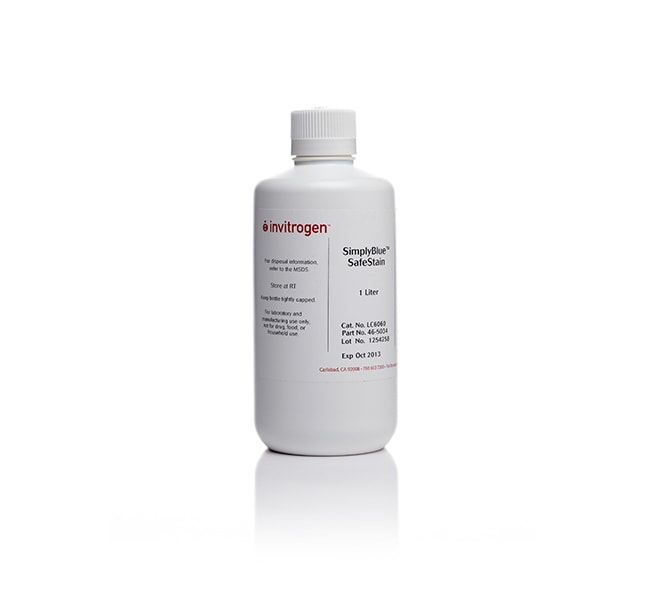

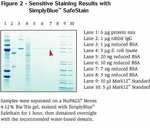


SimplyBlue SafeStainは、すぐに使用可能で、迅速、高感度、および安全なCoomassie G-250染色剤です。これにより、ポリアクリルアミドゲル、および乾燥したPVDF膜上のタンパク質バンドを可視化できます。この染色剤にはまったく有害性がなく、メタノールや酢酸の固定剤や脱染色剤は不要です。有害物質が曝露するリスクや不快な臭いが取り除かれるため、より健全なラボ環境を構築できます。
すべてのCoomassie染色剤を比較 ›
使いやすいプロトコル
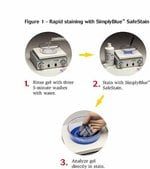
SimplyBlue SafeStainのプロトコルは簡単に実施でき、3時間以内に完了できます。速度を上げるために、簡単なマイクロ波の手順を12分で完了できます。脱色は不要ですが、質量分析などのダウンストリーム解析を行う場合や、非常に透明なバックグラウンドが必要な場合は特に、最大感度を得るために脱イオン水で脱色する場合があります。
すべてのCoomassie染色剤を比較 ›
使いやすいプロトコル
SimplyBlue SafeStainのプロトコルは簡単に実施でき、3時間以内に完了できます。速度を上げるために、簡単なマイクロ波の手順を12分で完了できます。脱色は不要ですが、質量分析などのダウンストリーム解析を行う場合や、非常に透明なバックグラウンドが必要な場合は特に、最大感度を得るために脱イオン水で脱色する場合があります。
研究用途にのみご使用ください。診断目的には使用できません。
仕様
検出位置ゲル内検出
検出法比色法
数量1 L
品質保持期間6カ月
標的分子タンパク質
色Blue
標識または色素Coomassie
製品ラインSimplyBlue
製品タイプ安全なタンパク質染色
Unit SizeEach
組成および保存条件
SimplyBlue™ セーフ染色剤は、すぐに使用できる1X染色試薬として提供いたします。室温保存。適切に保存した場合、6カ月間安定しています。この製品に関連する危険物料金はありません。
よくあるご質問(FAQ)
カスタムオリゴ(TaqMan®プローブ・プライマー)を購入しました。TaqMan® Gene Expression Assayのように20xのワーキングストックを作成したいのですが、どのように調整したらよいでしょうか。
Can I use the Colloidal Blue Staining Kit (Cat. No. LC6025) for membrane staining to detect proteins that are transferred to a membrane?
Why is Coomassie G-250 used as the tracking dye in NuPAGE LDS Sample Buffer instead of bromophenol blue?
Is the SimplyBlue SafeStain the appropriate stain for quantitation by densitometry?
The sensitivity of my SimplyBlue SafeStain seems to be decreasing over time. Why is this?
引用および参考文献 (5)
引用および参考文献
Abstract
Enzymatic hydrolysis of pyridoxine-5'-beta-D-glucoside is catalyzed by intestinal lactase-phlorizin hydrolase.
Journal:J Biol Chem
PubMed ID:12023280
'An obligatory step in the mammalian nutritional utilization of pyridoxine-5''-beta-D-glucoside (PNG) is the intestinal hydrolysis of its beta-glucosidic bond that releases pyridoxine (PN). This laboratory previously reported the purification and partial characterization of a novel cytosolic enzyme, designated PNG hydrolase, which hydrolyzed PNG. An investigation of the subcellular distribution of
2F3 monoclonal antibody recognizes the O26 O-antigen moiety of the lipopolysaccharide of enterohemorrhagic Escherichia coli strain 4276.
Journal:Clin Diagn Lab Immunol
PubMed ID:15138178
'Enterohemorrhagic Escherichia coli (EHEC) and enteropathogenic E. coli (EPEC) organisms are groups of pathogenic strains whose infections are characterized by a typical lesion of enterocyte attachment and effacement. They are involved in enteric diseases both in humans and in animals, and EHEC strains can be responsible for hemolytic uremic syndrome
Selective fluorescent labeling of S-nitrosothiols (S-FLOS): a novel method for studying S-nitrosation.
Journal:Nitric Oxide
PubMed ID:18706513
'Protein S-nitrosation is a reversible post-translation modification critical for redox-sensitive cell signaling that is typically studied using the Biotin Switch method. This method and subsequent modifications usually require avidin binding or Western blot analysis to detect biotin labeled proteins. We describe here a modification of the Biotin Switch assay that
Vascular endothelial growth factor-C and C-C chemokine receptor 7 in tumor cell-lymphatic cross-talk promote invasive phenotype.
Journal:Cancer Res
PubMed ID:19118020
'Most carcinomas spread to distant sites through lymphatic vessels. Several preclinical and clinical studies have shown a positive correlation between the incidence of lymph node metastasis and secretion of the lymphatic growth factor vascular endothelial growth factor-C (VEGF-C) by tumor cells, suggesting tumor lymphangiogenesis as an escape mechanism. However, recent
Yeast Expression and NMR Analysis of the Extracellular Domain of Muscle Nicotinic Acetylcholine Receptor alpha Subunit.
Journal:J Biol Chem
PubMed ID:11812776
The alpha subunit of the nicotinic acetylcholine receptor (AChR) from Torpedo electric organ and mammalian muscle contains high affinity binding sites for alpha-bungarotoxin and for autoimmune antibodies in sera of patients with myasthenia gravis. To obtain sufficient materials for structural studies of the receptor-ligand complexes, we have expressed part of