Search


Citations & References (5)
Invitrogen™
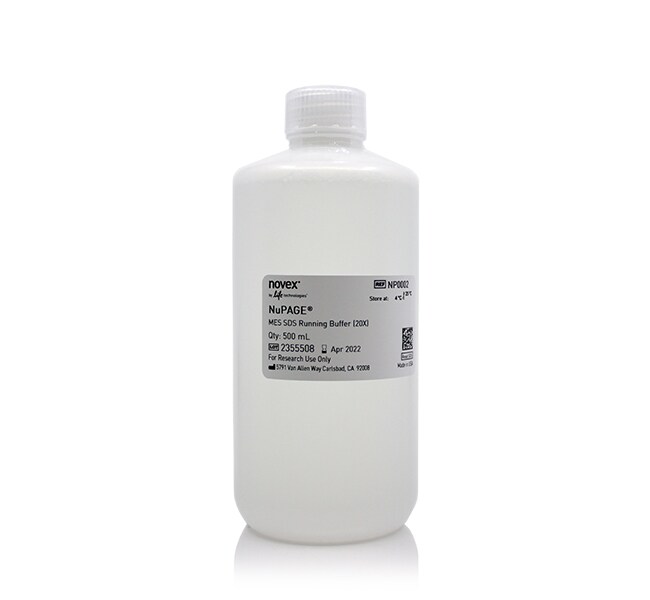
NuPAGE™ MES SDS Running Buffer (20X)
NuPAGE MES SDS泳動バッファー(20X)は、NuPAGE Novex Bis-Trisゲルでのタンパク質泳動用に調製されています。小~中サイズのタンパク質の分離に推奨されます。タンパク質の分離を最適化する適切なバッファーをご使用ください詳細を見る


製品番号(カタログ番号) NP0002
価格(JPY)
18,200
Each
数量:
500 mL
価格(JPY)
18,200
Each
NuPAGE MES SDS泳動バッファー(20X)は、NuPAGE Novex Bis-Trisゲルでのタンパク質泳動用に調製されています。小~中サイズのタンパク質の分離に推奨されます。
タンパク質の分離を最適化する適切なバッファーをご使用ください
NuPAGE MES SDS泳動バッファーおよびNuPAGE MOPS SDS泳動バッファーはどちらもNuPAGE Bis-Trisゲルで使用できます。MESのpKaはMOPSよりも低いため、MES SDS泳動バッファーはMOPS SDS泳動バッファーよりも高速です。イオン移動の差異はスタッキングに影響することから、これらのバッファーでのタンパク質の分離範囲に差が生じます。MOPSバッファーを使用すると、MESバッファーを使用する場合よりもタンパク質の泳動速度を遅くすることができます。
MESを使用した場合とMOPSを使用した場合のNuPAGE Bis-Trisゲルでのタンパク質移動の比較
SDS-PAGEに使用可能なすべてのバッファーと試薬の一覧
タンパク質の分離を最適化する適切なバッファーをご使用ください
NuPAGE MES SDS泳動バッファーおよびNuPAGE MOPS SDS泳動バッファーはどちらもNuPAGE Bis-Trisゲルで使用できます。MESのpKaはMOPSよりも低いため、MES SDS泳動バッファーはMOPS SDS泳動バッファーよりも高速です。イオン移動の差異はスタッキングに影響することから、これらのバッファーでのタンパク質の分離範囲に差が生じます。MOPSバッファーを使用すると、MESバッファーを使用する場合よりもタンパク質の泳動速度を遅くすることができます。
MESを使用した場合とMOPSを使用した場合のNuPAGE Bis-Trisゲルでのタンパク質移動の比較
SDS-PAGEに使用可能なすべてのバッファーと試薬の一覧
研究用にのみ使用できます。診断用には使用いただけません。
仕様
化学物質名または材質Running Buffer
組成1X: 50 mM MES, 50 mM Tris Base, 0.1% SDS, 1 mM EDTA, pH 7.3
推奨保存方法Contents: NuPAGE™ MES SDS Running Buffer (20X)
Storage: +4°C to 25°C
Storage: +4°C to 25°C
溶解度情報Water
濃度20X
物理的フォームLiquid
製品ラインNuPAGE
数量500 mL
pH7.3
Unit SizeEach
よくあるご質問(FAQ)
Can I prepare my protein sample with the reducing agent and store it for future use?
My LDS or SDS sample buffer precipitates when stored at 4 degrees C. Can I warm it up? Can I store it at room temperature?
How are Bolt gels different than NuPAGE gels?
What is the advantage of NuPAGE Gels over regular Tris-Glycine gels?
Are the NuPAGE buffers/components (i.e., sample buffer, running buffer, and antioxidant) compatible with Bolt gels?
引用および参考文献 (5)
引用および参考文献
Abstract
Matrix GLA protein, a regulatory protein for bone morphogenetic protein-2.
Journal:J Biol Chem
PubMed ID:11741887
'Matrix GLA protein (MGP) has been identified as a calcification inhibitor in cartilage and vasculature. Part of this effect may be attributed to its influence on osteoinductive activity of bone morphogenetic protein-2 (BMP-2). To detect binding between MGP and BMP-2, we performed immunoprecipitation using MGP and BMP-2 tagged with FLAG
Oligomerization of the integrin alphaIIbbeta3: roles of the transmembrane and cytoplasmic domains.
Journal:Proc Natl Acad Sci U S A
PubMed ID:11606749
'Integrins are a family of alpha/beta heterodimeric membrane proteins, which mediate cell-cell and cell-matrix interactions. The molecular mechanisms by which integrins are activated and cluster are currently poorly understood. One hypothesis posits that the cytoplasmic tails of the alpha and beta subunits interact strongly with one another in a 1:1
beta -Glucoside Kinase (BglK) from Klebsiella pneumoniae. PURIFICATION, PROPERTIES, AND PREPARATIVE SYNTHESIS OF 6-PHOSPHO-beta -D-GLUCOSIDES.
Journal:J Biol Chem
PubMed ID:12110692
ATP-dependent beta-glucoside kinase (BglK) has been purified from cellobiose-grown cells of Klebsiella pneumoniae. In solution, the enzyme (EC ) exists as a homotetramer composed of non-covalently linked subunits of M(r) approximately 33,000. Determination of the first 28 residues from the N terminus of the protein allowed the identification and cloning
An engineered Escherichia coli tyrosyl-tRNA synthetase for site-specific incorporation of an unnatural amino acid into proteins in eukaryotic translation and its application in a wheat germ cell-free system.
Journal:Proc Natl Acad Sci U S A
PubMed ID:12097643
Tyrosyl-tRNA synthetase (TyrRS) from Escherichia coli was engineered to preferentially recognize 3-iodo-L-tyrosine rather than L-tyrosine for the site-specific incorporation of 3-iodo-L-tyrosine into proteins in eukaryotic translation systems. The wild-type TyrRS does not recognize 3-iodo-L-tyrosine, because of the bulky iodine substitution. On the basis of the reported crystal structure of Bacillus
Adverse drug reactions.
Journal:Anaesthesia
PubMed ID:29313907