Search


Citations & References (1)
Invitrogen™
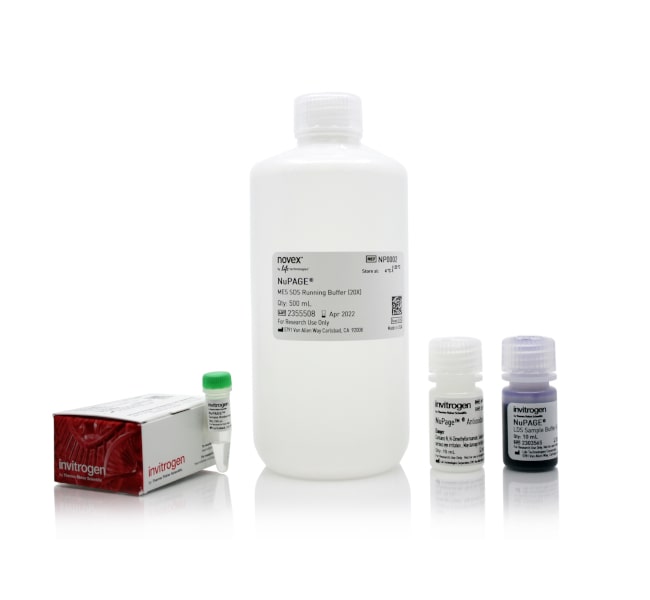
NuPAGE™ MES SDS Buffer Kit (for Bis-Tris Gels)
NuPAGE MES SDSバッファーキットは、NuPAGE Bis-Trisゲルでの小∼中サイズのタンパク質の分離用に設計されており、以下のバッファーを含んでいます。• NuPAGE MES SDSランニングバッファー詳細を見る
| 製品番号(カタログ番号) | 数量 |
|---|---|
| NP0060 | 1キット |
製品番号(カタログ番号) NP0060
価格(JPY)
23,500
Each
数量:
1キット
NuPAGE MES SDSバッファーキットは、NuPAGE Bis-Trisゲルでの小∼中サイズのタンパク質の分離用に設計されており、以下のバッファーを含んでいます。
• NuPAGE MES SDSランニングバッファー(20X、500 mL、カタログ番号NP0002)
• NuPAGEサンプル還元剤(10X、250 µL、カタログ番号NP0004)
• NuPAGE抗酸化剤(カタログ番号NP0005)
• NuPAGE LDSサンプルバッファー(4X、10 mL、カタログ番号NP0007)
NuPAGE Bis-TrisゲルでMESおよびMOPを使用してタンパク質の移動パターンを比較
SDS-PAGEに利用可能なすべてのバッファーと試薬を確認
• NuPAGE MES SDSランニングバッファー(20X、500 mL、カタログ番号NP0002)
• NuPAGEサンプル還元剤(10X、250 µL、カタログ番号NP0004)
• NuPAGE抗酸化剤(カタログ番号NP0005)
• NuPAGE LDSサンプルバッファー(4X、10 mL、カタログ番号NP0007)
NuPAGE Bis-TrisゲルでMESおよびMOPを使用してタンパク質の移動パターンを比較
SDS-PAGEに利用可能なすべてのバッファーと試薬を確認
研究用途にのみご使用ください。診断目的には使用できません。
仕様
ゲルタイプSDS PAGEゲル
数量1キット
Gel CompatibilityNovex™ Tricine Gel
製品ラインNuPAGE
製品タイプBuffer Kit
Unit SizeEach
組成および保存条件
付属品
• NuPAGE™ MES SDSランニングバッファー(20X、500 ml)
• NuPAGE™サンプル還元剤(10X、250 µl、500mMジチオトリトールを含む)
• NuPAGE™抗酸化剤(15mL)
• NuPAGE™ LDSサンプルバッファー(10 ml)
それぞれの保管温度は4℃です。NuPAGE™ LDSサンプルバッファーを使用する前に25℃に温めてください。
• NuPAGE™ MES SDSランニングバッファー(20X、500 ml)
• NuPAGE™サンプル還元剤(10X、250 µl、500mMジチオトリトールを含む)
• NuPAGE™抗酸化剤(15mL)
• NuPAGE™ LDSサンプルバッファー(10 ml)
それぞれの保管温度は4℃です。NuPAGE™ LDSサンプルバッファーを使用する前に25℃に温めてください。
よくあるご質問(FAQ)
Can I prepare my protein sample with the reducing agent and store it for future use?
My LDS or SDS sample buffer precipitates when stored at 4 degrees C. Can I warm it up? Can I store it at room temperature?
How are Bolt gels different than NuPAGE gels?
What is the advantage of NuPAGE Gels over regular Tris-Glycine gels?
Can beta-mercaptoethanol (BME) be used rather than DTT as the reducing agent in the NuPAGE LDS Sample Buffer?
引用および参考文献 (1)
引用および参考文献
Abstract
Spermidine but not spermine is essential for hypusine biosynthesis and growth in Saccharomyces cerevisiae: Spermine is converted to spermidine in vivo by the FMS1-amine oxidase.
Journal:Proc Natl Acad Sci U S A
PubMed ID:14617780
In our earlier work we showed that either spermidine or spermine could support the growth of spe2Delta or spe3Delta polyamine-requiring mutants, but it was unclear whether the cells had a specific requirement for either of these amines. In the current work, we demonstrate that spermidine is specifically required for the